

Lyme Adapts Zoning Regulations to State Housing Law, Grapples With Affordability
With high land and construction costs challenging affordability, Lyme officials are working to expand housing options while preserving the town’s rural identity.
LYME, CT – Growing recognition that the town is unaffordable to young families and older adults, combined with outside pressure to do something about it, has prompted local officials to think creatively about how the provisions of a new state housing law can be implemented in town.
The Planning and Zoning Commission (PZC) this month amended its regulations in accordance with Public Act 25-1, which was signed into law a year ago by Gov. Ned Lamont. The new provisions allow certain mixed-use housing developments in commercial districts through a streamlined approval process and prohibit off-street parking requirements for smaller residential developments, with certain exceptions.
Local officials have argued the state didn’t take rural towns like Lyme – with limited infrastructure, challenging terrain and a longstanding commitment to preserving open space – into account in its sweeping effort to address a statewide housing shortage.
At Monday’s Affordable Housing Commission meeting, Chairman Jim Miller put it this way: “Nothing in the statute contemplated rural towns.”
Member Carol House, who also sits on the PZC, said there are provisions in the law that don’t make sense locally. That’s why the town needs to interpret the requirements in a way that works for Lyme residents, according to House.
“I think that’s also a really good thing for us to do: to look at all the things that sound really stupid and then see if we can – with the writing that’s there in the law – do something that means something more for Lyme,” she said.
A subcommittee of PZC members Anne Littlefield and Jennifer Tiffany, with PZC Chair Mary Stone as an ex officio member, has worked since the beginning of the year to craft the regulations.
Littlefield, the subcommittee chair, told commission members on Nov. 9 that the goal was to make recommendations for bringing the town into compliance with the new law while remaining consistent with Lyme’s foundational planning philosophy. The local approach to development is laid out in the Plan of Conservation and Development, which is updated every 10 years and has consistently emphasized preserving the town’s quality of life and natural resources.
Rural Workaround
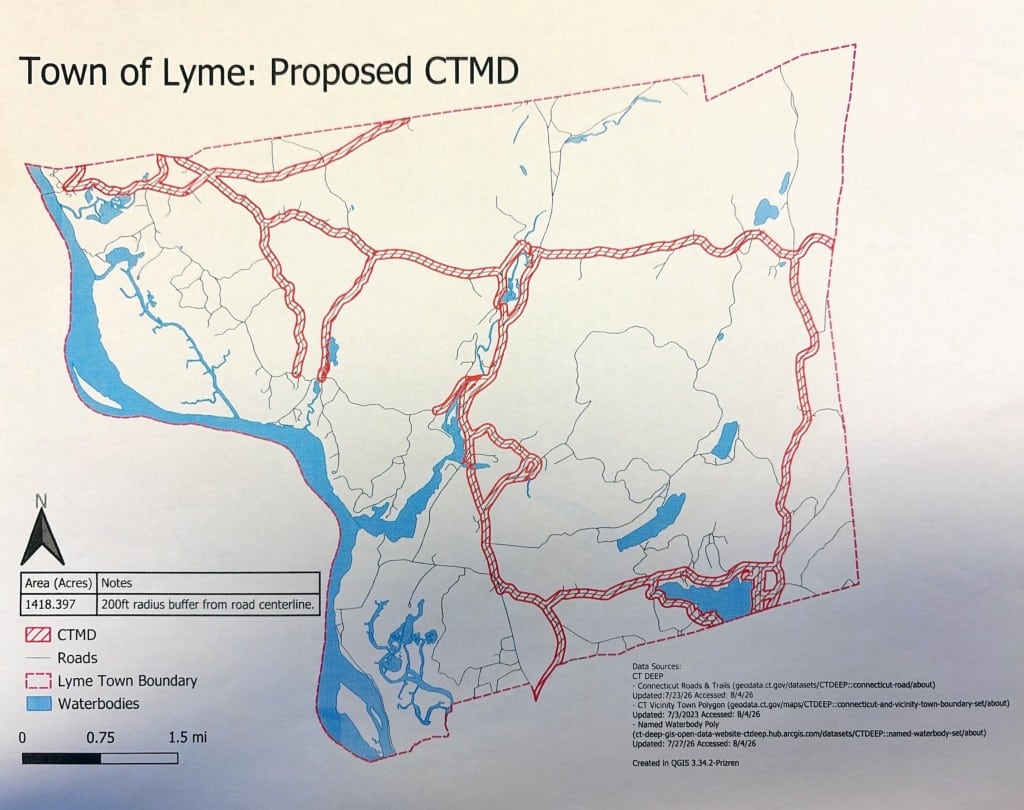
House cited the town’s new Conservation and Traffic Mitigation District as an example of the creative approach the town will need to take if it wants to satisfy residents and the state. The regulation was adopted in response to a provision in the state law generally prohibiting towns from requiring off-street parking in developments with 16 or fewer units.
Loosening or eliminating off-street parking requirements has been promoted by housing advocates as a way to make development more financially feasible and encourage the use of public transportation.
The law allows the town to establish special districts covering up to 8% of its land area where certain off-street parking requirements can be retained.
The PZC subcommittee’s initial map included properties abutting selected roads in the district. That approach quickly exceeded the 8% threshold without including all the areas where members felt it would be unsafe to park on the street.
The committee instead designed the district to follow the roads themselves rather than the properties that surround them, generally extending the district 100 feet on either side of the road, according to assistant Zoning Enforcement Officer Ross Byrne. That allowed members to include more roads where traffic speeds are high and there is little safe space for vehicles to park.
After this month’s vote, Jennifer Tiffany said the regulation was reviewed by the town attorney for compliance with state law.
The proposal also received a positive referral from the Lower Connecticut River Council of Governments (RiverCOG), according to a letter read into the record at the Nov. 9 meeting by Zoning Enforcement Officer Lannie Mossberg.
“There’s guidance, but not a lot of it,” Tiffany said of the law. She added it was the commission’s obligation to ensure the resulting regulation was appropriate for Lyme.
RiverCOG Executive Director Sam Gold on Wednesday said the regulation update appears to comply with the state law, even as he questioned how much of a difference it would make when legal and practical considerations are factored in.
He said a developer whose property touches the road, but who plans to build a house in a portion of the lot outside the map boundary, could argue no off-street parking is required.
He also noted the town could regulate on-street parking through local ordinances by prohibiting parking, which he described as “completely legal and completely unaddressed in statute.”
But those points may be moot because “Lyme is a town that would be incredibly difficult to live in without a car,” according to Gold.
“Any new residential development is going to need parking for its residents. And so, although the developer is no longer required to provide that parking, I don’t see commercially how they could not.”
The Cost Challenge
According to Gold and local officials, the housing challenge will be finding ways to make it financially feasible to increase the availability of affordable options in a town like Lyme.
At the Nov. 23 Affordable Housing Commission meeting, member and real estate agent Allyson Cotton said the last property she sold for less than $100,000 was about 10 years ago.
The price of land and high construction costs make affordability difficult to achieve, according to members. But Tom St. Louis, who serves on the commission as well as the Board of Selectpeople, said officials need to think about the town’s future.
“Do we want to have some home properties in town that are in the $300,000, $350,000 range because that’s what young families can afford?” he asked.
Cotton said yes, adding that it would require updating zoning regulations in a town that has long favored single-family homes on large lots.
“It means changing something,” she said.
The commission also discussed the possibility of working with HOPE Partnership, a nonprofit organization that collaborates with municipalities, builders and other private partners to create housing for low- and moderate-income residents.
House said HOPE representatives previously told the commission that the organization generally needed about 30 units to break even, but would be willing to consider smaller developments spread across town.
“We could have maybe 10 units here, six units there,” she said.
Miller cited the new zoning regulation approved this month that allows mixed-use developments of two to nine residential units in commercial zones.
The regulations specify one out of every four units must be deed-restricted for at least 30 years to remain affordable for households earning less than 80% of the area median income.
Member Stephen Buccheri said Lyme’s physical characteristics will naturally limit development due to factors such as ledge, wetlands and the cost of installing utilities there.
“If we can’t attract new development, what do we do? We gave it a shot,” Buccheri said.
He noted the Lymewood housing development on Boston Post Road in Old Lyme was built to meet the needs of older adults in both towns. Although Lyme and Old Lyme were involved in its creation, he said the development doesn’t count toward Lyme’s affordable housing stock because it was built outside town limits.
“It’s a nice development. It works well for that area,” he said. “And we could probably carve something like that out here.”
He reiterated zoning regulations would have to change to allow that kind of development.
The commission also pointed to a proposed housing rehabilitation loan program as a way to help make existing homes more affordable.
The proposal, which was previously brought to the Board of Selectpeople, would provide loans to homeowners who agree to place deed restrictions on their properties to keep the homes affordable into the future. Selectpeople tabled the proposal so the commission can include it in its next affordable housing plan, required under PA 25-1 to be submitted by June 2028, before returning to selectpeople for a vote.
Gold applauded the loan program as an example of a way to increase affordable housing options without relying on new construction, which he described as cost-prohibitive and unrealistic in towns like Lyme.
He said PA 25-1 might make local regulations friendlier to developers, but it is unlikely to spur development in places where builders cannot expect a return on their investment.
“The issue with statewide zoning laws is they work in some places, and they just won’t work in others,” he said.
Author

Related Articles
Lyme Considers First Building Permit Fee Increase in 25 Years
Lyme’s building official wants to raise permit fees to bring the town in line with Old Lyme. He said the move could generate an additional $45,000 to $50,000 annually.

Region 18 Approves 3.5% Administrator Raises Through 2030
The highest-paid Region 18 administrator will earn $226,379 by the final year of a new contract signed this month.
Lyme ZBA to Decide Koch Case on Existing Record Next Month
The board postponed its court-ordered review of the Avenue B application until next month, when it will decide without a public hearing or new evidence.
Comments (0)
There are no comments on this article.