

Old Lyme Finance Board Advances Proposed $48.2 Million Budget With 3.89% Tax Increase
Members used surplus funds to mitigate the impact on taxpayers amid debates over reserve levels and long-term planning.
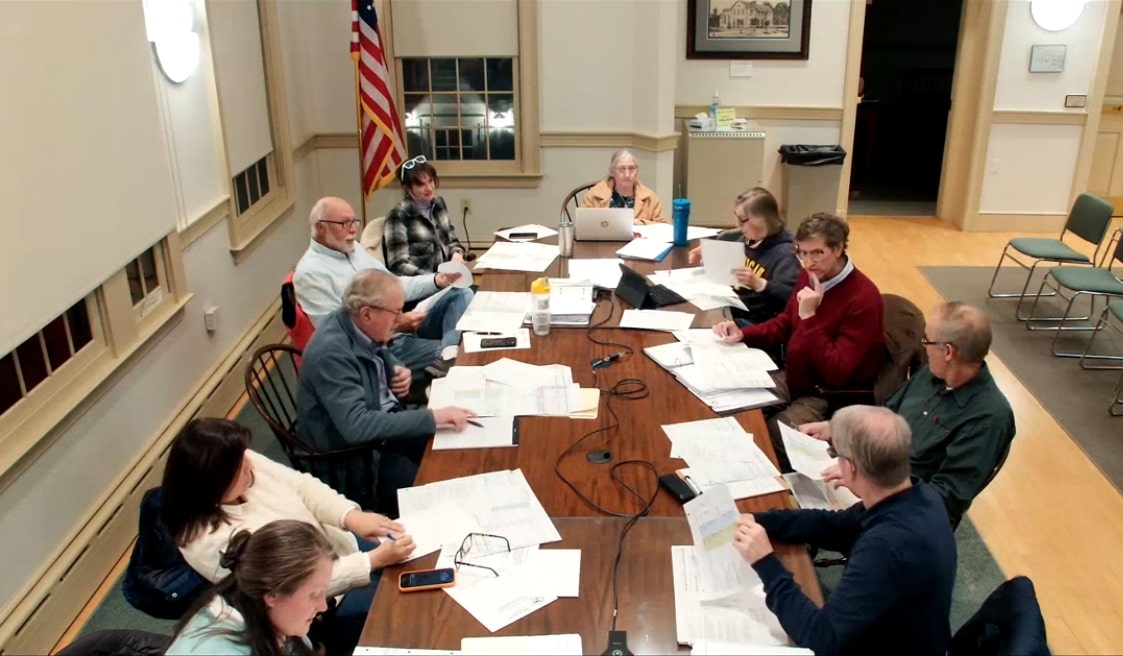
OLD LYME, CT – The Board of Finance this week unanimously forwarded its proposed $48.2 million 2026-27 budget to a public hearing along with a 3.89% tax rate increase over the current year.
The tax rate is anticipated to rise by 0.6 mills to 16.86 mills after the finance board Tuesday decided to use $1.2 million from the town’s surplus to offset the increase. Without the use of surplus funds, taxpayers would be facing a 1.1-mill increase, or 6.8%.
Based on the projected tax rate, a homeowner with a house assessed at $350,000 would see the tax bill rise from $5,681 to $5,901, an increase of about $220 for the year.
Residents and taxpayers can weigh in on the budget at a public hearing April 20 at Old Lyme Memorial Town Hall and vote at the annual town budget meeting May 18.
The town spending plan – which includes town operations, education, debt and capital costs – represents an increase of $2.8 million, or 6.2%, over the current year.
Old Lyme’s share of the proposed Region 18 school budget comes in at $33.6 million, up $2.1 million, or 6.57%, from current spending. Increases in the district, which covers Lyme and Old Lyme, are driven by salaries, health insurance and unanticipated special education costs.
The town’s $14.1 million general government proposal reflects a $925,972 increase over current spending – or 7.0% – to cover operating costs for town hall departments, public works, police and other town services.
The plan includes a new public works maintainer position and brings the tax department assistant to full time. It also adds a police officer mid-year to mitigate the impact of a full-year position and to reflect hiring timelines amid declining applicants statewide.
Debt service comes out to $544,000 in the spending plan, which is down $158,350, or 22.6%, from the current budget.
Total capital expenditures in the general fund are set to decrease by $178,035, or 26.7%, to $489,590. The budget also includes $2.14 million to be drawn from special funds for capital projects, up $365,200, or 20.6%, from the current year. Expenses include ongoing investments in public safety equipment, public works vehicles, road maintenance and town buildings.
During Tuesday’s deliberations, finance board member David Kelsey warned the town is looking at more than $7 million in road repairs over the next five years but does not have a long-term plan for funding them. Rogers Lake Trail, which he said hasn’t been properly paved since the 1980s and was chip-sealed repeatedly as a stopgap, was left off this year’s paving schedule due to what First Selectwoman Martha Shoemaker described as a paperwork mix-up.
Kelsey acknowledged there will likely be enough money to address Rogers Lake Trail in the coming year between the proposed $1 million allocation to the Road Improvement Fund and any surplus from the current year’s line item. But he said the episode underscores the need for better long-term planning.
“We’re again back to doing things a little bit in a vacuum,” he said.
Rainy Day Fund
In a separate motion, members voted 3-1, with Kelsey abstaining, to use $1.2 million from the town surplus to ease the burden on taxpayers. Chairman Bennett J. Bernblum abstained due to finance board custom limiting the chair to tie-breaking votes.
Known in finance parlance as the undesignated fund and colloquially as the “rainy day fund,” the surplus is made up of higher-than-expected revenues and unspent funds from prior budgets.
Finance Director Anita Mancini predicted the fund will stand at approximately $16.6 million by July 1. She said the $800,000 set aside from the surplus in last year’s budget planning cycle did not need to be used.
Based on Mancini’s estimate, Old Lyme’s surplus would equal about 31.9% of total operating expenses in the proposed budget after the $1.2 million withdrawal.
Healthy reserves help towns qualify for higher bond ratings, which in turn earn favorable interest rates on municipal bonds. Bond agencies generally recommend municipalities keep at least two months of annual operating expenses in the undesignated fund, or roughly 17%.
Like last year, the discussion was divided along party lines. Republicans advocated for stronger reserves for emergencies, including powerful storms threatening the shoreline tax base, while Democrats called for using a larger share of available funds to reduce taxes.
Candace Fuchs, a Democrat, said her research into the issue as part of an informal group within the finance board placed Old Lyme among the top seven in the state for the size of its surplus.
Targeting 30% as a healthy goal, Fuchs cited a “diminishment of return” in terms of credit rating benefits once the fund exceeds that amount.
Democrat Anna Reiter said this budget cycle is not the first time the finance board has allocated surplus money to lower the tax rate but ultimately not used it.
“So it stays there and it grows,” she said. “And I think that’s not necessarily what taxpayers would like us to be doing.”
Republican Andy Russell cautioned that drawing too heavily from the fund all at once could reduce flexibility for future budgets, potentially leading to larger tax increases if less surplus is available.
“So it has to be a controlled and certainly calculated path if the goal is 30%,” he said.
According to Reiter, there are other ways to plan for emergencies while maintaining the town’s credit rating. She cited a 2019 state law pioneered in Branford that allows a municipality to establish a climate change and coastal resiliency reserve fund, with broader investment options than those available to the general undesignated fund.
“Do we need to come up with a resiliency objective? We do,” she said. “But I don’t see how taking $1.5 million out of the undesignated fund right now is really honestly going to make a difference if the whole shoreline gets wiped out.”
A motion from Kelsey, a Republican, to use $1 million from the surplus failed in a party-line vote with Kimberly Thompson, Reiter and Fuchs voting against it.
Kelsey reiterated the need for a strong undesignated fund in the absence of solid long-term planning that accurately predicts the needs that will arise in a given year. He cited a recent year when the town took $1.1 million from the surplus due to unanticipated expenses.
Editor’s Note: This article was updated to clarify the surplus as a percent of the total operating budget once $1.2 million is withdrawn and to provide additional context on capital spending.
Author

Comments (4)
Comments are closed.
Related Articles
Election 2026: What to Know Before You Go
It’s time to vote. Find early voting and Election Day hours and locations, along with profiles of the local candidates, in your handy LymeLine election guide.

Labriola Calls for Common Sense Approach in 23rd District Run
The Old Saybrook treasurer is running for the 23rd District seat on a platform of affordability, local control and bipartisan cooperation.
Old Lyme Library to Lend Laptops to Eligible Residents
Libraries are partnering with the state to close the digital divide. The goal is to expand access to the tools people need to use important services online.
Dear Mr. Meek:
The line by line budget along with Monday’s presentation is now up on the town website.
The line by line budget can be found here:
https://ct-oldlyme.civicplus.com/DocumentCenter/View/4309/Proposed-Budget-Card-FY26-27-Draft-42026
The April 20th meeting was the initial presentation, and there will be a full public hearing on the budget on May 18th ahead of the referendum.
Best,
Jim
Ive been looking for the proposed budget prior to tonights mtg. Town finance webpage says “available in april”. So i went to town hall (finance) asked for the information and was told ” probably around 430 pm”….day of mtg!!!??? Am i wrong thinking this is wrong and predetermined to alleviate questioning of spending. Our board of education does the same thing. THIS IS WRONG
Is the proposed “line by line budget” available for review prior to Apr. 20th mtg.?
A sneaky way of using surplus funds to coverup a bloated budget. This is like. You and I, using our savings account to pay for frivolous purchases. How gullible does the Board of Finance take us for, Elections have consequences.