

Residents Turn Out in Droves to Discuss Halls Road, Other Zoning Issues
The final workshop in a three-part zoning series brought an overflow crowd to the Lymes’ Senior Center, with Halls Road emerging as the evening’s biggest draw.
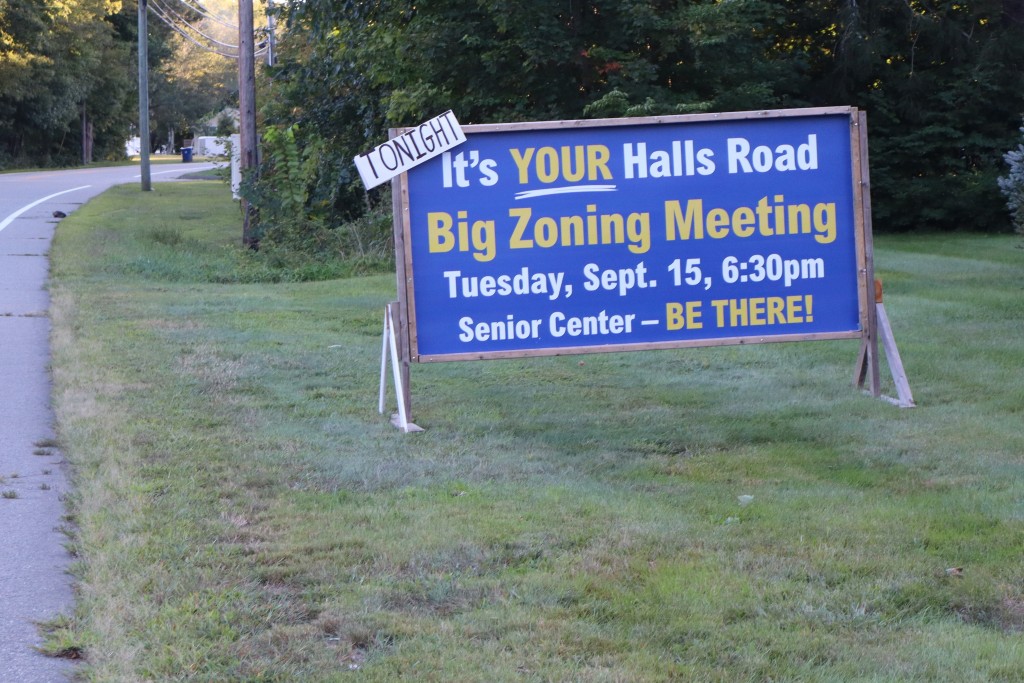
OLD LYME, CT – The prospect of development on Halls Road drew more than 260 people to this week’s Zoning Commission workshop on the rules guiding commercial projects in town.
The Sept. 15 event was the final in a three-part series to gather public input for a comprehensive overhaul of the town’s zoning regulations. The evening’s breakout format divided the crowd into separate sessions on commercial, industrial and waterfront districts.
Lead consultant Francisco Gomes of Hartford-based IMEG said it was the largest crowd he had seen at a workshop during his 25 years of planning work in the state.
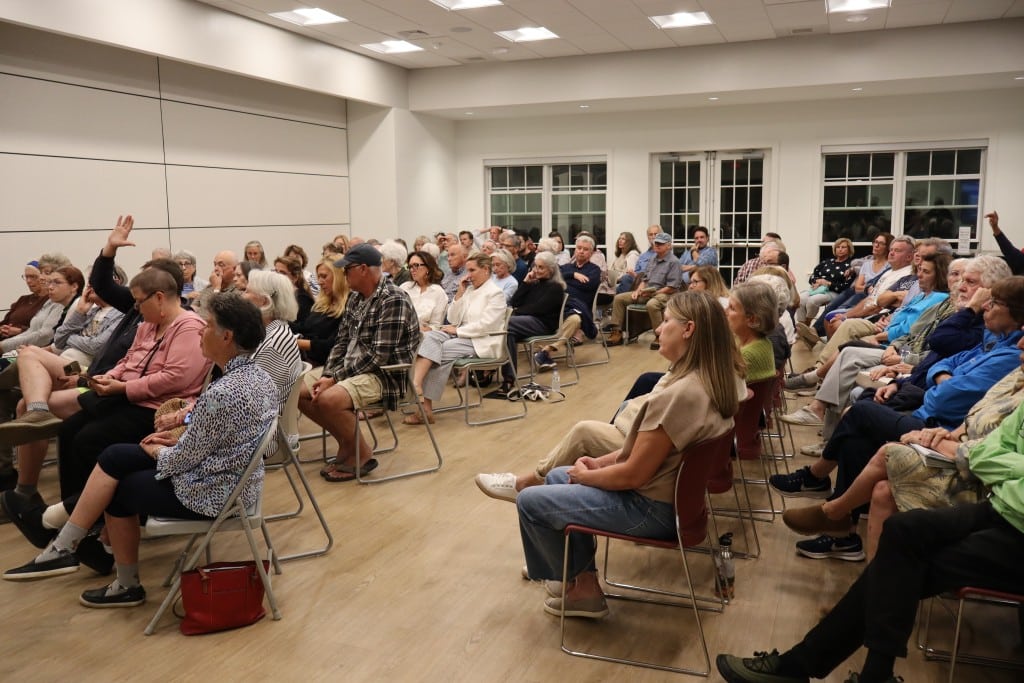
Officials said the Lymes’ Senior Center’s main meeting space reached its 260-person capacity, but they managed to accommodate the overflow in nearby rooms hooked up to a main video feed without anyone having to be ordered to leave the building by Deputy Fire Marshal Dave Smith.
Land Use Coordinator Eric Knapp stood up at the start to acknowledge Halls Road as the star of the show. But he emphasized there were no proposals for the controversial span on the table that evening.
“So if that’s all we talk about, we will have missed an opportunity,” he said.
The commercial strip between two highway interchanges was the focus of an even larger zoning meeting last year, when more than 500 people attended a meeting largely in opposition to a proposed Halls Road Overlay District that would have allowed apartments and condominiums above or behind ground-floor businesses.
That sentiment remained Tuesday among those who alleged planning for the Halls Road area was happening “behind closed doors” with the interests of developers, rather than an engaged community, in mind.
Gomes told attendees during the first of several sessions focused on Halls Road that he wasn’t aware of any commercial interest driving the process.
“We were hired to help the town update its zoning regulations – to really modernize them and to meet the needs of the community – and we weren’t hired for a particular project or property owner or developer,” he said.
Residents expressed support for retaining a supermarket on Halls Road, but not for bringing in hotels. A call for “tasteful” housing drew jeers, while others acknowledged the need for additional housing options, including places where seniors could downsize.
“But not at Halls Road,” someone called out.
The discussion revolved around familiar concerns including traffic, environmental impacts and water and sewer capacity as residents called for development to remain in scale with the surrounding area.
“There is a desire to improve the area, to retain small businesses, to fill vacancies, to make it more walkable, to beautify it,” Gomes said after everyone had a chance to weigh in. “But not at the expense of losing the charm of the area, and of building something that you feel doesn’t belong in Old Lyme.”
The two-year process for rewriting the town’s zoning regulations is roughly halfway complete, with work expected to continue through 2027. Gomes emphasized the Zoning Commission is still in the information-gathering stage and has not proposed any changes yet.
The Zoning Commission is considering additional opportunities for public input because of the level of interest, according to Gomes.
Citing data from a townwide zoning survey that’s drawn 800 responses since this spring, Gomes said 55% called for more food-service establishments, 42% for more retail and 35% for more mixed-use development. About 36% said there are uses currently allowed in commercial and industrial zones they think should be prohibited.
Data centers, warehousing and gravel pits topped the list of businesses respondents don’t want, or do not want more of, in town.
The survey remains open through Sept. 30.
In a separate discussion on the commercial districts most prevalent on Route 156 and the Laysville section of Boston Post Road, IMEG facilitator Toni Pignatelli said town zoning allows properties to be used in a broad range of ways.
“Almost any commercial use that you could envision is permitted within your commercial districts,” she said.
One idea discussed was combining one of the smallest commercial zones along Route 156, which includes the swath from Cross Lane to the Old Lyme Police Department, with the nearby Sound View Village District.
Currently known for Teddy’s Old Lyme Pizza Palace and Rooney’s Package Store, the C-10 zone can include retail, service, office, adult entertainment, financial institutions, clubs, cemeteries, theaters, veterinary clinics, package stores and motor vehicle service.
The Sound View district’s more streamlined list of allowed uses consists of mixed-use or stand-alone housing, restaurants, retail, recreation facilities, entertainment and parks designed to promote a “compatible mix of smaller-scale residential and commercial uses and a physical design that maintains an open, airy, light-filled seaside community quality.”
The C-30 zone, which covers the largest sections of commercially zoned areas on Route 156, prescribes minimum lot sizes of 30,000 square feet compared to 10,000 in the C-10 zone. It’s the square footage that gives the zone their names.
Emerson Colwell, who opposed the Halls Road Overlay District, said he is not necessarily opposed to additional development along Route 156.
He pointed to the potential economic impact of defense giant Electric Boat’s expanding workforce and the business they could bring to a thriving shoreline.
“Now that we’re getting sewers down there, that can change that area considerably,” he said. “As long as it ends there and it doesn’t get any further, that should be OK.”
IMEG facilitator Raul Irizarry also brought up Electric Boat when he summarized ideas expressed during sessions focused on the light industrial zone situated near Interstate 95 on the East Lyme border,
He said residents favored capitalizing on skilled labor drawn to southeastern Connecticut as part of a hiring spree fueled by massive U.S. Navy submarine contracts. The possibility of introducing limited commercial uses and mixed-use housing was raised.
“There was a big push for incorporating mixed-use housing if possible,” Irizarry said. “But the overarching theme was the fact that they wanted it to remain a place of industry and a place of revenue.”
Gomes noted that a state law that went into effect July 1 requiring zoning commissions to allow multifamily housing in commercial zones does not apply to industrial zones. While residential and industrial uses are often incompatible, he said the question could be evaluated as part of the zoning rewrite.
“That’s something we’ll take a look at,” he said.
Facilitator Rory Jacobson, of IMEG, said the overriding concerns among participants at the session on the town’s waterfront zones involved the environment, parking and traffic, as well as the need to support small businesses.
“And to make sure that we’re not, through zoning, having unintended consequences that make it difficult for those water-dependent uses to function,” she said.
The waterfront districts include marinas and other water-dependent businesses on Shore Road, Ferry Road, Neck Road and Four Mile River Road.
Sean O’Malley, president of the DiMillo’s Yacht Sales said regulations concerning fill and property improvements need to recognize the particular needs of boatyards and marinas.
The company replaced the Old Lyme Marina on Neck Road earlier this year.
His comments came amid a recommendation from the Flood & Erosion Control Board to tighten restrictions on placing fill – soil, sand or other material used to elevate land – in flood-prone areas. The proposal is intended to preserve flood storage capacity and reduce flood damage.
He said regulations should include exceptions or accommodations for businesses such as marinas and boatyards so the tradition can continue to thrive.
“Old Lyme has a storied history of shipbuilding, marina use,” O’Malley said.
Author

Related Articles
Old Lyme Zoning Survey Finds Support for Flexibility, Not Major Change
Residents want to preserve Old Lyme’s small-town feel by allowing accessory apartments, limiting data centers and ensuring a say in the future of Halls Road.

Berke Wins as Campbell Falls Short in Third Region 18 School Board Bid
Democrat Devin Berke defeated Republican Brandy Campbell in Tuesday’s special election, extending the Democratic Party’s hold on all nine seats.

Lyme’s Lisa Holmes Takes Farmers’ Stories From Field to Film
A documentary from Lyme resident Lisa Holmes digs into the challenges facing independent farmers and the changing landscape of American agriculture.