

Old Lyme Weighs Cost of Tougher Flood Regulations
How can Old Lyme protect homeowners and the environment in a changing climate? It’s a key question facing Zoning Commission members as they overhaul their regulations.
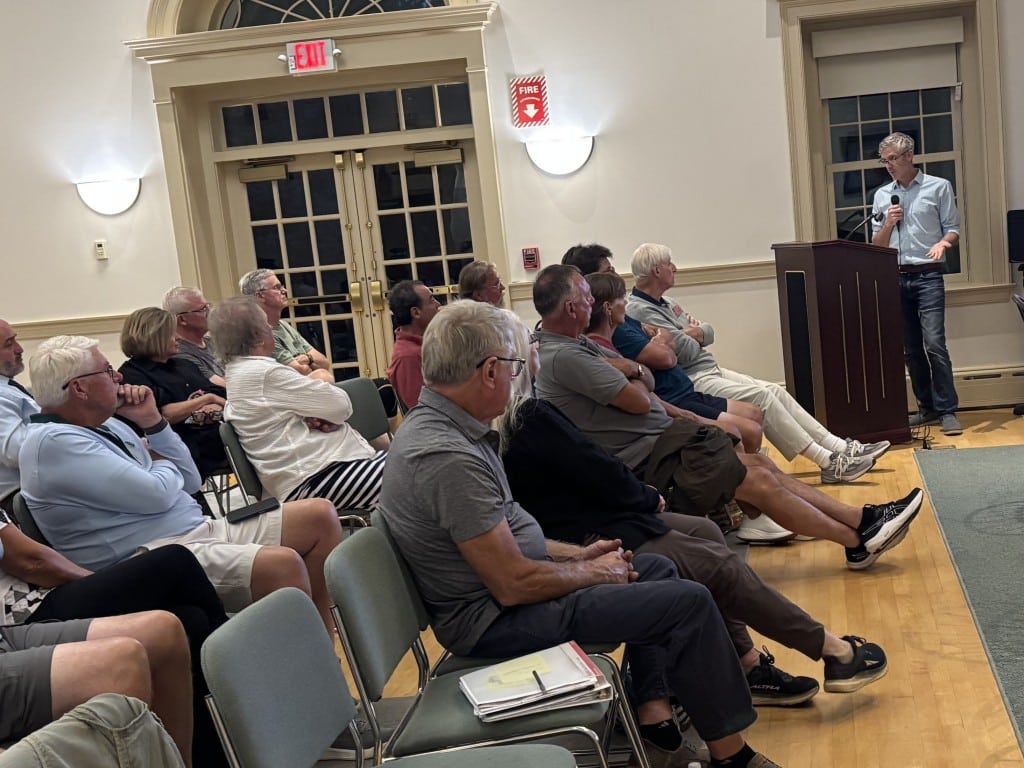
OLD LYME, CT – The local Flood and Erosion Control Board this week outlined its recommendations for zoning changes intended to make flood-prone areas more resilient to climate change while reducing individual flood insurance premiums by as much as 15%.
But residents from Old Lyme, where flood risks come from multiple rivers that empty into Long Island Sound beneath increasingly stormy skies, questioned whether reduced insurance payments would make up for the cost of regulations with the potential to drive out families who have been in town for generations.
Sondra Lintelmann-Dellaripa was among those who attended Monday night’s Zoning Commission meeting to hear more about the board’s recommendation for Old Lyme to join the Federal Emergency Management Agency (FEMA) Community Rating System (CRS).
FEMA’s rating system rewards communities that take steps to reduce flood risk with discounts on flood insurance premiums for property owners.
Lintelmann-Dellaripa said the family has owned a house on 5th Ave. since the 1930s.
“We just had the fifth generation dunk her feet in water,” she said of the family’s youngest member.
She said she supports the concept of participating in the FEMA program because it could provide insurance savings and other financial benefits, but laid out a series of questions she said the Zoning Commission should examine before the regulations are adopted.
She called for more specific details on costs, discounts and the effect on property values before adopting the regulations.
Residents also questioned whether recommended changes would trigger costly new requirements – including potentially raising homes on stilts.
The recommendations came in response to a request from the Zoning Commission asking town boards and commissions to weigh in as part of the ongoing rewrite of zoning regulations that dictate what can be built, where it can go and how projects are approved.
Flood and Erosion Control Board member Damon Coppola, a disaster-risk manager who said he has worked in the field for 25 years, told the Zoning Commission that the idea of the recommendations “is to, over time, get properties that are at risk into a more resilient and a more sustainable situation so that we can preserve property values.”
He said the town has seen $8.2 million in flood insurance claims since joining the National Flood Insurance Program in 1973. Forty-six properties have filed claims more than once, approaching the 50-property threshold that would trigger increased federal requirements and local oversight.
Properties in high-risk flood areas with mortgages from government-backed lenders are required to have flood insurance.
“We’re trying to do what we can to make sure that as a town, we stand our ground and don’t push ourselves into one of these high-risk towns that have difficult access to not only get flood insurance, but just to get insurance as a whole,” he said. “There’s a lot at stake.”
He said the CRS assigns points based on steps taken to manage construction and significant renovations in areas most prone to flooding. Higher scores correspond to greater discounts.
The board’s recommendations include expanding the town’s regulated flood zone to include areas designated by FEMA as the 500-year flood plain, increasing building elevation requirements for new builds and substantial improvements, restricting fill in flood-prone areas, preserving more open space and tightening standards intended to reduce future flood damage.
“We’re having king tides, blue-sky flooding,” he said, referring to phenomena that can occur with abnormally high tides even in the absence of storms. “We’ve got some serious issues.”
Coppola on Wednesday said the regulation changes alone could earn roughly 1,200 CRS points if the town received the maximum available points for each recommendation. That’s equivalent to a 10% discount.
Combined with existing open space regulations already helping to mitigate the flood risk, he said the town could be looking at enough points to secure a 15% discount.
He emphasized the recommendations are based on increasing the community’s resilience to flooding – not on achieving a certain insurance discount.
“That they also provide significant benefits under the Community Rating System only adds to the justification for why we are asking the Zoning Commission to consider them,” he said.
Expanding and Looking Back
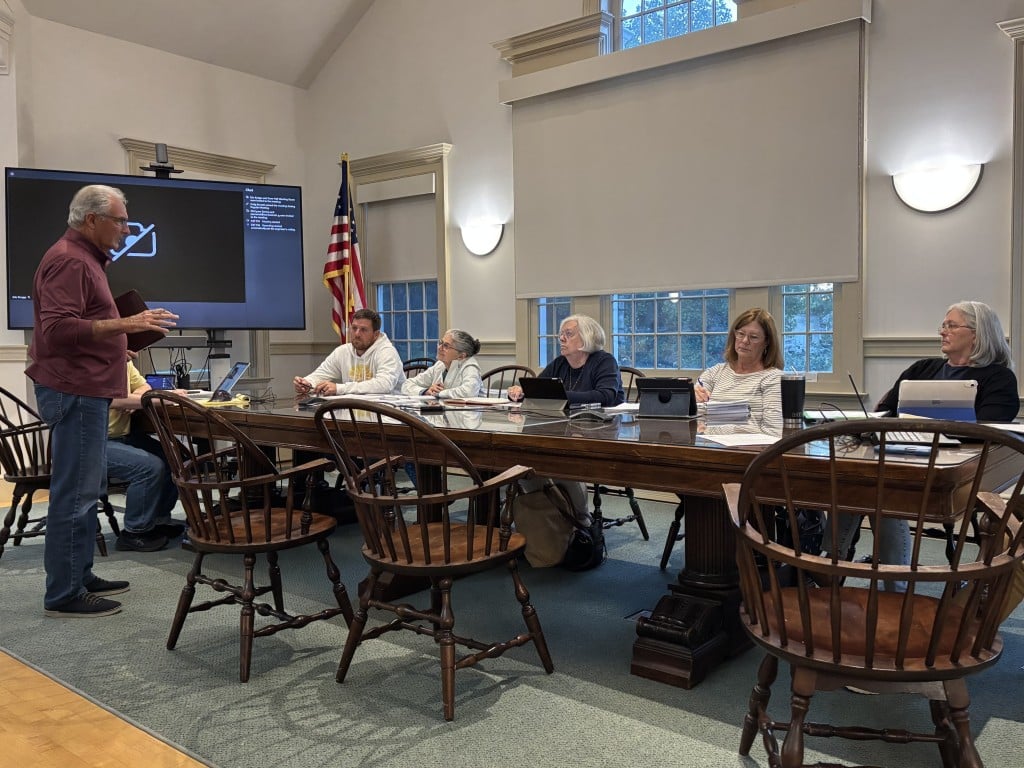
Old Lyme’s regulated flood zone currently comprises areas with a 1% statistical probability of flooding each year. It’s known as the 100-year flood plain because that probability equates to a one-in-100 annual chance of flooding.
The board’s recommendations would extend the regulated area to the 500-year flood plain: areas with a 0.2% annual probability of flooding.
Coppola’s presentation showed the change would add 1,507 acres to the 1,784 acres already regulated within the 100-year flood plain. There are a total of 15,602 acres in town.
Residents also questioned how far back the town should look when determining whether a project undertaken over multiple years qualifies as a “substantial improvement.”
The recommended changes would extend the “lookback” period from five to 10 years.
Under FEMA’s substantial improvement rules, improvements amounting to 50% of a building’s market value can trigger requirements to bring the structure into compliance with current flood plain regulations.
Coppola’s presentation criticized the current five-year lookback period for being “short enough that a remodel can be done in pieces so the threshold never trips.”
Todd Habicht, who owns five buildings on Seaside Lane that have been in his family for three generations, said ordinary maintenance could eventually push him out of Old Lyme.
Already, he said he has made improvements since 2024, including siding and exterior electrical work, and has now been told by his insurance company that one of the buildings needs a new roof.
“If I put a roof on, I’ve got to raise my house,” he said.
Doubling the lookback period to 10 years would be “brutal,” according to Habicht.
“I don’t even know how to begin,” he said. “I won’t be able to maintain these.”
He questioned what would happen to the landscape – from the socioeconomic factors that make it unique to the views afforded to residents – if longtime owners like him are forced out.
“The land’s worth a million dollars. The house is worth $130,000,” he said. “So if the house gets destroyed and I sell the land and somebody puts up a monstrosity on stilts in front of the beach line … it blows my mind.”
Gentrification
Zoning Commission Co-Chair Denise Savageau also cited concern over the possibility that flood regulations could alter the characteristics that have defined Old Lyme’s shoreline neighborhoods.
She described “gentrification overnight,” a phenomenon she observed as Greenwich’s conservation director in charge of the flood mitigation program.
“People who lived in those neighborhoods could not afford to elevate, and so what they ended up having to do was they sold their properties to people who could self-insure and afford to do the rebuilding,” Savageau said.
Zoning Commission alternate member Michael Barnes echoed the concern. He estimated that raising a coastal home currently costs about $300,000 and questioned whether an insurance discount would go far enough to mitigate the expense.
“That’s a lot of insurance payments to get to that $300,000 mark for these people who live in the beach zone,” Barnes said.
Coppola argued more residents could qualify for federal funds if the zone extends across the 500-year flood plain, since the assistance is only available now to those in the 100-year flood zone.
He said the change would benefit homeowners who want to elevate their houses but are not currently in a flood zone eligible for funding.
But he acknowledged federal grant programs can change and said he would support revisiting the 10-year lookback if data shows the regulations would come at too steep a price for residents.
“If it’s something that would have a significant impact on homeowners in this town, I wouldn’t recommend that,” he said.
He noted the board rejected some measures, including an outright prohibition on flood plain construction that alone could have earned 1,000 points – or a 10% discount on flood insurance.
“We wouldn’t recommend it because our goal is to protect the town’s vision and values,” he said.
Savageau told meeting attendees that the discussion on the Flood and Erosion Control Board’s recommendations will continue through this year and into next. She estimated draft regulations would be ready for a public hearing and subsequent discussion sometime around March.
“The idea is to make sure that we continue to have an open dialogue between the commission, residents and the boards that serve you,” she said. “It’s a give-and-take until we have the regulations drafted.”
Author

Comments (1)
Comments are closed.
Related Articles
Old Lyme Zoning Survey Finds Support for Flexibility, Not Major Change
Residents want to preserve Old Lyme’s small-town feel by allowing accessory apartments, limiting data centers and ensuring a say in the future of Halls Road.

Berke Wins as Campbell Falls Short in Third Region 18 School Board Bid
Democrat Devin Berke defeated Republican Brandy Campbell in Tuesday’s special election, extending the Democratic Party’s hold on all nine seats.

Lyme’s Lisa Holmes Takes Farmers’ Stories From Field to Film
A documentary from Lyme resident Lisa Holmes digs into the challenges facing independent farmers and the changing landscape of American agriculture.
Just one day later, the Board of Finance discussed various ways that the Unassigned Fund could be used to mitigate risk of climate disaster. Wouldn’t it be great to have these groups work together to improve Old Lyme’s climate sustainability ?