

Lyme Doctor Creates Jewelry Line Linking Hope and Community
After a breast cancer diagnosis, Dr. Lori Stetz created Hopelink, a jewelry line connecting people facing challenges with the friends, family and caregivers who support them.

Editor’s Note: Please join us in welcoming one of our newest interns, Evelyn Gage. The Old Saybrook High School senior will help us cover people, places and events across Lyme and Old Lyme.
LYME, CT – Dr. Lori Stetz, a Lyme resident diagnosed with breast cancer in 2021, is celebrating Breast Cancer Awareness Month cancer-free with a jewelry line she hopes will bring love, hope and strength to others facing challenges.
Approximately 1 in 8 women in the United States will develop breast cancer in their lifetime, according to the National Cancer Institute. Stetz is among 4 million breast cancer survivors in the United States currently.
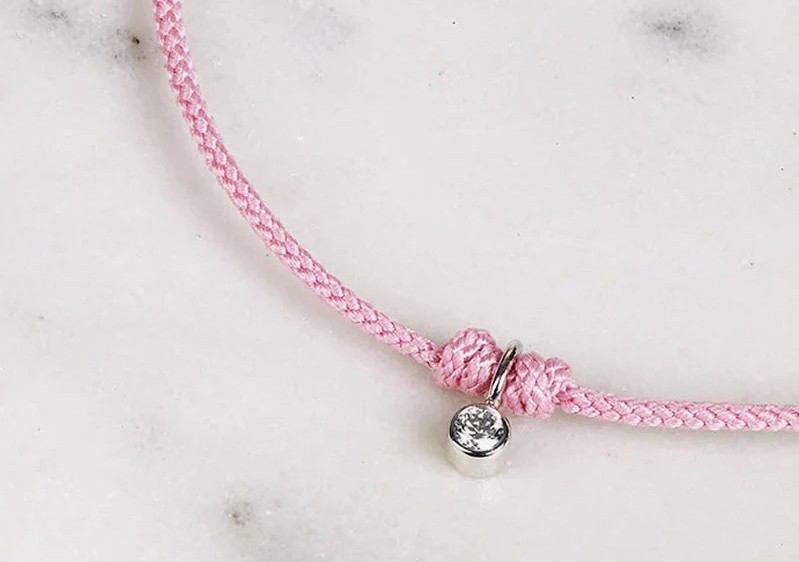
Stetz, a medical executive with Aetna International who previously operated a private practice in Lyme, created the jewelry company Hopelink while going through cancer treatment. The company sells bracelets for friends, family members and caregivers to wear in support of someone facing a challenge. The person they’re supporting can then collect the diamond charms from the different bracelets and wear them all on a necklace.
In an interview last month at her home in Lyme, Stetz recalled that hospitals were a scary place to be when she was being treated for cancer during the COVID-19 pandemic.
“It was pretty dicey,” she said. “Especially for someone undergoing chemo.”
She noticed nurses, doctors, family and friends were doing nice things for her along the way, which she said helped her to recognize the light at the end of the tunnel and to see the value of the little things.
Stetz remembered making a panicked phone call to a family friend, who also happened to be a hairdresser, when her hair began to fall out after multiple rounds of treatment.
The friend gave her a pixie cut and took her out to buy a wig, she said.
The gesture made Stetz want to give back, so she created bracelets made of thin string with a simple diamond strung on each one.
“I handed them out as a thank you,” she said.
Stetz realized she wanted to keep handing out the bracelets to people. She recounted telling them, “If you could do me the favor of wearing this … I’ll ask for the diamond back when I’m through the worst of it.”
She said the bracelets gave the nurses a reminder of how important their job is, while seeing the bracelets on their wrists helped Stetz in a time of immense discomfort.
“It gave me solace every time I looked at it,” she said.
She emphasized that many people helped her throughout her treatment. During her final round of chemotherapy, friends organized a winter driveway party to welcome her home, complete with bells and posters, because pandemic protocols prevented them from gathering inside.
Despite the cold, “they stood in the driveway … and waited for me to get out of chemo,” she said.
“It was really the fabric of the community that helped me up. Everyone should have that.”
Once Stetz was through the worst of it, she took back every diamond from each bracelet and strung them on a gold chain around her neck.
‘Hope is Essential’
Before Stetz’s diagnosis, her best friend, Kristen Palma, lost husband Paul Poth to cholangiocarcinoma. Following his diagnosis in 2009, the couple created the TargetCancer Foundation to accelerate research into rare diseases. Poth died that August.
In an interview this month, Palma said Stetz is a member of the foundation’s scientific advisory board and a “huge help since the beginning.”
She described Stetz as an advisor as well as a friend.
Palma remembered Stetz creating Hopelink to keep her mind busy during treatment. She said her friend also realized how important it was to surround herself with support.
As the recipient of a Hopelink bracelet, Palma said she was touched by the gesture and felt strongly about the Hopelink idea.
“Every time I looked at it, I was thinking of her and giving her that positive energy,” Palma said.
Stetz designed her product and business plan around heroes going through treatment and the allies who support them.
Palma said, “Seeing her have this passion has been a really great, wonderful thing.”
A single bracelet on myhopelink.com goes for $235, with sets starting at $425. The company donates 5% of its proceeds to the TargetCancer Foundation and Breast Cancer Research Foundation.
Stetz noted Hopelink bracelets can be used for a multitude of reasons, not just to support someone with cancer.
She defined a hero as someone who’s faced an incredible personal challenge. An ally is someone who supports the hero through a difficult time.
Both can feel overwhelmed, according to Stetz.
After her battle with cancer, she said she believes “hope is essential.”
Related Articles

Region 18 Special Election Comes to Lyme
Republican Emma Griffith and Democrat Jodi Lott are vying for a Lyme seat on the Region 18 Board of Education, with both citing AI and screen time as key concerns.
Old Lyme Launches ‘Under the Oaks’ Partnership with Barbizon, France
Old Lyme and Barbizon, France, are launching a 2027 exchange program to build on their shared artistic heritage.
Election 2026: What to Know Before You Go
It’s time to vote. Find early voting and Election Day hours and locations, along with profiles of the local candidates, in your handy LymeLine election guide.
Comments (0)
There are no comments on this article.