
Law Enforcement Runs in the Family for Old Lyme’s New Resident State Trooper
After more than a decade with the state police, including five years as a major crimes detective, Derek McGregor has added the title of resident state trooper to his resume.
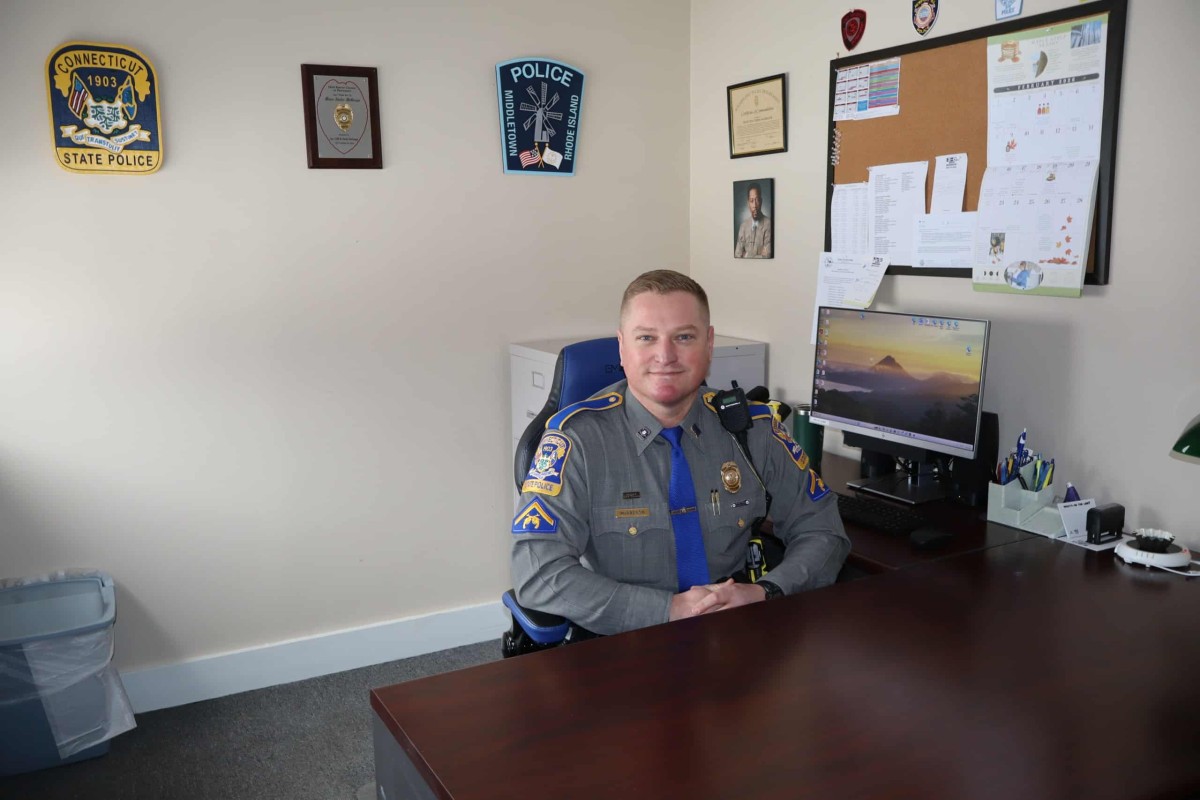
OLD LYME, CT – For Resident State Trooper Derek McGregor, law enforcement is a family business.
From the Shore Road police department last week, McGregor pointed to one brother serving as a lieutenant in Newport, R.I., and another as a deputy chief in Middletown, R.I. Their father, Capt. Alister McGregor, was killed on Dec. 27, 2001, during a SWAT training exercise when one of his men fired a rifle he thought was unloaded.
“My whole family’s police,” McGregor said.
The Rhode Island native said he was hired by the Connecticut State Police more than 12 years ago along with one of those brothers. But a week before they were due to start at the academy, his brother backed out, saying the commute no longer made sense after his fiancée accepted a new job.
“I’m like, ‘dude, what are we doing here?’” he said. “I’m going to Connecticut alone?”
McGregor graduated from the academy in January 2014, with stops at Troop K in Colchester and Troop E in Montville, before spending five years as a detective with the state police Major Crime Unit out of Westbrook’s Troop F.
The new resident trooper cited his participation in investigations of high-profile incidents including the stabbing of a father by his son in Essex and the ambush killing of Sgt. Dustin DeMonte and Officer Alex Hamzy of the Bristol Police Department.
“I’ve been a lot of places, done a lot of things,” he said. “They say it’s always good to try something new, learn new things and expand your horizons to be a better, well-rounded trooper.”
McGregor started work the day after Christmas as the replacement for Matt Weber. The five-year resident state trooper left in October to oversee the State Troopers Offering Peer Support (STOPS) program with his Labrador retriever Viera, a certified state police Comfort K-9.
McGregor lives in East Lyme with his wife and two middle school-aged daughters. For the first time in his career, he doesn’t need the highway to get to work.
His new commute gives him a chance to explore Old Lyme, from winding roads along rivers and wetlands to the gridlike streets of its beach communities.
“It’s definitely different,” he said.
Staffing Needs and Traffic Cameras
McGregor supervises four constables with full police powers and one recruit currently at the academy. Efforts to replace longtime Cpl. Wayne Collins, who retired late last year, are ongoing.
The Board of Selectmen has requested a seventh officer in its 2026-27 proposed budget to supplement existing day and evening shifts.
“Midnight shift is currently covered by the state police,” he said. “You never know who you’ll get.”
Consistent coverage by local officers who know the area is the goal, according to McGregor. He noted Old Lyme’s population increases significantly in the summer.
“I know when I have to call the police, I want someone to come soon. I don’t want to wait a half hour for a trooper to come to my house,” he said.
On the subject of traffic enforcement cameras – now under consideration by the town – McGregor declined to weigh in.
He said any official positions must come through the Connecticut State Police Public Information Office.
He emphasized that the decision ultimately rests with local officials.
Members of the local Road and Public Safety Committee have said guidance from the resident state trooper will be a factor in deciding whether to use traffic cameras to issue speeding tickets. The committee is charged with making recommendations to the Board of Selectmen about how road safety can be improved in town.
Under a state law enacted in 2023, the Board of Selectmen must hold a public hearing, update town ordinances, and submit a plan to the state Department of Transportation (DOT) if they approve traffic enforcement cameras in town.
The speeding fines, which under state law cannot exceed $50 for a first violation and $75 for subsequent violations, must be used to cover the costs of the camera program or directly address traffic safety.
“I haven’t done enough research on it to give an honest opinion,” he said. “I don’t know much about how they operate, the statistics created, revenue or anything.”
Settling In
McGregor described himself as community-oriented and eager to connect with residents.
“I’m a family man. I care about the community. I like to meet people, hear their opinions and concerns,” he said.
Among his responsibilities is continuing school engagement efforts and overseeing the town’s summer ranger program, which is currently in its hiring phase.
Roughly two months in, McGregor says he remains focused on getting to know the community and settling fully into his new role.
“I really enjoy this position and everyone from top to bottom I’ve dealt with so far,” he said. “Everything’s working smoothly.”
Author

Related Articles
Lyme Voters to Weigh $14.23 Million Budget and Extra Snow Removal Costs at Town Meeting, May 21
Voters will consider a $14.23 million budget and a $119,000 request for winter highway costs and equipment repair.

LymeLine to Offer Free Obituary Notices as Public Service
Our goal is to make meaningful remembrance accessible to every family with ties to Lyme and Old Lyme.

Body Recovered from Connecticut River in Lyme
State EnCon Police are investigating after a boater reported a body in the Connecticut River near the Chester-Hadlyme Ferry on Saturday afternoon.