

‘The Price We Pay for the Success We Have’: Lyme-Old Lyme Principals Defend Modest Budget Requests as District-Wide Increase Looms
Lyme-Old Lyme principals say their budget requests strike a balance between fiscal restraint and protecting successful programs.
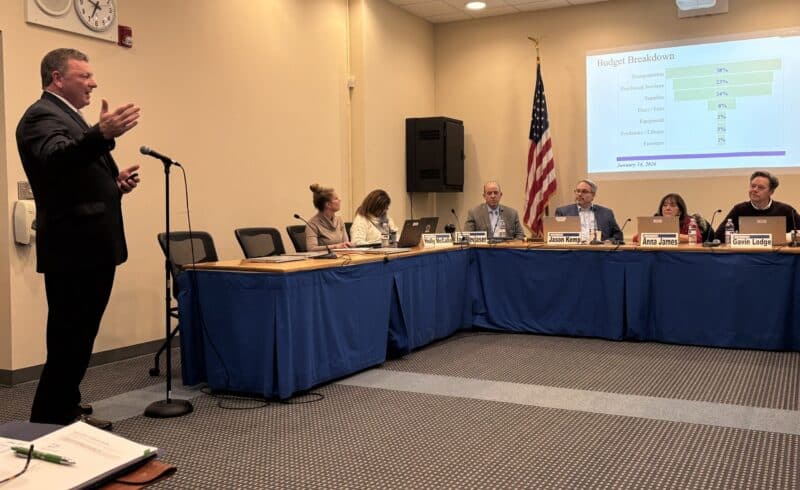
LYME/OLD LYME, CT – With school spending accounting for more than 60% of town operating budgets in Lyme and Old Lyme, and debt continuing to mount from a four-school renovation project, school officials this week emphasized careful spending in their 2026-27 classroom budget requests.
At Wednesday’s special Region 18 Board of Education budget meeting, the district’s principals and curriculum director revealed a combined $1.48 million request for building-specific supplies and services. That’s an increase of $48,062 over current spending, according to budget documents.
Superintendent of Schools Ian Neviaser said the expenses – which ranged from computer software to competition fees to one particularly coveted photocopier – represent only a small fraction of the district’s overall budget.
Neviaser told school board members his total recommended budget will not be made public until next week, when the district presents its special education, facilities, technology, operations and central services budget requests – including salaries and benefits. He said the district-wide services account for 96.4% of the proposed spending plan.
The current $39.7 million budget for Lyme-Old Lyme Schools was approved in May, up 7.39% from the previous year’s budget. The unusually high increase was attributed largely to debt from the renovation project.
Neviaser has said project payments are likely to drive up the budget for several years.
The district’s expenses are shared by its two sending towns, where education spending currently accounts for about 69% of Old Lyme’s $45.39 million budget and 61% of Lyme’s $11.37 million budget.
Success Comes With Costs
Lyme-Old Lyme High School Principal James Wygonik introduced a $777,458 budget request – up $17,866 from the current budget. The increase is driven by a once-a-decade accreditation process, a 4% increase in transportation contract costs and rising athletic officials’ fees.
Wygonik said his budgeting goal is “to improve the product that we have” rather than introduce something new.
“We never rest on our laurels,” he said.
The school’s success didn’t happen by accident and costs money to maintain, according to Wygonik.
He pointed to the 94% of students who met or exceeded state benchmarks in English during the past school year; the 94% who showed mastery on AP exams; and the 90% who participated in clubs, athletics, or the arts.
He said very few local residents are sending their children to school outside the district, while families from other towns “are bringing their kids here, and paying tuition to do it.”
The school, which bills itself as a “private school experience in a public school setting,” offers tuition options for non-resident students. The board in April 2025 set the high school tuition rate for out-of-town students at $19,000. Revenue in the current budget is estimated at $320,000.
Wygonik cited athletics as another strength in the school, where there are 25 sports teams and 9 cooperative programs with other districts.
He said 279 of 350 students played at least one sport in the last school year, taking home three state championships.
“And every time we go into these tournaments and things, there are more buses, more registration fees; those things just keep adding up,” he said. “But it’s the price we pay for the success we have.”
Wygonik said enrollment projections show there will be 352 high school students in the coming year, compared to 397 in 2023-24 and 360 currently.
He said decreasing enrollment might equate to some savings in the supplies budget, but doesn’t directly translate to lower costs elsewhere.
“It doesn’t really matter if you have five kids or 50 kids on a bus, you’re still running a bus,” he said.
Reflecting the roughly 4% increase in busing costs based on a contract with M&J Bus Company signed last year, the transportation and travel line of Wygonik’s requested budget is going up from $278,532 in the current budget to $294,752 in the coming year.
In response to a question from a board member about the possibility of buying vans so staff members could transport smaller groups of students rather than calling on the bus company, Neviaser said the district’s research showed managing a van fleet would cost more in the long run.
He said the district operates two vans for special education, but said the numbers don’t support an expansion to cover students in low-enrollment programs such as golf.
He pointed to factors including insurance, maintenance, staffing, and replacement that would ultimately make district-owned vans more expensive than contracting transportation services.
“It was not a cost savings for us, unfortunately, because we would prefer to do that versus taking a whole bus,” he said.
Looking Within
The budget request from Curriculum Director Michelle Dean came in at $143,350, up from $131,150 in the current spending plan.
Dean told the school board her budget fluctuates each year based on outside forces such as federal grants and state mandates.
She cited $103,000 in federal grants received in the 2023-24 school year, compared to $53,000 in 2024-25.
Dean said she continuously evaluates expenses – including software programs she described as the department’s largest budget driver – to make sure the district is spending its money wisely. She referenced a recent effort to explore options after deciding to drop the Panorama Education program, a dashboard for teachers to track student progress. The district considered a free alternative from Google, but ultimately rejected it because it was labor intensive to customize and maintain.
“Long term, it’s kind of like the vans,” she said. “It wouldn’t necessarily be cost-effective.”
The district decided to consolidate and enhance existing resources instead of bringing in a new program, according to Dean.
Middle School Principal Mark Ambruso attributed his $223,358 request, up $12,700 from current spending, to modest program growth and the increasing cost of transportation.
Ambruso said his goal is to produce students who are ready for high school, and “life-ready,” when they finish 8th grade. He pointed to programs like family and consumer science that address a growing skills gap among students.
One math teacher’s recent plan for a lesson using the real-world example of meal preparation fell flat when she realized a significant number of them “were missing the life experience of cooking,” Ambruso said.
“We think all these kids have the experiences, but they don’t; And so tech ed, family consumer science, visual performing arts, and music arts – those are all great things that we’re proud to offer.”
He said startup costs for a new, parent-led Lego robotics program were partially offset by parent support, and future expenses are expected to level off after initial equipment purchases.
The middle school spending increase includes about $2,000 to purchase robots and upwards of $700 in transportation costs, plus competition fees.
According to Ambruso, the school emphasizes extracurricular activities, field trips and sports “because we know the more kids that are connected to us, the better success they have in middle school and later in high school.”
Elementary school principals Kelly Enoch, of Mile Creek School, and Allison Hine, of Lyme Consolidated School, described a $323,007 budget request, up about $4,950.
The principals said a lot of their work revolves around ensuring resources are spread equitably across the two elementary schools and students’ social and emotional needs are met. But Enoch said the most coveted budget item is the copy machine she put in the spending plan now that the Mile Creek School is getting back a faculty room used for special education classes during part of the renovation project.
“This is really the thing that all staff at Mile Creek is most excited about,” she said to laughs from the room. “So, it has to stay.”
Author

Related Articles

Lyme Veterans Committee Raises Betsy Ross Flags to Honor Revolutionary War Veterans
To mark America’s 250th anniversary, Lyme’s Veterans Memorial Committee raised Betsy Ross flags at nine landmarks honoring the town’s Revolutionary War veterans.