

Theater Review: ‘Osaki-San’ at Gillette Castle Shines Light on Remarkable Life of Gillette’s Gentleman Valet
The life of William Gillette’s valet, Yukitaka Osaki, is portrayed in a thoughtful and quietly moving performance. A historian and professor offers perspective on the show.
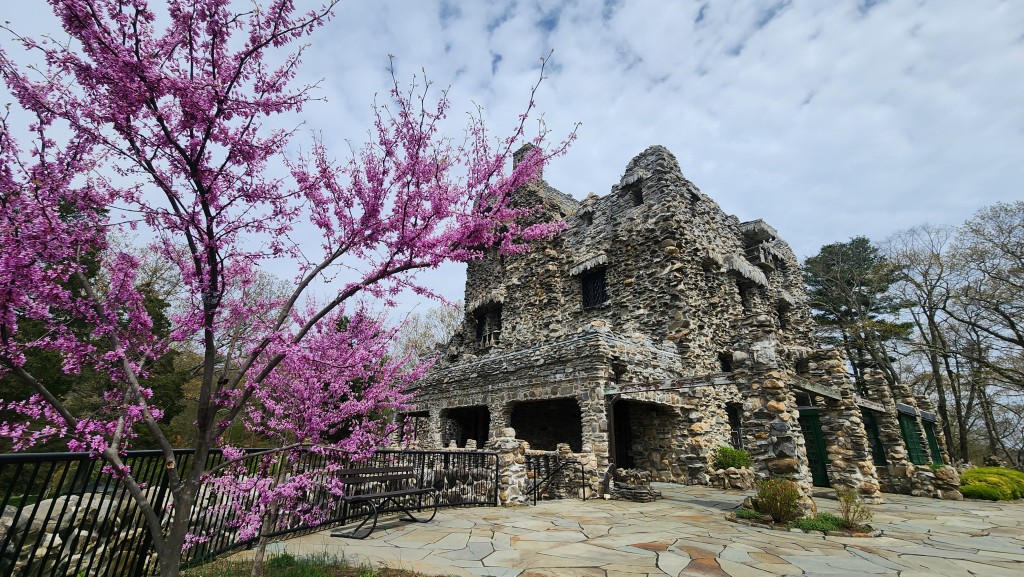
The experts had threatened us with rain, but the sky remained clear and sunny as we drove past the frog pond and parked by William Gillette’s vegetable cellar. Walking across the bridge to the enormous fieldstone castle is always a pleasure, but this visit felt special: we were here to watch a performance inside Gillette Castle itself. Members of the Friends group ushered us into the great room, and we took our seats for what promised to be an intimate afternoon.
The utterly unique two-story great room, dominated by its massive stone fireplace, was decorated with an assortment of frog figurines, an affectionate nod to Gillette’s quirky pond. In front of the hearth sat a simple bench holding a watering can and gardening tools. Nearby were a stool with a pair of leather shoes, a coat rack bearing a plain brown coat, another stool with a basket and trowel, and a small table set with a bowl, a flower, and a cloth. That was it. The rest of the “stage’s” atmosphere came from the room itself: the vintage record player, the fireplace tools, the odd and wonderful fieldstone walls, rattan mats, and Gillette’s elaborate wooden door locks and light switches.
About forty chairs were arranged in a semicircle, close enough that there was no separation between actor and audience. Spotlights mounted on the upper walkway went unused in the bright matinee light. On the seats were programs, which included an article written by Yukitaka Osaki for the Allegheny College student newspaper, dated December 17, 1896, titled “A Midnight Walk through Uyeno Park.”
“O! The awful solemnity of death that comes to all!” he wrote. “Hope alone remains. Like the morning star, it cheers us from afar and lights us through our journey of life.” That reflection proved an apt prelude to a play about the man himself.
This one-man show, Osaki-San: William Gillette’s Gentleman Valet, tells the story of Osaki’s life. It is written and directed by Kandie Carle, who specializes in immersive historical performances and leads the East Haddam Stage Company. The role of Osaki is performed by Taku Hirai, who came to the United States as an agricultural exchange student and found a passion for theater, studying acting at the HB Studio and Stella Adler Studio of Acting, and joining the Screen Actors Guild.
The Friends of Gillette Castle State Park president Lynn Wilkinson opened the afternoon, thanking sponsors and members, and noting that plans are underway for the restoration of Osaki’s own home on the property. Then, the music came on and Hirai stepped forward and introduced himself as Yukitaka Osaki.
Osaki, he told us, spent 54 years in America—most of it living on a houseboat, and some of it in “Gillette’s pile of stones.”
“He is far more interesting than me,” Osaki quips of Gillette. “Perhaps that is true. But that does not mean I did not live a full life.” The performance is, in many ways, an exploration of what a “full life” actually means.
Born in 1865, Osaki was the second son of a samurai family. Only a few years later, the rigid class system was abolished during the revolution that dismantled the old shogunate and propelled Japan into modernity. His older brother became a political dissident and helped organize a journey to the United States and beyond to study new forms of government. Yukitaka, who had studied in Shanghai, joined his brother as an interpreter. After nineteen days crossing the Pacific, they arrived in San Francisco, then traveled across the continent to New York and Washington, D.C. When the brother departed for England in 1888, Yukitaka remained behind.
He spent a year in the U.S. Navy, serving not in combat but as a waiter aboard a ship docked in New York Harbor. He then went to Pennsylvania for several years to study philosophy. By 1897 he was back in New York City, where he met and was hired by America’s most famous stage actor, William Gillette.
At that moment in the performance, Hirai carefully and deliberately removed Osaki’s Japanese jacket and robe, slipped off the traditional slippers, and put on leather shoes, suspenders, a white shirt, and trousers. The transformation into Western dress was quiet but powerful, and it was here that the audience seemed to settle fully into the story.
Osaki described how Gillette, grieving the loss of his wife, had retreated to life aboard his houseboat, the Aunt Polly. Osaki became steward of the boat, negotiating with engineers and suppliers and helping Gillette escape the pressures of celebrity. The two shared a love of cats, and the houseboat was filled with them.
Osaki became indispensable to Gillette, also serving as his personal assistant during his years on the stage in New York and on tour across America and England, especially with his most successful play, Sherlock Holmes. He tells a wonderful story of a 14-year-old Charlie Chaplin playing “Billy” in the play in London. When Holmes instructed, “Billy, I want you to watch the thieves,” the young Chaplin instinctively glanced toward the Royal Box, prompting laughter from King Edward himself.
Only later did Gillette learn that his indispensable assistant had a famous relative. Osaki’s brother went on to become mayor of Tokyo and was instrumental in the gift of cherry trees to Washington, D.C. He later came with his daughters to visit the two of them in East Haddam.
Hirai shares further anecdotes—meeting Helen Hayes, the loss of Gillette’s business manager aboard the Lusitania, the construction of the Seventh Sister castle in which we were sitting, and its subsequent permeation by cats. Eventually, Osaki acquired a house of his own down by the river near where Aunt Polly was moored. He cultivated a large garden and enjoyed the companionship of his cats and a donkey that helped haul supplies up from the docks to the castle. He befriended his neighbors, two sisters, scientist Alice Hamilton and author Edith Hamilton, who lived next door near the ferry landing.
After Gillette’s death, Osaki was left lifetime rights to the house by the docks. Hirai movingly conveys Osaki’s sense that one’s world naturally becomes smaller with age. Then came December 7, 1941. At the news of the bombing of Pearl Harbor, Osaki cries out in Japanese: “Nothing could have hurt Japan more!” He condemns the nation’s leaders and admits, simply and painfully, “My heart ached for my America.”
In the aftermath, the FBI questioned the gentle Japanese-American gardener, as they did countless others across the country. The pastor of the East Haddam Congregational Church and several neighbors spoke on Osaki’s behalf, and he was ultimately cleared. In a spring 1942 letter to Gillette’s niece Elizabeth, Osaki wrote, “I am thinking of flowers, more flowers, and more flowers.” Yet the shadow of Pearl Harbor never fully lifted. He rails against the warlords who attacked the United States, calling them the worst enemies Japan had ever known.
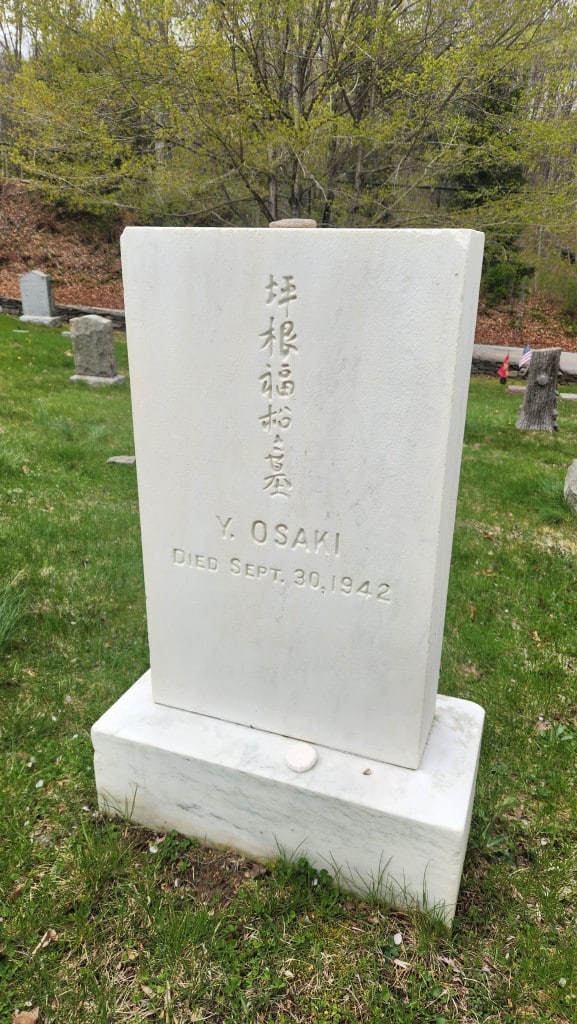
Osaki died that autumn at the age of 77. Following a funeral held at the Hamiltons’ home, he was laid to rest in a nearby cemetery.
Hirai took a well-earned bow, and we filed quietly out—down the stairs, past Gillette’s workshop, and back into the sunlight. Outside, a troupe of elaborately costumed cosplayers had gathered along the castle walls to take photographs. We got back in the car, drove past the frog pond, and down the hill to Ferry Road, where we found Osaki’s marble gravestone near his friends, the Hamilton sisters. As we stood there, the first drops of rain began to fall.
About the Author: Eric D. Lehman is the author of 23 books, including New England at 400, A History of Connecticut Food, Literary Connecticut, and Connecticut: Off the Beaten Path. He is a regular contributor to Estuary, for which he has won several awards from the Connecticut chapter of the Society of Professional Journalists. He has been consulted on diverse subjects and quoted by The Atlantic Monthly, USA Today, the BBC, the History Channel, Deutsche Presse-Agentur, and The Wall Street Journal.
Comments (1)
Comments are closed.
Related Articles
Old Lyme Creates Arts and Culture Liaison
The position will connect Town Hall with local artists and cultural organizations as Old Lyme seeks to support its arts community and renew its Sustainable CT certification.

LAA’s Fall Lineup Offers Taste of New England Art and Cuisine
Autumn at the Lyme Art Association includes landscapes, food-inspired art and the annual Palate to Palette gala, plus a call for artists for Deck the Walls.

Musical Masterworks’ 36th Season Explores What Makes Music ‘American’
Starting Oct. 10 and 11, the season will celebrate traditions and influences that have shaped American music.
Beautiful piece Eric. I visited the castle years ago but didn’t know about Osaki
Great story