

Lyme Turns to State Police for Targeted Speed Enforcement
The town has traditionally been reluctant to initiate traffic enforcement operations for fear of targeting local speeders, according to the town constable.
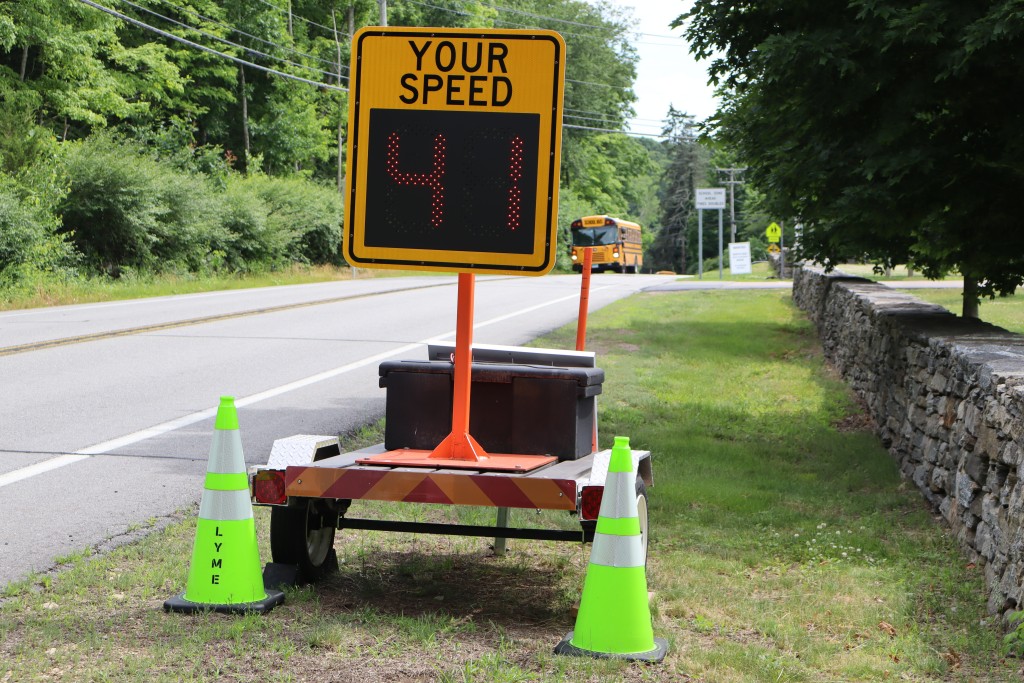
LYME, CT – The Board of Selectpeople last week unanimously authorized the town constable to bring in Connecticut State Police for targeted traffic enforcement as part of a broader discussion about speeding in town.
Town Constable John C.L. Evans told selectpeople at Monday’s meeting that the town has historically been cautious about conducting targeted patrols because it’s not just out-of-towners who speed through state and local roads.
“The risk is, we get our own residents,” he said.
Evans recommended posting advance alerts with the time, date and location of any enforcement operations on the town website and social media “so that those that get caught have been forewarned.” First Selectwoman Christy Zelek and Selectmen John Kiker and Tom St. Louis agreed all enforcement would be publicized.
As of publication, no dates had been set for the targeted patrols.
Zelek pointed to concerns raised in an email she received recently about speeding on Mount Archer Road. She said similar issues have been cited repeatedly about roads across town.
“It’s everywhere,” she said.
Data from the University of Connecticut Crash Repository shows there were 92 crashes in town over the past three years, including one fatal crash and three serious-injury crashes. Two of the four severe crashes occurred on Route 156 near Elys Ferry Road. Another occurred on Route 82 east of Hadlyme Four Corners, while the most recent was on Keeny Road.
Top Crash Locations (3-Year Period)
Source: University of Connecticut Crash Repository
Route 156 – 43
Route 82 – 8
Grassy Hill Road – 5
Bill Hill Road – 4
Blood St. – 4
Joshuatown Road – 4
Brush Hill Road – 3
Town Woods Road – 3
Keeny Road – 2
Route 148 – 2
Evans cited statistics from the town’s portable radar speed detection signs that show speeding is “a chronic problem” in town. One sign is currently in front of the Town Hall next to Lyme Consolidated School.
“The average speed passed here during school hours is 50 to 60 miles per hour,” he said. “And the highest report is 100.”
The town currently owns five of the speed detection signs, including two donated by the University of Connecticut. He said equipment, permitting and installation requirements have limited the town’s ability to use all of its speed-feedback signs, though he’s working toward having three of the signs in use at any given time.
He said he is ordering a trailer to move the signs around more easily.
The signs will likely rotate between Joshuatown Road, Mount Archer Road, Brush Hill Road, Cove Road, Beaverbrook Road and Town Woods Road, according to Evans. Those roads serve as commuter routes to neighboring towns, pass through more densely populated areas or, in the case of Cove Road, feature steep hills near seasonal activity.
Evans said data from the signs show they have a positive effect. But he acknowledged they can become ineffective if they sit there too long.
“That’s why the signs have to be combined with some targeted enforcement with state police,” he said.
He said the town generally pays for requested state police traffic enforcement patrols, but could not specify the cost for the recommended enforcement operations at the time.
There is $13,250 allocated for police services in the approved 2026-27 town budget. He said funding related to traffic enforcement – including an hourly rate for troopers, radar signs and cloud storage for the data – also comes from various line items comprising the total $678,860 public safety and sanitation budget.
Capturing Images?
The town’s radar signs record speeds but do not capture images.
Selectman Tom St. Louis suggested that image-capturing signs could allow the town to proactively reach out to residents identified as “frequent fliers” without involving state police.
“I’m just thinking it’d be better if we had the ability to collect images,” St. Louis said. “We could reach out to residents and say ‘Hey, can you do something?’”
Lyme, which does not have an independent police force or dedicated Resident State Trooper, relies on state police from the Troop F barracks in Westbrook for most law enforcement functions.
While state law gives appointed constables authority to enforce certain traffic, vehicle, animal control and election laws, traffic stops generally remain the responsibility of certified police officers.
Evans told St. Louis the town’s signs do not capture images and described such technology as controversial. He said he was not opposed to exploring it, but emphasized any use of images would require careful management of the information collected.
After the meeting, Evans reiterated his recommendation to “start with a moderate approach” that combines radar signs with state police enforcement.
He acknowledged the state granted expanded authority to cities and towns in 2023 when it legalized local traffic enforcement cameras. The process in towns like Lyme would require public hearings, an ordinance approved by the Board of Selectpeople and voters at a town meeting, and the official go-ahead from the state Department of Transportation (DOT).
The cameras are under consideration in Old Lyme by the advisory Road and Public Safety Committee. In East Lyme, the process has gone through local approvals and is awaiting the green light from the state DOT.
Automated-camera speeding fines, which under state law cannot exceed $50 for a first violation and $75 for subsequent violations, must be used to cover the costs of the camera program or directly address traffic safety.
Evans said the cameras tend to get a lot of resistance in small towns where everybody knows everybody.
He cited “hidden costs,” including deploying staff members to review the photos and fighting lawsuits that might emerge.
“I’m not sure it’s in character with our town right now,” he said.
Author

Comments (2)
Comments are closed.
Related Articles

Labriola Calls for Common Sense Approach in 23rd District Run
The Old Saybrook treasurer is running for the 23rd District seat on a platform of affordability, local control and bipartisan cooperation.
Old Lyme Library to Lend Laptops to Eligible Residents
Libraries are partnering with the state to close the digital divide. The goal is to expand access to the tools people need to use important services online.
Old Lyme Zoning Survey Finds Support for Flexibility, Not Major Change
Residents want to preserve Old Lyme’s small-town feel by allowing accessory apartments, limiting data centers and ensuring a say in the future of Halls Road.
The real issue here is public safety in Lyme and Old Lyme — not whether anyone has a supposed “right” to speed without consequence, whether enforcement comes from a police officer or a camera.
Speed limits are not suggestions; they are laws designed to protect all of us. In today’s world, we are routinely captured on cameras throughout daily life, from grocery stores to shopping centers. I find it difficult to sympathize with objections based solely on the possibility of being caught and penalized for breaking a sensible law intended to protect public safety.
We all share responsibility for keeping our roads safe. Let’s act like responsible adults and respect posted speed limits to protect our fellow citizens — especially our children traveling to and from school.
Glad to see these signs on 156. Note that two of the severe accidents happened at 156 and Elys Ferry Road. Suggest that a radar sign be established at the town line or further up near Elys Ferry/ Bill Hill.