

Lyme-Old Lyme High School’s ECOS Club Works To Maintain Trails, Protect Natural Order
Lyme-Old Lyme High School students plant native shrubs, tend local trails and harvest sweet potatoes through the ECOS Club’s environmental stewardship efforts.
Editor’s Note: We’re pleased to welcome Caliana Rand and Ella Davis, members of Lyme-Old Lyme High School’s LymeLine News Club. This story is their first contribution to LymeLine.
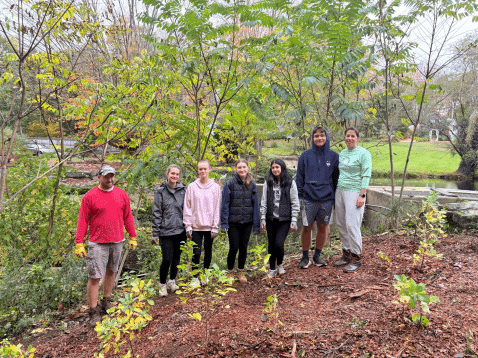
LYME/OLD LYME, CT – Lyme-Old Lyme High School’s Environmental Community of Stewards (ECOS) Club is continuing work to maintain the natural order, including efforts this month to plant native shrubs, maintain trails and harvest sweet potatoes.
Throughout the month of October, Lyme-Old Lyme High School’s ECOS Club planned events in locations around Old Lyme, including the George & Woodward H. Griswold Preserve and Town Woods Park. Through these activities, members are learning about the importance of protecting local wildlife and natural habitats.
The ECOS Club is overseen by advisor Karen Taylor. Along with managing the ECOS Club, she serves as a steward of the Griswold Preserve with her husband, Craig Taylor. In an interview, she described how they took on the position of caring for the Griswold Preserve.
“Our family always hiked and always liked to be in the woods and this preserve was close to our property,” she said. “When the old stewards stepped down, I asked if anyone wanted to take their stewardship position to maintain the preserve and they didn’t, so we decided to get involved.”
The club visited Griswold Preserve on Saturday, Oct. 17, to plant a shrub species known as clethra, which is native to North America and essential to the local area.
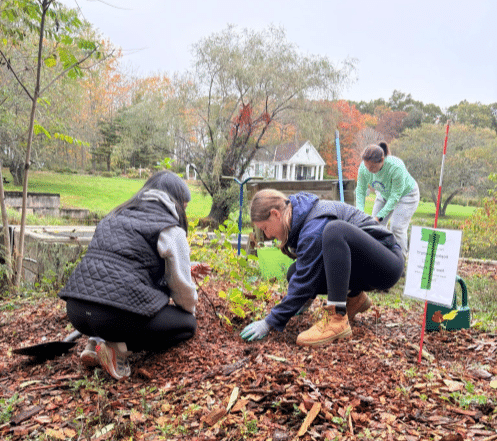
Before planting the shrubs, the ECOS Club was introduced to the Mary Griswold Steube Fish Ladder, which is near the preserve’s Lower Mill Pond Dam. There are various fish ladders throughout Lyme and Old Lyme that work as a water-filled staircase for migratory fish to swim around dams. The Mary Griswold Steube location alone has assisted 60,000 fish this year, including blueback herring and eels, in their migrations between freshwater and saltwater habitats.
Afterward, Craig Taylor explained the purpose of implementing clethra into the ecosystem.
“Invasive species, like spotted lanternflies, feed on specific plants, their main source being the tree of heaven. By planting clethra, the lanternflies do not have a stable host to feed off of,” he said.
He added that the Old Lyme Land Trust plans to cut down the tree of heaven plants at a later date.
According to the National Invasive Species Information Center, the removal of spotted lanternflies is important to the survival of ecosystems. Spotted lanternflies produce a liquid known as honeydew, which sticks to plants and prevents them from photosynthesizing.
The ECOS Club visited last spring and removed many other invasive species from the area. They covered the space with cardboard and wood chips to prevent their growth. This time, they planted the clethra in the wood-chipped area to encourage the growth of more native species.
Craig Taylor said non-native plants promote non-native insects, which is detrimental to the natural ecosystem.
“So, putting cardboard down prevents sunlight from reaching the invasive plants and overall makes the soil less healthy for the invasive species,” he said.
Once the club planted a sustainable number of clethra plants, they moved on to pruning the trails.
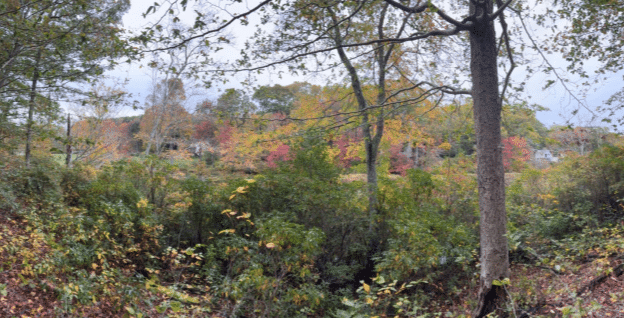
Throughout the event, high school students Emerson Coker, Zoe Womack and Weston Taylor explained their reasons for joining the ECOS Club.
“I really enjoy gardening and live near a preserve that I try to clean up after storms,” Womack said.
The members also expressed their ambitions for the club. Coker explained, “Currently we have a bunch of invasive species taking over and I think it’s important to take back and protect the ecosystem.”
On Oct. 10, the club visited the Lyme Old Lyme Food Share Garden in Town Woods Park. They were given a tour of the garden by Peter Hunt of the food share Board of Directors.
Hunt explained to the group the importance of the garden, where producing fruits and vegetables allows the volunteers to address the local food insecurity. The garden uses ecologically-based practices to ensure the soil and plants are protected. He also explained how the food share garden is entirely volunteer-run, with regular meetings. Anyone willing to help has the freedom to come when they are available to assist with managing the garden.
Afterwards, ECOS members were able to harvest the sweet potatoes that were growing there for donation to a local food pantry.
Karen Taylor has announced plans for the group to make posters and help organize the local Thanksgiving food drive in partnership with the Lymes’ Youth Services Bureau (LYSB). The food drive will take place Saturday, Nov. 14 and Saturday, Nov. 21, from 10 a.m. to 2 p.m., and Wednesday, Nov. 18, from 3 to 7 p.m. at Old Lyme Marketplace, 90 Halls Road.
For environmental activities relating to the Griswold Preserve, Craig Taylor said a variety of other projects and events have been proposed to the Old Lyme Land Trust. This includes a plan to connect the Griswold preserve to Upper Mill Pond within the next couple of years.
Related Articles
No Tricks, Just Treats on Lyme Street
Costumed crowds filled Lyme Street for Old Lyme’s annual Halloween tradition as Amtrak representatives resurrected a rail planning study that has long haunted residents.
Point O’ Woods Receives $107,500 Grant for Channel Dredging
The dredging will maintain fire department access to Long Island Sound and protect water flow to a nearby nature preserve, the association said.
After Years in Search and Rescue, Trooper Takes on New Role in Old Lyme
Connecticut State Police Trooper Garrett Boehm brings 18 years of law enforcement experience, including nearly a decade working with a K-9 partner.
Comments (0)
There are no comments on this article.