

In Old Lyme, Amtrak Pitches ‘Fresh Look’ at Rail Planning
An Amtrak official acknowledged lingering concerns over a nearly decade-old rail proposal and vowed to rebuild trust through public outreach before new recommendations are made.
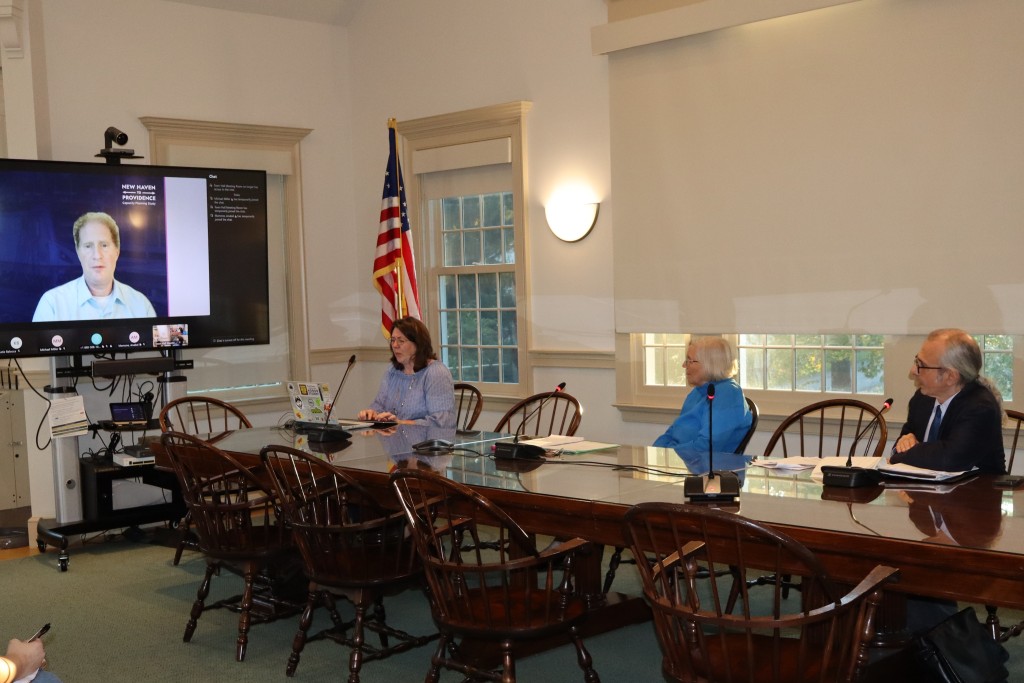
OLD LYME, CT – An Amtrak official on Monday stopped short of ruling out new rails through Old Lyme, but said a comprehensive study on the New Haven to Providence corridor will rely heavily on community input for whatever recommendations – if any – come out of it.
Joe Barr, Amtrak’s senior director for state partnerships and development, acknowledged the local uprising almost a decade ago when a federal rail planning effort known as NEC FUTURE proposed a high-speed rail bypass through Old Lyme’s historic Lyme Street.
Dubbed the Old Saybrook to Kenyon bypass, the route cut inland through southeastern Connecticut to the village of Kenyon, R.I., to reduce travel time from New York to Boston.
Barr attended the Board of Selectmen meeting virtually to present the new study and answer questions from selectmen and the audience. He said community support is critical to getting past the planning stages with the necessary funding to improve passenger service from New Haven to Providence, R.I.
He told selectmen at their regular meeting that the 2017 plan “was not well loved, to put it mildly.”
The sentiment was echoed during the roughly hour-long back-and-forth by Selectman Jim Lampos, who said the bypass “would’ve destroyed our historic district.”
Connecticut Examiner Editor-in-Chief Gregory Stroud joined selectmen at the table to question whether the new study would be bound by the same criteria – including targets for faster, more reliable service and the ability to accommodate more trains – that made the Old Saybrook to Kenyon bypass a logical choice for planners almost 10 years ago.
According to Barr, the difference this time around is public engagement.
“Our goal is to talk to you first so you don’t have to have a US senator threatening to tie themselves to the tracks to keep the project from happening,” he said.
Barr introduced the New Haven to Providence Capacity Planning Study as an outgrowth of the bypass proposal that was abandoned in 2017 in favor of further evaluation.
He described the study as a “fresh look” at the original NEC FUTURE performance goals that revolved around improving speed, capacity and reliability while addressing long-term impacts of extreme weather events.
He said planners need to hear from the public before they develop a “long list” of potential improvements, which will eventually be narrowed to a short list and then a preferred alternative.
“It’s just so hard to know, you know, again, if we’re even going to come out of the other end of this with something meaningful,” he said. “And if we’re so lucky to manage to do that, then I’m happy to try to figure out, ‘OK, how do we make this work within the parameters of NEC FUTURE?’”
Barr said it is unlikely the study will produce a single major project like the Old Saybrook to Kenyon bypass that proved so controversial the first time around.
Instead, the study could identify a series of improvements that could be phased in over time.
“We don’t know how it’s going to start, we don’t know how it’s going to end,” Barr said. “The challenge in front of us is to try to work with all of you to make sure we can come up with something that we can all feel good about.”
The study is being conducted in collaboration with the Connecticut Department of Transportation, Rhode Island Department of Transportation, Massachusetts Department of Transportation and Massachusetts Bay Transportation Authority, Federal Railroad Administration and Northeast Corridor Commission.
He also identified a Public Advisory Committee made up of residents representing interests across the municipal, business and tribal communities in Connecticut and Rhode Island.
The group includes Old Saybrook First Selectman Carl Fortuna along with representatives of Mashantucket Pequot Tribal Nation, the Mohegan Tribe, Yale University, the Eastern Connecticut Chamber of Commerce, Pfizer and Electric Boat.
Barr identified Fortuna as a key point of contact for municipalities throughout the process.
“The intent there is not that he is just representing Old Saybrook,” he said.
The process includes pop-up events and open houses where project officials can speak informally with people to gauge their thoughts and answer their questions. Previous pop-ups were held at Rocky Neck State Park in East Lyme in August and at the Old Mistick Village Garlic Festival in September, with one scheduled on Oct. 31 at the traditional Trick or Treat event on Lyme Street in Old Lyme.
Barr credited First Selectwoman Martha Shoemaker with inviting him to Monday’s meeting to help address residents’ concerns.
Community Concerns
Lampos told Barr the study raises serious concerns in an area where the specter of high-speed rail looms large.
“And the expectation, not only the fear, but the expectation, is that if we had high-speed rail coming somewhere along the coast, it again would just be a destructive element and not something that would help us,” he said.
Citing inhospitable local geology that would require significant blasting, he suggested planners look outside the shoreline corridor to defunct or underutilized tracks farther inland.
He pointed to the former Air Line Railroad corridor that spanned New Haven to Windham in the 19th and 20th centuries before the sections east of Middletown were abandoned. Much of the eastern portion has since been incorporated into Air Line Trail State Park from Portland to Thompson.
Lampos on Wednesday said he didn’t think there’d be a public appetite for turning the Air Line Trail Park back into rail service and clarified he was mostly referring to the portions of the old Air Line Railroad currently operated by the Providence and Worcester Railroad for freight.
The selectman also urged Barr to consider rail improvements that would benefit shoreline communities rather than sending trains through them as quickly as possible.
“What we need here is more commuter rail,” he said.
He noted that Old Lyme, East Lyme, Waterford and Groton at one time each had their own train stations, which he said could be restored as part of expanded Shore Line East service.
Shore Line East is owned by the state DOT in partnership with Amtrak.
Lampos, who lives in the Sound View section of Old Lyme and operates a restaurant in Groton, described the advantages of the kind of commuter service that used to exist in the area.
“At my house, I could look out my window and see where the old Lyme station was. At my restaurant, I could look out my window and see where the Groton station was,” he said. “So theoretically, years ago, I could have taken the train to work very easily.”
Barr reiterated “Everything’s on the table at this point.”
He said identifying a path for the high-speed Acela trains, which he acknowledged are probably not going to stop between New Haven and Providence, could free up room on the rail line for more local service.
“We need to look more broadly and see what we can come up with that people might be interested in, and try to come up with win-win scenarios where there are benefits and not just impacts,” he said.
Barr, who has become familiar with the area as a resident of New London, told selectmen he has his own questions about the original study.
“I look at that and I’m like, ‘there’s just some not great ideas in this,’” he said, adding that much of the Old Saybrook to Kenyon proposal “doesn’t actually work that well” on its technical merits.
But “the past is the past,” according to the Amtrak official – and now it’s time to rebuild trust.
“We’re not going to agree all the time, but we want to try to make sure that you know that we really are trying to come up with something that folks can feel good about,” he said.
Process Questions
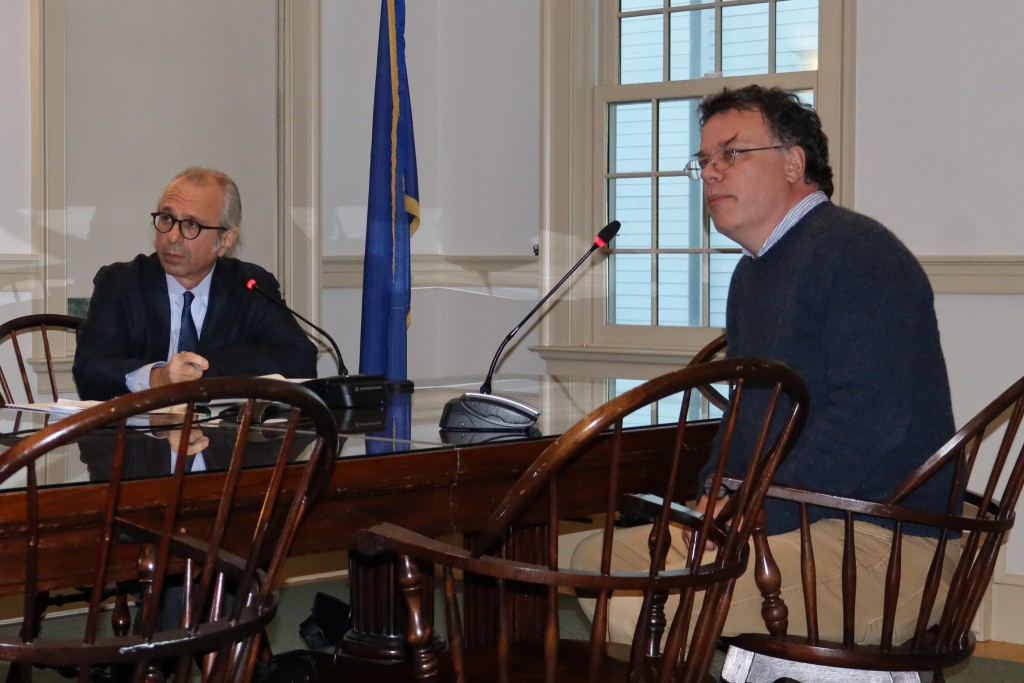
Stroud after the meeting acknowledged the Connecticut Examiner exists in part because of his involvement at the grassroots level in opposition to NEC FUTURE, when he learned firsthand about the difficulties small towns can have navigating large federal processes.
He founded the online news outlet in 2019.
He said his goal is to take significant issues and lay them out at the local level so readers can understand what’s happening.
Stroud said he’s wearing a different hat in the discussion now that he’s editor-in-chief of a statewide publication. While the role “may take on some advocacy” as the situation develops, he is currently focused on getting the facts.
He said providing the public with project information is critical, as is trying to communicate local issues to Amtrak so they can better understand the impact on shoreline towns.
His big question remains whether planners are still bound by the goals for faster, more efficient service that drove the original NEC FUTURE route selection.
“They chose the previous route, not because they wanted to damage Old Lyme, but because they needed a way to meet those metrics,” he said.
If the same criteria are still in play, he said it could be difficult to develop a route that does not affect Old Lyme “or at least some towns” along the shoreline if the impact is shifted from one community to another.
He reiterated a point first raised by Lampos about insufficient representation on the advisory committee composed of municipal, business and tribal leadership, with Fortuna as the only local leader from Connecticut and no environmental interests represented.
Stroud noted that Fortuna came out in opposition to the bypass and its effects on shoreline communities, but added the proposal would have had little impact on Old Saybrook.
“He was speaking in solidarity,” Stroud said.
Stroud emphasized the need for Amtrak not only to listen to residents, but also to provide answers.
He recalled a public forum attended by Amtrak officials in 2017 for residents of Charlestown, R.I., who were facing similar impacts on the other side of the border. But he said people in Old Lyme didn’t have the same opportunity.
His main concern revolves around the lack of specific protocols for taking public comments and responding to them amid a focus on conversational pop-up events and open houses.
“We want to avoid an informal process with formal ends,” he said.
Author

Related Articles

Talking Transportation: A Rumble Mumble Grumble
As one Connecticut mayor pushes back against plans for centerline rumble strips, columnist Jim Cameron weighs the safety benefits against noise concerns.

First Responder Ride Honoring Fallen 9/11 Firefighters to Pass Through Old Lyme, Sept. 8
A 343-mile cycling ride honoring the 343 firefighters killed on Sept. 11 will pass through Old Lyme along Route 156. Residents are encouraged to cheer riders along the route.
Sound View Debate in Old Lyme Sends Beach Party to New London
A longtime Sound View gathering is moving to New London after officials raised concerns about loud music. One selectman is calling the response unwelcoming.
Comments (0)
There are no comments on this article.