

DEEP Gives Old Lyme Tepid Approval to Test the Waters on Sewer Alternatives
Selectman Jim Lampos wants to explore advanced septic systems in Sound View, but DEEP says the town must also consider connecting to the existing sewer project.
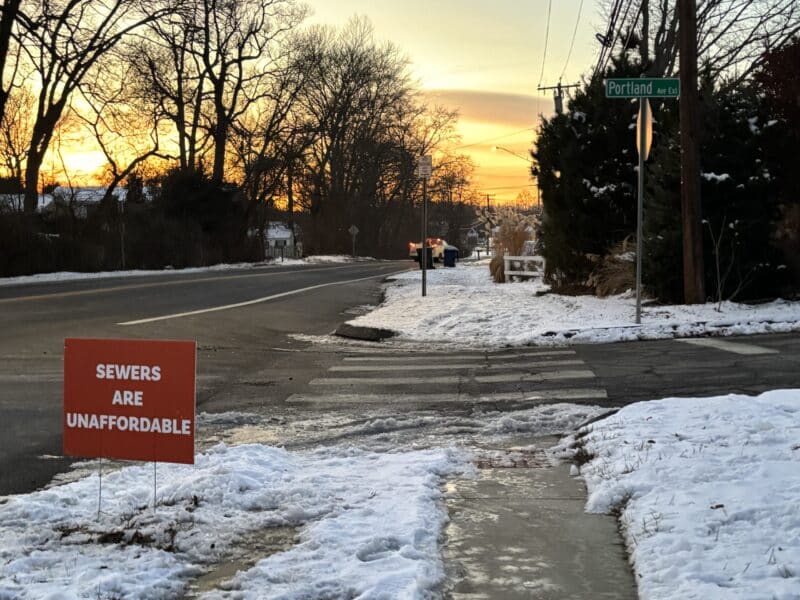
OLD LYME, CT – After Old Lyme voters rejected a request for additional sewer funding in Sound View Beach, a local selectman said state environmental officials have “opened the door” to exploring alternatives to sewers.
At this week’s Board of Selectmen’s meeting, Selectman Jim Lampos said the state Department of Energy and Environmental Protection (DEEP) has agreed to a process for evaluating wastewater options, including advanced septic systems.
Lampos acknowledged the state continues to favor sewers.
“But they did give us a path to drafting an alternative sewage system for Sound View,” he said.
In an Oct. 9 letter to First Selectwoman Martha Shoemaker and Lampos, acting DEEP Commissioner Emma Cimino said the town must enter into a binding agreement with the agency, known as a consent order, that establishes the terms and timeline for a “cost-effectiveness analysis of all wastewater options.”
The letter was a response to two meetings between Lampos and DEEP officials since April, according to the selectman. That’s when he pitched a new plan for Old Lyme: Inspect the roughly 200 septic systems in Sound View, then update or replace any that don’t meet environmental standards.
Lampos’s proposal emphasized residents’ willingness to pursue a comprehensive wastewater strategy. He said a “do-nothing” approach was never the intent.
Cimino in her letter acknowledged the town’s commitment to addressing the issue.
“To demonstrate this commitment in good faith, we agree that the Town should enter into a consent order with DEEP by the end of 2026 to outline the process for selecting a viable approach for addressing pollution from septic systems,” she said.
The state has long held that sewers are the most practical solution for addressing pollution of groundwater and Long Island Sound by local septic systems. For just as long, shoreline residents responsible for installation have balked at the cost.
Cimino said the final analysis must be submitted for state approval by the end of next year, with the most cost-effective option going to Old Lyme voters for authorization by June 30, 2028.
Almost a decade ago, the private beach communities of Miami Beach, Old Colony Beach and Old Lyme Shores signed their own consent order with the DEEP to build sewers. The Sound View Beach area, which is under the town’s jurisdiction, joined the project voluntarily but dropped out in December after the failed townwide vote.
The roughly $20.5 million Sound View sewer project had been criticized by residents there as too costly, even after a state forgivable loan and Clean Water Fund assistance promised to cut the local expense by about half.
The state emphasized any analysis must consider the option of connecting to the sewer project moving forward in the private beach communities.
The agency said the town may qualify for assistance from the state-administered Clean Water Fund to pay for planning and investigative work if it competitively selects an engineering firm and obtains DEEP’s approval of the proposed scope of work.
Central to Lampos’ proposal is new groundwater testing, which addresses a long-standing complaint of Sound View residents that the state is relying on old data to show there’s a pollution problem emanating from local septic systems.
The state continues to maintain that new groundwater samples alone cannot disprove previously documented pollution.
DEEP’S Position
Cimino’s letter emphasized sewers remain the “most cost-effective and technically sound solution to address documented pollution” based on conditions in Sound View.
She cited a 2017 study by Woodard and Curran, commissioned by the town and subsidized by the Clean Water Fund, that documented pollution in the area. Previous monitoring found bacteria in nearly a quarter of the drinking water wells tested in the area, according to the letter.
“Any additional groundwater sampling cannot be used to disprove the presence of pollution in Sound View since different groundwater sampling methods and temporal variables can cause pollution levels to fluctuate or appear differently at the exact same location and time,” she wrote.
Cimino said the agency cannot “say with certainty” whether current factors – including a decline in the number of people occupying Sound View homes and local efforts requiring homeowners to pump out their septic systems more regularly – will continue.
“A comprehensive assessment must take into account groundwater quality data, as well as other overall site constraints and considerations, to make the determination whether a community pollution problem exists or can be reasonably anticipated now or in the future,” she said.
Cimino noted the town of Old Saybrook moved away from plans to upgrade conventional septic systems in some neighborhoods because installing advanced systems capable of removing nitrogen would be a costly project on difficult terrain.
Sound View faces similar conditions, including shallow groundwater, dense development and highly permeable soil, according to the commissioner.
Old Saybrook is now exploring a community system that would collect wastewater through sewers and transport it to an off-site location for treatment in the ground, she wrote.
Lampos Makes His Case
Lampos on Monday called for charting a new course when it comes to cleaning up Long Island Sound more effectively and for less money.
He pointed to programs in Massachusetts, New York and Rhode Island that use advanced wastewater technologies and offer financial assistance for septic upgrades.
“Sound View could be a model that could be replicated in other areas that sewering is impractical or too expensive,” he said.
He said he worked with David Potts, an environmental scientist and president of the Old Saybrook-based Geomatrix advanced wastewater treatment company, to develop his recommendations.
The proposal envisions a comprehensive program of inspections, groundwater monitoring and system upgrades, with the goal of reducing nitrogen entering Long Island Sound. It also suggests exploring shared leach fields and other community-based septic approaches.
Lampos characterized his discussions with the DEEP as respectful. He said a representative with the agency indicated that the state was approaching the issue with a clean slate and all options on the table.
Shoemaker said she met with the agency twice after the referendum and ultimately asked Lampos to present his ideas because she believed he could explain them more effectively.
“I handed it to Jim to present his ideas to them,” Shoemaker said. “That’s how we got here.”
Lampos noted the agency did not accept his proposal as written, adding he had not expected it to.
“We’re going to have to have additional discussions with DEEP and we’ll see if we can find a middle ground that we can pursue,” he said.
Author

Related Articles

Marx Eyes Broader Housing Protections and Relief for Families in 20th District
State Sen. Martha Marx, D-New London, discusses psychedelic therapy for veterans, eviction protections and the equal time dispute that took her opponent off the air.

Lee Elci Talks Politics, Policing and Personal Freedom Off the Air
After more than two decades on the radio, Lee Elci wants to be a voice in Hartford for lower spending, limited government and a shift away from progressive politics.

Ferraro Aims to Return to State Office
Charles Ferraro, a former state representative, is challenging Norm Needleman on housing, energy costs and local control.
Comments (0)
There are no comments on this article.