

Report Shows Steady Improvement in Long Island Sound Water Quality
The Eastern Basin of Long Island Sound, which includes Old Lyme and the Connecticut River estuary, earned a perfect 100 in Save the Sound’s 2025 Report Card, up from 99.
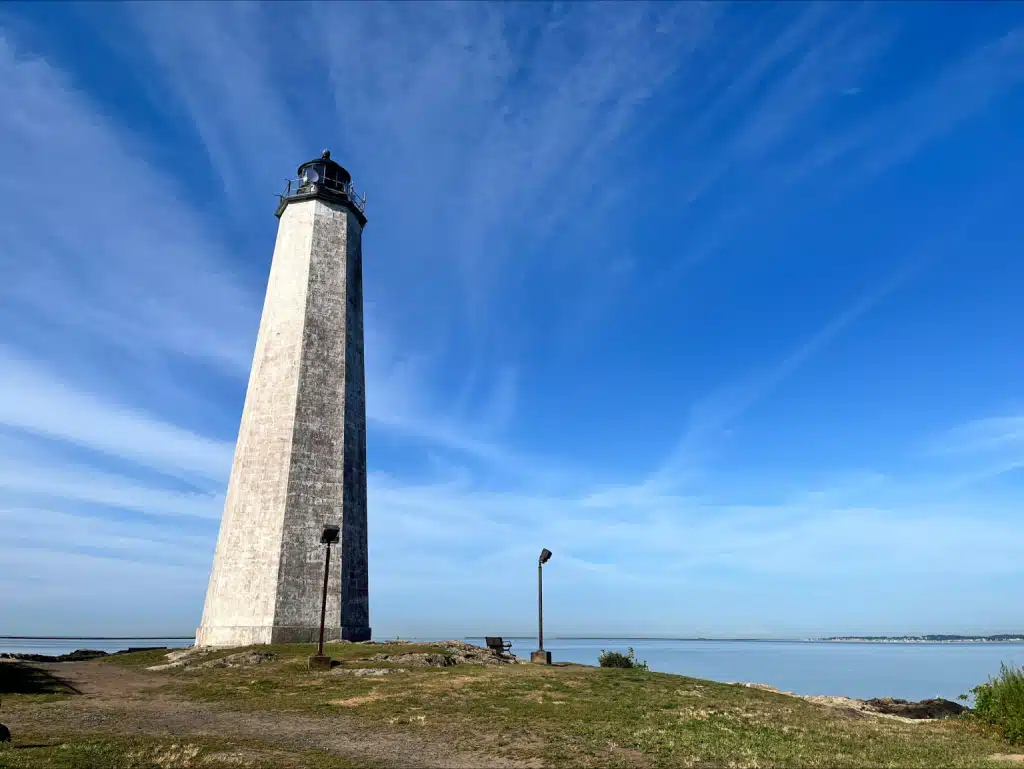
Billions of dollars spent on wastewater treatment and other infrastructure upgrades in Connecticut and New York have resulted in apparent improvements in Long Island Sound’s water quality, according to a report from the ecological nonprofit Save the Sound.
Published every two years, the group’s report divides Long Island Sound into five segments: the eastern, central and western basins that cover the widest portions of the Sound between New York and Connecticut, and the western and eastern narrows around lower Fairfield County, Westchester County and New York City.
The three basin segments all received “A” grades in the latest report, which relied on data from water samples taken in 2025.
The eastern narrows received a “B” grade for the second consecutive report and the western narrows — the smallest by total area, covering the waters directly around New York City — rose from an “F” grade to a “D,” for the first time since Save the Sound began publishing its report in 2008.
“It’s a remarkable success story in that the investments paid dividends, the water quality is improving,” said Peter Linderoth, Save the Sound’s director of healthy waters and lands.
Still, he and other officials said Tuesday that Long Island Sound continues to face challenges from climate change, coastal development and occasional overflows from combined stormwater and sewer systems that can send millions of gallons of untreated wastewater flowing into rivers and, eventually, the Sound.
“It could take time,” to address lingering points of concern, Linderoth added.
The report also published letter grades for dozens of smaller inlets, bays and other bodies of water around the Sound. Of the 28 sites within Connecticut that were measured, 19 recieved “A” or “B” grades.
Researchers looked at several key indicators from water samples in their grading rubric, including measurements of dissolved oxygen, organic carbon, populations of phytoplankton and water clarity. Samples taken from harbors were also tested for oxygen saturation and levels of seaweed — which, in moderate amounts, is typical of healthy ecosystems, while too much seaweed can be a sign of of nitrogen pollution.
Water sampling in the open-water areas of the Sound was conducted by the Connecticut Department of Energy and Environmental Protection, the Interstate Environmental Commission and the New York City Department of Environmental Protection. Samples from smaller coastal areas were taken by over a dozen partner organizations working with Save the Sound as part of the group’s Unified Water Study.
At a press conference to unveil the report’s findings Tuesday at Weed Beach in Darien, officials credited “billions” of dollars in state and federal investments — particularly on fixing antiqued wastewater treatment systems — with helping to improve the heavily-polluted Sound’s reputation.
Approximately $1.2 billion has been spent in Connecticut alone over the last 20 years to address the problem of combined sewer overflows, according to DEEP.
“Save The Sound’s report reflects the improvements to the quality of Long Island Sound waters as a result of the investments the state of Connecticut has made through its Clean Water Fund, and the General Permit for Nitrogen Discharges to reduce nutrient pollution from the state’s wastewater treatment facilities,” DEEP spokesman Bill Flood said in a statement Tuesday.
The U.S. Environmental Protection Agency also provides funding to support conservation projects in both Connecticut and New York through its Long Island Sound Program. Overall funding for that program reached $40 million in the most recent fiscal year, up from just $1 million a decade ago.
U.S. Rep. Jim Himes, D-4th District, said support for conservation projects in and around Long Island Sound has historically been bipartisan. He said that continues to be the case under current EPA Administrator Lee Zeldin, who is a former Republican congressman from Long Island.
“The [Trump] administration has taken a particularly aggressive stance in certain areas, like wind,” Himes said. “But I haven’t seen that same animus out of this administration with respect to conservation projects. For the moment, we’re in — I think — pretty good shape.”
In 2025, Zeldin’s EPA closed the agency’s dedicated Long Island Sound office in Stamford as part of a wave of government cost-cutting. Staff members were reassigned to the agency’s regional offices in New York City. An EPA spokesperson said at the time there were no impacts to the work of the agency’s Long Island Sound Program.
Also last year, officials with the Long Island Sound Partnership reported that areas of hypoxia — where low levels of dissolved oxygen kill off fish — had reached their lowest levels since data collection began in the 1980s. However, the Save the Sound report noted that rising water temperatures in the Sound due to climate change could reverse that trend, as warmer water holds less oxygen.
Bill Lucey of Save the Sound said Tuesday that while there had been some “ups and downs” in dealing with the current Trump administration, work improving water quality has continued unabated.
“In the future, it’s going to be wide open for fish consumption, shellfish consumption, no more closure days for swimming,” Lucey said. “We’re so much farther along than we were 15 years ago.”
This article first appeared on CT Mirror and is republished here under a Creative Commons Attribution-NoDerivatives 4.0 International License.
Comments (1)
Comments are closed.
Related Articles

Old Lyme Zoning Survey Finds Support for Flexibility, Not Major Change
Residents want to preserve Old Lyme’s small-town feel by allowing accessory apartments, limiting data centers and ensuring a say in the future of Halls Road.

Berke Wins as Campbell Falls Short in Third Region 18 School Board Bid
Democrat Devin Berke defeated Republican Brandy Campbell in Tuesday’s special election, extending the Democratic Party’s hold on all nine seats.

Lyme’s Lisa Holmes Takes Farmers’ Stories From Field to Film
A documentary from Lyme resident Lisa Holmes digs into the challenges facing independent farmers and the changing landscape of American agriculture.
Good news that despite the DEEP discharges of millions go gallons of partially treated sewage each year, LIS is in such good condition. Yet the DEEP continues to mandate sewers with no testing or evidence that the Old Lyme beach communities are polluting LIS.
Problems with individual sites should be resolved by the owner of the property. Usually the most simple systems are the most reliable; such as on site septic systems using well designed and proven systems.
Sewer systems are inviting problems and ensuring that when there is a problem it becomes a major one impacting many properties. Exporting water will prove to be one of those issues. Then there are mechanical failures; pumps fail and cut down the entire system. Severe weather causing flooding impacts the sewers as well.
Anyone recall the last time we had a beach closure in Old Lyme? Not for decades yet in New London and Waterford they occur every year due to the sewer treatment plant in New London.