

Old Lyme Sets Ground Rules for New State Housing Law
Amid a state law allowing housing in commercial zones without a public hearing, the Zoning Commission approved regulations governing how it applies locally.
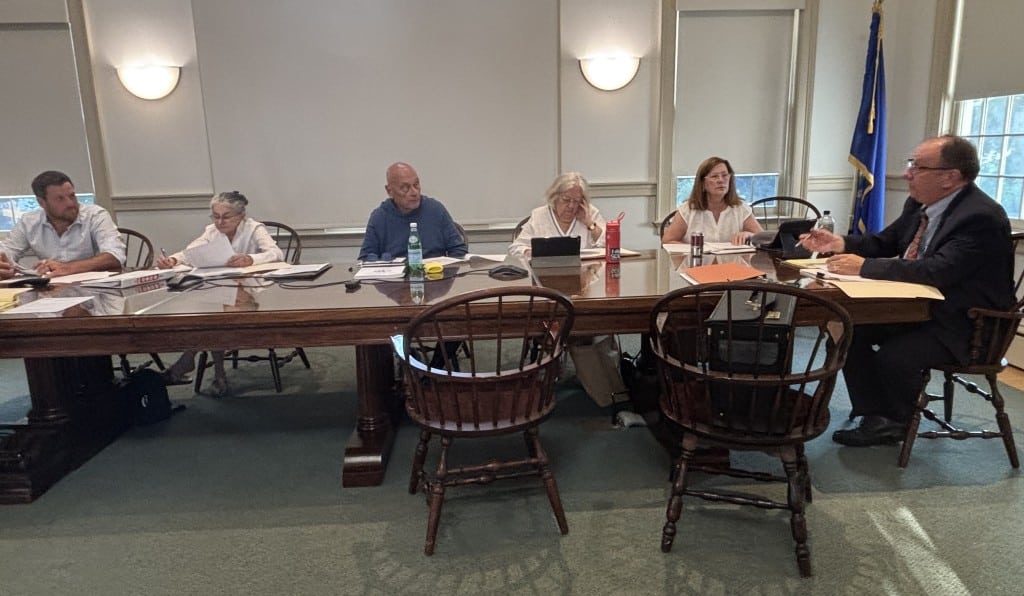
OLD LYME, CT – In a state where housing advocates and lawmakers say demand far outstrips supply, the Old Lyme Zoning Commission on Wednesday moved to restrict key provisions of a new state law aimed at increasing housing production on the same day it took effect.
The commission unanimously approved a package of zoning amendments that will determine how the state statute known as Public Act 25-1 is implemented locally.
A planning consultant, land use attorney and several commission members said the changes were needed to preserve local oversight of development decisions, even as several speakers urged the town to do more to address housing needs in an increasingly unaffordable market.
Matthew Willis, the zoning attorney for the town, characterized the state law as a significant erosion of municipal authority.
“The legislature is clawing back your powers,” Willis told commissioners. “That’s what’s really going on.”
Still, he acknowledged the town needs to do something. That’s because amending local regulations to reflect the new law is the only way to impose local standards on development projects permitted under the measure.
Despite his misgivings about the law, he urged the commission to adopt the recommended regulation changes.
“It’s clear that you’re going to be having less powers, and this gives you some of that back,” he said.
He said developers are ready to submit applications across Connecticut based on the measure requiring cities and towns to allow housing in commercially zoned areas without a public hearing.
“I know that in some towns, there are people knocking on the door waiting to do something that the town zoning commission may not like,” he said.
To comply with the law, the commission approved regulations allowing two- to nine-unit housing developments in commercial districts, but only when the building includes retail, office, or other non-residential uses.
The state law allows stand-alone residential and mixed-use projects, though municipalities may choose just one category. Qualifying developments are defined as “middle housing,” falling between single-family homes and larger multifamily buildings.
Consultant Francisco Gomes of the planning and design firm IMEG, which helped draft the regulations through a RiverCOG planning assistance program, said the language takes a conservative approach to meeting the state’s requirements while remaining “largely consistent” with local zoning regulations.
He said the downside of having no local regulations is that municipalities must still comply with the state law, including allowing middle housing or mixed-use development in commercial zones without added local standards.
The amendments also address a state provision barring municipalities from requiring off-street parking for residential developments of 16 or fewer units, with limited exceptions.
The law comes amid long-standing criticism from housing advocates of “exclusionary zoning,” local regulations that limit multifamily housing through density or height restrictions. Critics say such rules can make projects less financially feasible by limiting how costs are spread across units.
Willis, during the commission’s deliberations, warned that communities across Connecticut are being left with fewer tools to shape development within their borders. He said the state’s zoning enabling law – which delegates zoning authority to municipalities – is “being eviscerated” by lawmakers.
He pointed to the adoption of the state law in November, and the July 1 implementation of the middle housing and parking provisions, as evidence.
“I think this is just too much too soon,” Willis said. “And I realize housing’s important, right? But you don’t want to have a situation where all of a sudden you look around and you go, ‘Wow, this isn’t Old Lyme anymore.'”
The commission ultimately decided to approve Gomes’ recommended language largely as written in order to get the regulations on the books. Members said they will revisit the regulations this summer as part of a broader overhaul of the local zoning regulations, which is ongoing for the first time since 2008.
Among the issues they vowed to discuss are whether to require developers to set aside housing units for households in lower income brackets and to allow residential-only buildings in commercial districts.
Commissioner Denise Savageau called the issues part of the bigger discussion that should occur “sooner rather than later.”
In the meantime, commission Chair Paul Orzel described the regulations as “a good initial firewall” to protect the town from what members described as a vague and one-size-fits-all approach by state lawmakers.
The amendments, which take effect July 6, establish regulations for middle housing developments in commercial districts, specify that the town’s existing site plan approval process constitutes the “summary review” process required by state law and create two parking management districts where parking requirements can still be imposed.
More Discussion Needed
Though not required under state law, the commission required that at least one out of every four units in a qualifying development be deed restricted for at least 30 years at rates affordable for households earning less than 80% of the area median income.
Based on current state Department of Housing income and rent limits, 80% of the region’s $129,200 median income for a four-person household equates to $103,360. The monthly rent for a family at that income level cannot exceed $2,236 for a three-bedroom unit to be considered affordable.
Affordable Housing Commission Chair Sheila Riffle during the public comment portion of the hearing called for the commission to make the affordability requirements more favorable to lower-income households rather than postponing the discussion until later this summer as part of the regulation rewrite process.
Riffle supported a proposal submitted by former commission member Michael Fogliano that would set aside some units for households earning 60% of the area median income rather than 80%.
“I think it’s a really reasonable request,” Riffle said.
Citing findings from the town’s 2022 Affordable Housing Plan, she noted that only 1.7% of Old Lyme’s housing stock was affordable under state definitions at the time.
“We really do need to focus more on the mixed housing, or larger-scale housing in general,” she said.
Riffle pointed to growing housing insecurity among older adults.
“There are many people who I know would love to stay in Old Lyme, and it’s getting harder and harder to afford to do so,” she said.
Commission members also considered whether developers should be able to propose residential-only buildings as well as mixed-use buildings.
The Old Lyme Planning Commission in an advisory opinion earlier this month recommended that both options be allowed in all commercial zones except for Halls Road, where they determined only mixed-use development is appropriate.
Resident Jeff Hartmann, the former CEO of Mohegan Sun Casino and a current multifamily housing developer, agreed mixed-use developments should not be singled out.
He asked commission members to “embrace the spirit” of the state law, which he said was designed to encourage housing.
Tying residential housing to first-floor commercial development will bring more commercial ventures to locations already struggling with vacancy on Halls Road and at Sound View Beach, according to Hartmann.
“Standard retail real estate dynamics will follow: rents will drop, vacancy will rise, and existing merchants will face new subsidized competition for a customer base that is not growing,” he wrote in a memo accompanying his public testimony. “The mandate is well-intentioned — it is meant to preserve commercial character – but its likely effect is to accelerate the decline of the very corridors it was designed to protect.”
He asked commission members at the meeting to focus on expanding housing opportunities for people struggling to remain in or move to Old Lyme.
“For our longtime residents who are looking to stay in town, for our new residents – that new teacher that’s going to start in August at Mile Creek, the fireman that wants to live in town, the young student … who’s looking for a place to live and doesn’t want to live with his parents any longer at age 26 – let’s build some housing,” he said.
Gomes acknowledged many Connecticut communities have already chosen to allow both mixed-use and residential-only developments under the new law.
He said about half of roughly 16 communities he has worked with in the RiverCOG region and beyond have opted to allow stand-alone residential and mixed-use development in commercial districts, while the remainder have limited projects to mixed-use.
He suggested Old Lyme could revisit the question later after residents have had the chance to weigh in through public workshops and continued commission debate as part of the regulation rewrite.
“This amendment will not cast this matter in stone,” Gomes said. “You as a commission can revisit this issue, make further adjustments.”
Author

Related Articles
Old Lyme Zoning Survey Finds Support for Flexibility, Not Major Change
Residents want to preserve Old Lyme’s small-town feel by allowing accessory apartments, limiting data centers and ensuring a say in the future of Halls Road.

Berke Wins as Campbell Falls Short in Third Region 18 School Board Bid
Democrat Devin Berke defeated Republican Brandy Campbell in Tuesday’s special election, extending the Democratic Party’s hold on all nine seats.

Lyme’s Lisa Holmes Takes Farmers’ Stories From Field to Film
A documentary from Lyme resident Lisa Holmes digs into the challenges facing independent farmers and the changing landscape of American agriculture.