

Cemetery Talk Reveals Story of Trailblazing Doctor Buried in Hadlyme
Alice Hamilton, the first female faculty member at Harvard University and a pioneer in workplace health and safety, is buried at Hadlyme Cove Cemetery with her family.
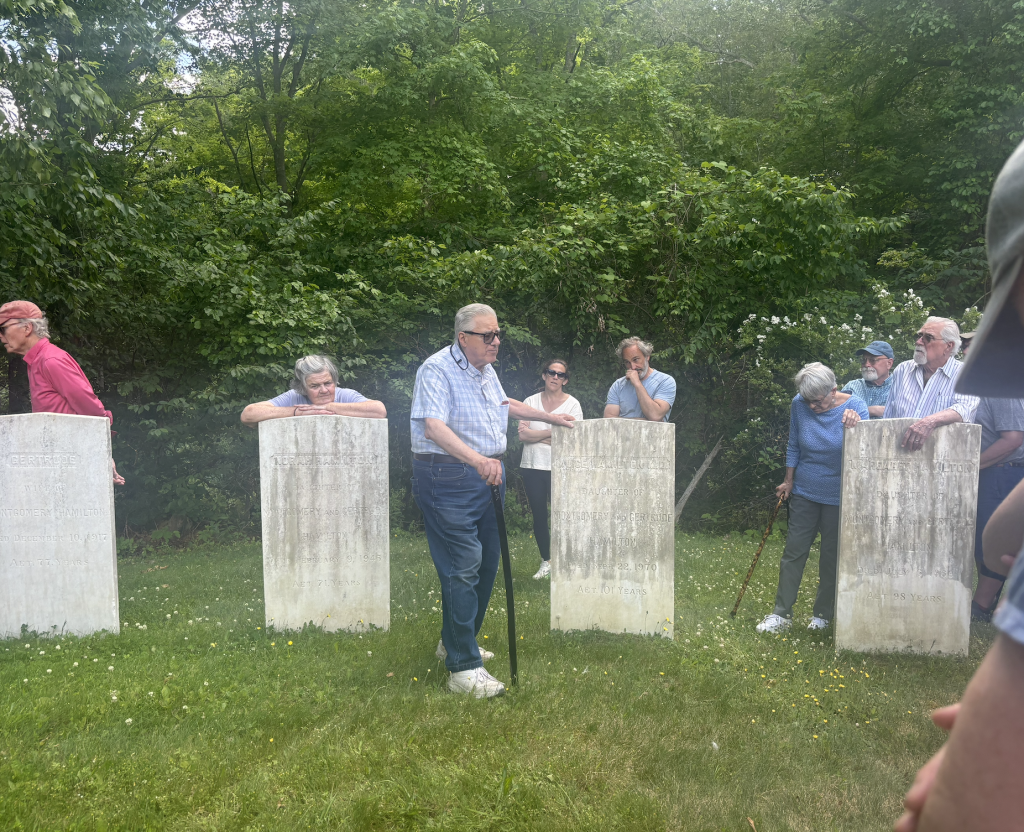
LYME, CT – This past Sunday afternoon, dozens of cars lined the typically idle Ferry Road with the promise of discovering stories hidden within the historically significant Hadlyme Cove Cemetery.
They left having learned that Alice Hamilton, the first female professor at Harvard Medical School, was buried there alongside her famous sister, writer Edith Hamilton.
A group of about 50 community members surrounded the entrance to the cemetery as local historian and storyteller Jim Leatherbee waited for the tour to begin.
“If These Stones Could Speak” was presented by Hadlyme Public Hall.
Leatherbee stood at the center of the circle of listeners with his arm resting on a cane he would later use to direct listeners’ attention and to navigate the rugged cemetery.
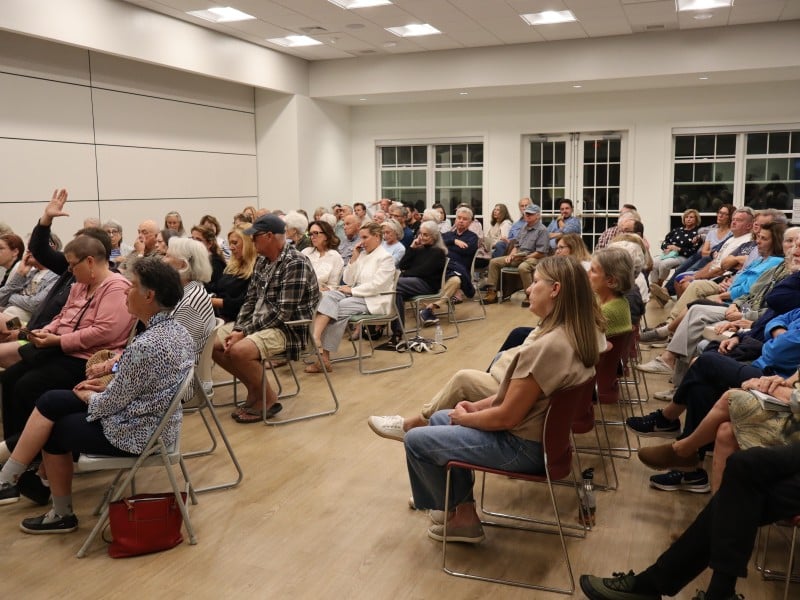
The group of listeners responded to Leatherbee’s storytelling with intense focus and participation, sharing relevant family connections and stories.
The tour wound through the cemetery with stops at significant graves, where Leatherbee would provide information accompanied by relevant town history and stories.
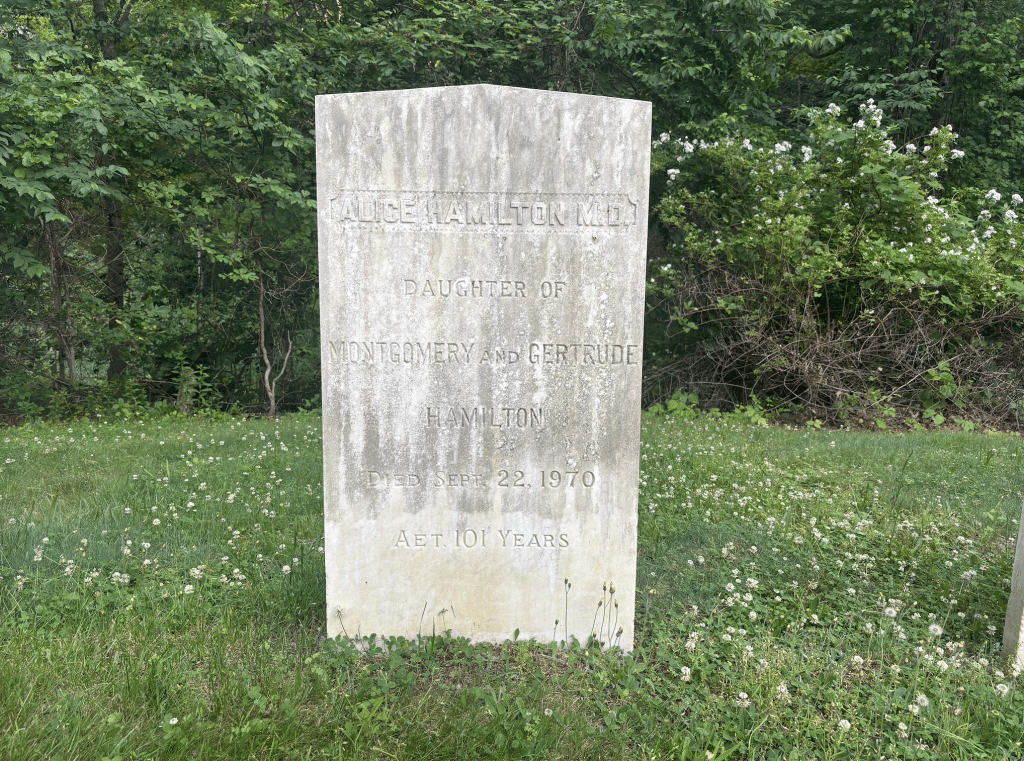
“I don’t know if any of you know about the Hamilton family, but Alice Hamilton was a nationally known…” Leatherbee began, trailing off as the group arrived at the site of the graves of four Hamilton siblings and their mother.
Janet Lemond, a retired environmental health and safety professional with the U.S. Environmental Protection Agency and an Alice Hamilton expert, filled in the blank.
“Doctor,” she said.
“Of what,” Leatherbee asked.
“Industrial hygiene, industrial toxicology, and occupational medicine,” Lemond said, adding that Alice Hamilton was also “the first female professor at Harvard University, even before women were allowed to attend.”
Leatherbee noted her influence was seen at the Hadlyme Post Office and beyond when the U.S. Postal Service issued a stamp in her honor. The Smithsonian National Postal Museum shows the stamp was issued for 55 cents in 1995.
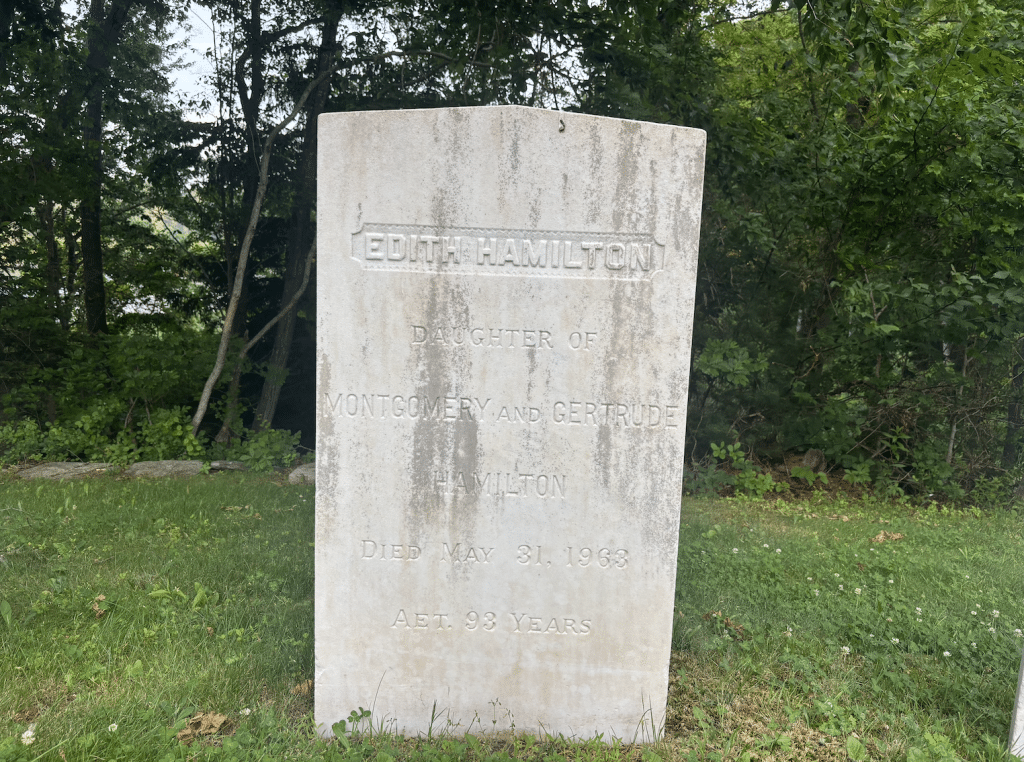
He described the Hamilton family as extremely progressive, citing involvement in the women’s suffrage movement in New York City and a focus on intellect and achievement. He shared that Alice Hamilton’s sister, Edith, is also buried in the family plot. Edith Hamilton was a graduate of Bryn Mawr College in Pennsylvania as well as Leipzig University in Germany.
In addition to her career in teaching, Edith Hamilton went on to write well-known Greek mythology books such as The Greek Way, published in 1930. Several people on the tour recalled being assigned Edith’s books in high school.
Lemond said Alice Hamilton retired to a house on Ferry Road in Hadlyme, and the rest of her family followed.
After the tour, Lemond provided more information about the Hamiltons’ upbringing in Fort Wayne, Indiana. She said their mother, Gertrude Hamilton (who is also buried in Hadlyme) urged her daughters to never marry, teaching them to prioritize independence and knowledge.
Lemond recalled a quote from Alice Hamilton’s memoir.
“‘Just rely on yourself,'” she recalled Gertrude Hamilton telling her daughter in the book. “You’ve got to make your own way.”
In Alice Hamilton’s early career, starting in 1897 after her graduation from the University of Michigan Medical School in 1893, she lived in Chicago in Hull House, which was a famous social settlement of progressives and activists serving the poor in Chicago.
She worked as the personal physician for Jane Addams, the co-founder of Hull House and the first female Nobel Peace Prize winner.
Alice Hamilton left Hull House in 1919 for an assistant professor role at Harvard Medical School.
Lemond used blunt terms to explain how Alice Hamilton was able to surpass Harvard’s centuries-long legacy of only hiring male professors.
“Because she was that good,” she said.
Lemond cited Alice Hamilton’s extensive research and teaching background in immunization studies, combined with experience treating and studying disease outbreaks in Chicago’s most underserved neighborhoods. She also noted that not many physicians specialized in the study of pathology and industry at that time.
Among Alice Hamilton’s most significant legacies was her research on labor ethics and workplace safety. Commissioned by Illinois Gov. Charles S. Deneen in 1910 to study industrial diseases, she spent a year investigating factory conditions, occupational hazards and failures in factory oversight. Her findings helped spur Illinois’ first workers’ compensation law in 1911 and influenced similar legislation in other states.
Lemond said her own grandfather was injured in New York City and was entitled to support while he was not able to work because of the legacy of Alice Hamilton’s 1910 study.
“I just wish more people knew about her life,” Lemond said. “If a man had accomplished just one of the things Alice accomplished in her life and he was buried here everyone would know who he was.”
Comments (3)
Comments are closed.
Related Articles

Labriola Calls for Common Sense Approach in 23rd District Run
The Old Saybrook treasurer is running for the 23rd District seat on a platform of affordability, local control and bipartisan cooperation.
Old Lyme Library to Lend Laptops to Eligible Residents
Libraries are partnering with the state to close the digital divide. The goal is to expand access to the tools people need to use important services online.
Old Lyme Zoning Survey Finds Support for Flexibility, Not Major Change
Residents want to preserve Old Lyme’s small-town feel by allowing accessory apartments, limiting data centers and ensuring a say in the future of Halls Road.
Before I lived in the Hadlyme part of town, I remember taking a dear friend of my (deceased)parents for a ride on the Ferry one day. As I was pounting out the wonderful colonial homes, she pointed to the house; saying, “I had tea there.” I inquired about the residents and was told, “It was the home of the Hamilton sisters, aunts (great aunts I’d imagine) of my husband, and we “called on them” one day. *That must have been in the 1930’s-40’s. Years later I learned more about the Hamilton sisters. By then, our friend had also passed away, or I would have asked more.
I keep wishing life would slow down and I’d learn about my incredible (and even every-day) neighbors before they pass.
I’m glad to see Alice Hamilton getting some well-deserved attention! Interested readers can learn more about her in “Remarkable Women of Old Lyme” by Jim Lampos & Michaelle Pearson. There are copies available at the Old Lyme Library.
Fascinating article. Alice Hamilton is a local and national treasure. How cool to know that she once lived here in Lyme.