

A View from My Porch: America’s Quarter Millennium – The Breaking Point
In the second part of this America 250-inspired series, Thomas D. Gotowka examines how Henry Knox’s “Noble Train of Artillery” changed the course of the Revolutionary War.
Libera nos, Domine.–Deliver us, O Lord,
Excerpt from “A Political Litany” by Philip Freneau (1775)
not only from British dependence, but also
From a junto that labour with absolute power,
Whose schemes disappointed have made them look sour,
From the lords of the council, who fight against freedom,
Who still follow on where delusion shall lead them.
From the group at St. James’s, who slight our Petitions,
And fools that are waiting for further submissions;
From a nation whose manners are rough and abrupt,
From scoundrels and rascals whom gold can corrupt.
From pirates sent out by command of the king,
to murder and plunder, but never to swing.
From Wallace and Greaves, and Vipers and Roses*,
Whom, if heaven pleases, we’ll give bloody noses.
*Captains and ships in the British navy, then employed on the American coast.
This is the second of my Views on the circumstances that led to the led to the creation of the Declaration of Independence, the “birth certificate” of the United States as a sovereign nation. In the last View, I reviewed how King George III and his government’s unrelenting imposition of new taxes and inflexible actions (peaking in 1774 with the Intolerable Acts) created significant unrest and opposition among the colonists, who were transformed from loyal Englishmen and women into American patriots and revolutionists determined to separate from Britain at any cost.
In this View, I consider how the British continued to test the mettle of the colonists in battle and how a brilliant and audacious mission led by Henry Knox impacted the course of the conflict. It has been cited by historians as one of the most daring logistical missions of the Revolutionary War.
The Massachusetts Provincial Congress: Delegates from across Massachusetts had gathered in Concord in October 1774 in open defiance of the earlier Massachusetts Government Act, a punitive measure imposed by the king in the Intolerable Acts, which had rescinded the Colony’s charter, limited its right to self-govern, and significantly expanded the authority of the royal governor. They formed what would be the first independent governing body in the colonies, and elected John Hancock as president. Releasing Boston from British control was an immediate priority, and the Congress passed a resolution in early April declaring that the “present dangerous and alarming situation required them to raise and establish an army for defense.” Local militias were mobilized across Massachusetts. Artemas Ward, a veteran of the French and Indian War, was appointed leader of the collective militia force. The colonial militia that pursued the British retreat from Concord had grown to 4,000 by the time the British reached the outer edge of Boston, as reinforcements had joined from villages along “Battle Road.” By June, 15,000 additional colonial militiamen had converged on the city. Most of these men initially came from the New England colonies, although companies of soldiers from Pennsylvania, Maryland, and Virginia had also been deployed to Boston.
The Siege of Boston: Action began in late
April, when the assembled Massachusetts militias surrounded the city in an effort to entrap the British. The militia operated armed boats that seized cargo, and prevented the delivery of supplies to the British garrison. The British force and militia engaged in a series of battles and skirmishes throughout the city and the harbor. On June 17, 1775, the militia was defeated at the Battle of Bunker Hill, although the high number of British casualties was especially striking.
Washington’s Arrival: General George Washington arrived in Cambridge in July 1775 and assumed command of the Siege. His immediate priority was to organize the roughly 22,000 militiamen gathered around Boston and shape them into a unified and disciplined Continental Army. He restructured the force into companies and regiments, established a chain of command, and developed supply lines in preparation for the anticipated lengthy operation. However, Washington’s forces lacked heavy artillery, which made offensive operations against British fortifications and ships anchored in the harbor nearly impossible. Fortunately, a substantial cache of artillery had been captured at Fort Ticonderoga on May 10, 1775, when colonial militia led by Ethan Allen and a still-faithful Benedict Arnold conducted an attack on the fort’s British garrison.
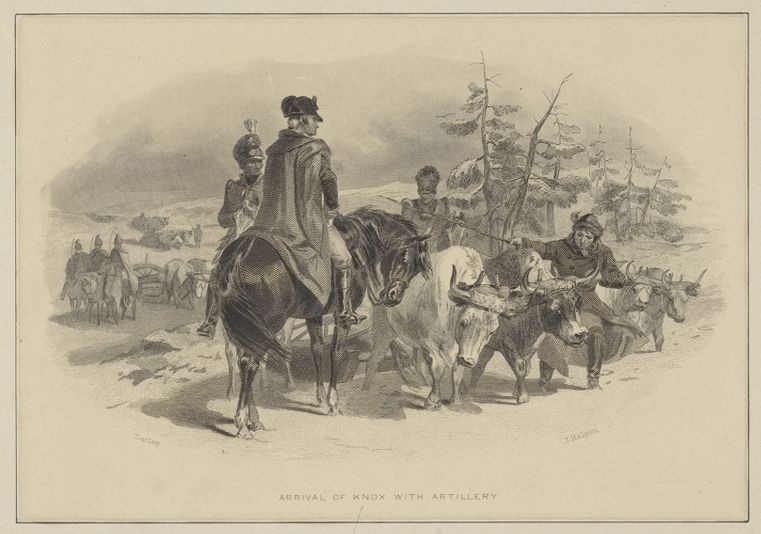
Henry Knox’s “Noble Train of Artillery”: In mid-November 1775, Washington authorized Henry Knox to retrieve the captured artillery from Fort Ticonderoga and transport it to the Continental Army encampment outside Boston. Knox was a member of the Boston Grenadier Corps, had witnessed the Boston Massacre, and served under General Artemas Ward at the Battle of Bunker Hill.
Washington also wrote to General Philip Schuyler in Albany and requested that he do everything possible to assist Knox. Schuyler commanded the Northern Department of the Continental Army, which was established in June 1775 by the Second Continental Congress to oversee military operations in northern New York and the surrounding areas.
On December 5, 1775, Knox and his brother arrived at the fort three weeks after leaving Boston. Knox chose 58 pieces of artillery for transport. Most were 12-or 18-pound cannons, but he also picked “Old Sow,” a 24-pound cannon that weighed more than 5,000 pounds (here pound refers to the weight of the projectile rather than the weight of the cannon). In total, Knox’s “noble train of artillery” carried an estimated 60 tons. With manpower provided by Schuyler and some local patriot farmers, the artillery was loaded onto three gundalows (flat-bottomed barges for transporting cargo).
On December 9, the three boats set sail for the southern end of Lake George, a distance of roughly 40 miles completed in about eight days. Knox’s journal indicates that ice had already begun to cover the lake. Knox and the team then secured the artillery to 42 sleds with runners and harnesses that allowed them to be pulled by teams of horses and oxen. Horses were essential for hauling the heaviest guns, which sometimes required eight animals per sled. Oxen were used for lighter loads or in areas where horses were less practical. Schuyler was able to provide the majority of the horse teams through militia and local supply networks. Local communities along the route provided significant support – farmers lent oxen, carpenters repaired sleds, and laborers hauled alongside animals on steep inclines.
On December 17, Knox and his team began the return leg of the expedition. The frozen Hudson River was a significant obstacle, and Knox had to cross it more than once. In early January 1776, after hauling the 60 tons of artillery and supplies through western Massachusetts, Knox finally reached Springfield and paused for rest and resupply. In late January, Knox reached Washington’s headquarters after traveling 56 days and nearly 300 miles from Fort Ticonderoga. Washington immediately ordered the guns emplaced on Dorchester Heights, a high ground commanding both the city and the harbor from the south, giving the Continental Army a decisive advantage.
The British Evacuation of Boston: Realizing that their position was now unsustainable, General William Howe, Commander of the British Army in North America, elected to withdraw his troops.
Washington realized that the American position at Dorchester Heights made a fight unviable and likely to result in heavy losses. Furthermore, Washington knew that a disorderly withdrawal might result in looting, burning, and destruction in the city, and signaled that his forces would not take retaliatory action. Howe, in turn, also indicated that he would not allow his troops to loot or destroy property. On March 17, 1776, 11,000 British troops and about 1,000 loyalists departed Boston by ship and sailed to the safety of Halifax, Nova Scotia. The successful delivery of the artillery not only ended the eight-year British occupation, but secured the first major American victory of the Revolutionary War. Had the Knox mission failed, the British would have retained control of Boston and the harbor, and the Continental Army’s position would have been far more precarious. Evacuation Day is celebrated on March 17 in Massachusetts.
Knox later rose to become the chief artillery officer of the Continental Army, accompanying Washington on most of his campaigns. He established training centers for artillerymen and manufacturing facilities for weaponry that were valuable assets to the army.
After the Revolutionary War, Knox continued to serve as Secretary of War under President Washington. He advocated for the building of a military academy at West Point and his proposal was approved by Congress in March 1802. He is also the eponym for Fort Knox in Kentucky, which is often associated with the United States Bullion Depository.
In my next View, I will consider the increasing resolve of colonial leadership that made the drive for independence and the drafting of the Declaration of Independence inevitable.

About the author: Tom Gotowka spent his career in healthcare. He will sit on the Navy side at the Army/Navy football game. He always sit on the crimson side at any Harvard/Yale contest. He enjoys reading historic speeches and considers himself a scholar of the period from FDR through JFK. A child of AM Radio, he probably knows the lyrics of every rock and roll or folk song published since 1960.
Author
Related Articles
Talking Transportation: The Drone Delivery Debate
Amazon wants FAA approval for up to 1,000 daily drone flights over North Haven and surrounding communities. Residents are pushing back.

On the Food Scene: Four Ways to Enjoy Apples This Fall
A chef, mixologist, barista and pastry chef share recipes inspired by this classic seasonal staple.
Talking Transportation: The Final Boarding Call
Jim Cameron revisits the airlines of a bygone era, from Mohawk (‘Mad Men,’ anyone?) and Braniff to Hooters Air, when flying was “fun and cheap.”