

Old Lyme Weighs Zoning Changes to Comply With New State Housing Law
The state is requiring towns to allow small multifamily or mixed-use developments in commercial zones without a public hearing.

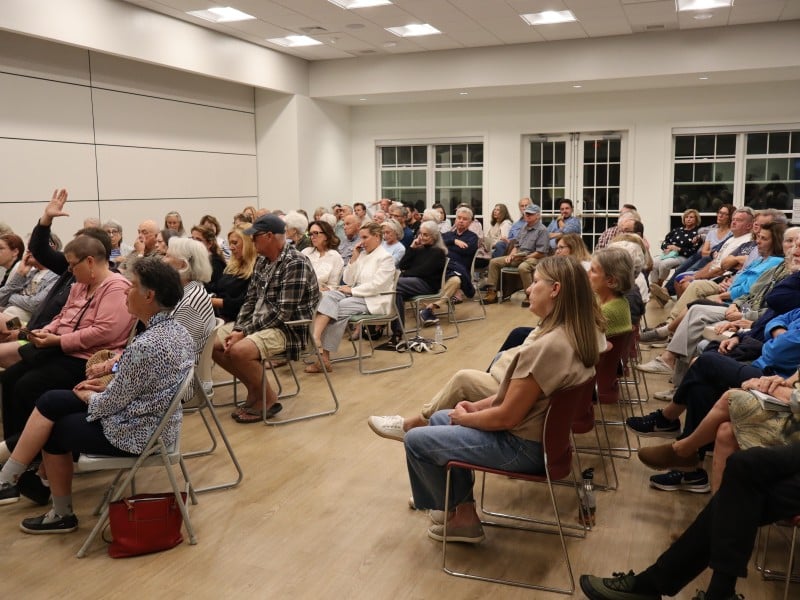
OLD LYME, CT – The Zoning Commission is preparing to amend its zoning regulations to comply with a new state housing mandate that limits local review and requires towns to allow small multifamily or mixed-use developments in commercial zones without public hearings.
The state law goes into effect July 1. Knapp said that date also happens to be the earliest the commission can change its zoning regulations due to statutory notice and public hearing requirements.
If approved immediately after the hearing, the altered regulations would go into effect July 18.
The proposed changes stem from a sweeping housing bill passed last year that requires municipalities to allow “middle housing” developments with 2 to 9 units or mixed-use buildings combining residential and commercial uses.
The National Conference of State Legislatures, a nonpartisan group that provides research and support to lawmakers, describes middle housing as a category of development that falls between detached homes and large multifamily developments in terms of scale. The group said such housing is missing in many communities because of zoning laws going back more than a century that prioritized single-family construction.
Francisco Gomes of the engineering and design firm IMEG Corporation – the lead consultant for a comprehensive rewrite of the town’s zoning regulations – on Wednesday provided the commission with draft language laying out his recommendation to allow mixed-use development rather than residential only.
Gomes said his firm and its land use attorney have interpreted the state law – which explicitly allows middle housing “or” mixed-use development, rather than middle housing “and” mixed-use development – to mean the commission can choose the type of development it wants to allow.
He said commercial zones in town were established to preserve space for economic development.
“And the required mixed-use development allows you to continue to do so in some capacity,” he said.
Knapp agreed, adding that allowing any residential-only construction could lead to a cascading loss of commercial space.
He said towns like Old Saybrook and Madison, which each have an expansive commercial strip, can stand to “lose pieces of it to residential” without sacrificing economic development.
But Old Lyme’s commercial areas are clustered in limited areas around Halls Road, which sits between two Interstate 95 interchanges, and along the shoreline near several beach communities.
“You guys only have a really limited commercial district,” Knapp said. “If Halls Road starts going residential, and you can’t stop it, then it’s too late.”
Summary Review and Affordability
Gomes, whose firm was hired by the Lower Connecticut River Council of Governments (RiverCOG) to help guide the regional implementation of the state law, said the measure was signed by Gov. Ned Lamont just before the Thanksgiving holiday.
The law has been the subject of vocal criticism in Fairfield County and other affluent communities from residents who say zoning decisions should remain under local control.
Among the requirements, developments must go through a “summary review” process that Gomes described as an “invention of the legislature.”
The system is a departure from the special permit process common in zoning regulations, which applies to developments that require additional scrutiny because they are more likely to have a significant impact on the surrounding area.
“You can require a site plan. You can send it to your zoning commission for approval,” Gomes said of the new summary review process. “But you can’t require a special permit, you can’t require a public hearing.”
It’s up to the commission to determine if a development complies with local regulations and ensure it will not “substantially impact public health or safety,” according to the draft amendment.
Alternate commission member Michael Barnes raised concerns about language requiring ground-floor commercial space in mixed-use developments when he said that similar projects often end up with vacant storefronts beneath occupied apartments. He also argued the requirement could reduce opportunities for accessible apartments on the ground level.
Gomes said the commission could consider requiring commercial storefronts only along street-facing portions of buildings while allowing residential units in the rear.
He said it would ultimately be up to the commission to decide whether it was more concerned with “losing space that might otherwise be available for commercial development, or having more commercial space than you need.”
Though not required under state law, the draft language specifies at least one out of every four units must be deed restricted for at least 30 years to remain affordable for households earning less than 80% of the area median income.
Based on current state Department of Housing income and rent limits, 80% of the region’s $129,200 median income for a four-person household equates to $103,360. The monthly rent for a family at that income level cannot exceed $2,236 a month for a three-bedroom unit to be considered affordable.
He said the proposal aligns with the legislature’s goal of expanding housing and would help the town move toward the 10% affordable housing threshold required under the state’s 8-30g law, which allows developers to bypass local zoning restrictions in towns that fall below that level.
Parking Management Districts
Under a separate provision of the law, municipalities can no longer require off-street parking for residential developments with 16 or fewer units.
The American Planning Association has referenced the state as a leader in parking reforms intended to make housing development more financially feasible and encourage the use of public transportation.
The law allows towns to establish overlay districts covering up to 8% of municipal land area that allow for limited parking requirements in up to two specifically delineated sections of town.
Gomes recommended applying the overlay to 556 acres in the area of Lyme Street and Halls Road, as well as 566 acres along the shoreline commercial corridor. He said the areas were selected because of existing density and parking concerns.
“I think, as everyone’s aware, on-street parking is at a premium, with already very limited off-street parking along the shore,” he said.
In those overlay districts, towns may require up to one parking space per studio/one-bedroom unit and two spaces per larger unit, unless a developer’s parking study justifies less.
“That’s what you have to allow and approve, unless you can demonstrate there will be an impact to public health or safety,” he said.
Commission members voted 4-0 to schedule the July 1 public hearing, which Knapp said is the earliest the members can vote due to a 35-day statutory notice requirement for public hearings.
Knapp acknowledged a roughly two- to three-week gap between the state law taking effect and the local regulations kicking in, during which a developer could submit an application for a residential-only development.
“So far I’m not hearing any rumors that there’s people out there who are looking to do this,” Knapp said. “So my expectation is that there’s not going to be this mad rush of people coming in during that gap.”
Author

Comments (4)
Comments are closed.
Related Articles
Old Lyme Zoning Survey Finds Support for Flexibility, Not Major Change
Residents want to preserve Old Lyme’s small-town feel by allowing accessory apartments, limiting data centers and ensuring a say in the future of Halls Road.

Berke Wins as Campbell Falls Short in Third Region 18 School Board Bid
Democrat Devin Berke defeated Republican Brandy Campbell in Tuesday’s special election, extending the Democratic Party’s hold on all nine seats.

Lyme’s Lisa Holmes Takes Farmers’ Stories From Field to Film
A documentary from Lyme resident Lisa Holmes digs into the challenges facing independent farmers and the changing landscape of American agriculture.
I have a question for our town leaders, different from the Halls Road saga.What is the town/state leash law regarding roaming dogs?I recently had an incident where I was walking my dog and he was attacked by a neighbors large dog.After the dust and dog spray settled,I was told not to walk that route(sad that, as I’ve lived here most of my life…).The owner of the other dog in question seems to feel no compulsion to restrain his beast and it continues to be able to run out onto the road and harass others it takes a dislike to.I was under the impression that a dog had to be restrained, either by a leash, physical fence or electric fence.I would appreciate one of the finer minds in town imparting their wisdom to me as I should be able to take my terrier down Whippoorwill Road in peace and safety.
As ive mentioned in earlier posts regarding this issue, initiate and institute a moratorium until all work is completed on both Town zoning reg.’s and all St. mandates are developed and approved by OPM 2 yrs from now.
This is a “perfect storm” of sorts governed by the lack of time. I applaud IMEG for professionally, (and practically), advising the town and River COG. Yet in the end a developer will “lawyer” their way to circumvent or take advantage of regulations yet to be concrete. Eyes wide open; PLEASE!
Has the state considered simply paying the towns a fair-market value amount for land and structures that they would then turn into housing developments, and operate as state-run institutions? Or has that idea been tested by other municipalities, and nations? Ponder…