

Lyme Selectpeople Block Polling Place Gun Ban — For Now
One resident stood up at the meeting to announce he was wearing a concealed firearm. “Do you feel infringed?” he asked. “Do you feel like you’re harmed?”
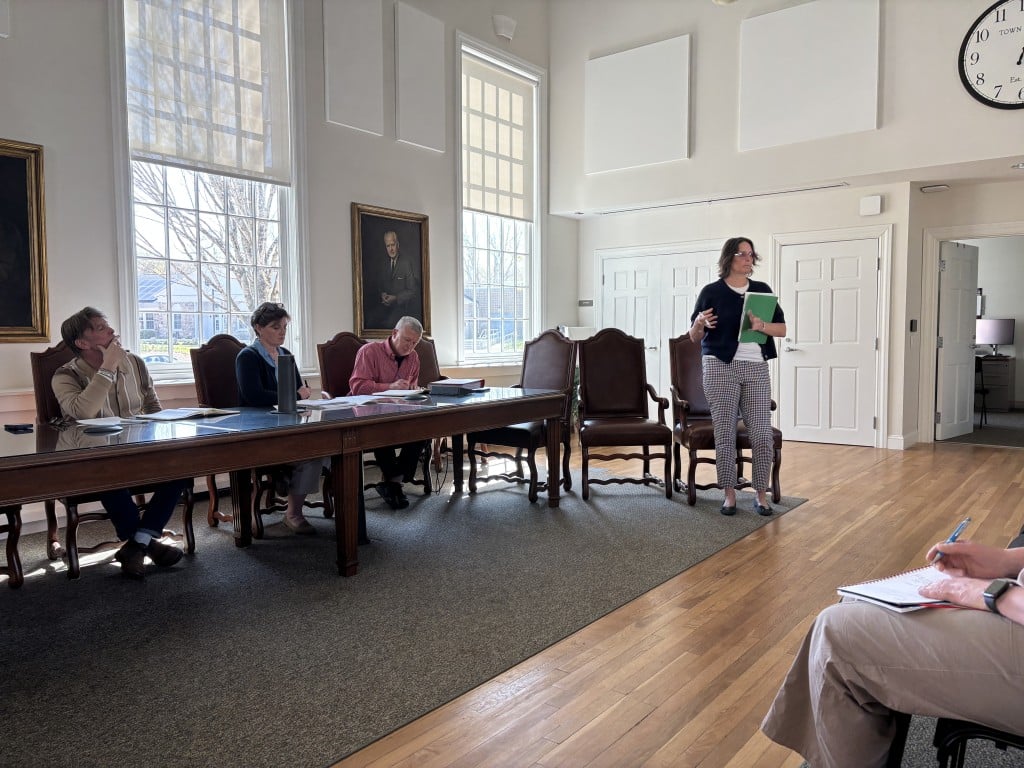
LYME, CT – A proposal to ban firearms at Lyme polling places was blocked Monday after the Board of Selectpeople declined to move it forward to a town meeting later this month.
About 20 people attended the roughly hour-long meeting, where opposition to the proposed restrictions drew a larger-than-usual crowd.
Ultimately, selectpeople deferred the proposal for further development rather than send it to town meeting. Selectman John Kiker, a Democrat, cast the lone nay vote on the three-member board made up of unaffiliated First Selectwoman Christy Zelek and Republican Selectman Tom St. Louis.
The issue revolved around a call from Democratic Registrar of Voters Dottie Wells for a draft ordinance to be presented to voters at the Annual Town Meeting on May 21.
Wells said she and Republican Registrar of Voters Judy Davies wanted to protect voters and election workers from physical violence and intimidation by prohibiting “possession, carrying, or discharging of weapons within 75 feet of any polling location or drop-off center in Connecticut.”
Davies did not participate in Monday’s presentation.
No draft ordinance language had been prepared or distributed ahead of the meeting. Wells said the idea emerged just last week, following a registrars’ conference where she learned municipalities can adopt their own ordinances governing polling places.
“It’s not difficult to get an ordinance together,” she said. “It’s a couple of sentences. I’ve already got something preliminary prepared.”
In a departure from convention, selectpeople allowed members of the public to participate in the discussion rather than limit them to the traditional public comment period at the beginning of the meeting.
One resident, who like most other commenters did not identify himself by name, stood up to announce himself as a concealed carry permit holder.
“I’m carrying right now,” he said. “Do you feel infringed? Do you feel like you’re harmed?”
The woman beside him asked if selectpeople could tell if she was carrying or not.
Selectman John Kiker, a Democrat, objected to the questions.
“This is not helpful,” Kiker said.
The selectman earlier in the conversation had argued voting places need to be neutral, non-intimidating environments where poll workers and voters feel protected.
“Voters have rights,” he said.
Many polling places in Connecticut are located in schools, where firearms are already prohibited under state and federal law.
Wells described her proposal as narrowly focused to polling places and ballot drop boxes.
But former First Selectman David Lahm warned against expanding local gun restrictions.
“My biggest fear is everywhere I’ve seen gun control — and that’s what this is, gun control — come in, it starts small and just gets bigger and bigger,” he said.
“No person shall possess a firearm, air gun, air rifle, crossbow, longbow, archery equipment, or other dangerous weapon at or within 75 feet of any polling location or drop box in the town of Lyme except the lawful possession of firearms on roads, streets, and in a properly secured box in a vehicle in a town parking lot.
Preliminary language for a “Voter Safety” ordinance suggested by Registrar of Voters Dottie Wells on May 4, 2026
The provisions of this chapter shall not apply to the town constable or other law enforcement officer acting within the scope of their duties when requested by either registrar of voters, election moderator, or head moderator, and other authorized town personnel.”
Republican Selectman Tom St. Louis said the state already prohibits carrying firearms openly and emphasized that concealed carry permit holders have to go through a firearm safety course as well as local and state approvals.
“There’s a background check, fingerprinting,” he said. “It’s a very serious process to go through.”
He and others argued threats are more likely to come from those using guns illegally than legal permit holders.
“And so I would ask, is this something that we really want to infringe on people’s rights? And what are we actually getting from that?”
St. Louis questioned how the ordinance would be enforced in Lyme, one of roughly two dozen Connecticut towns without a dedicated police department or resident state trooper. The town instead relies on state police patrols.
Lahm called the ordinance a “solution in search of a problem” in the absence of credible threats.
Lahm, a Republican who changed his party status to unaffiliated shortly before he decided not run for reelection last year, had served in the position since 2022.
“The solution is what we did in 2024,” he said of that year’s presidential election. “You hire state policemen to provide security during the election, and that’ll make everyone real polite.”
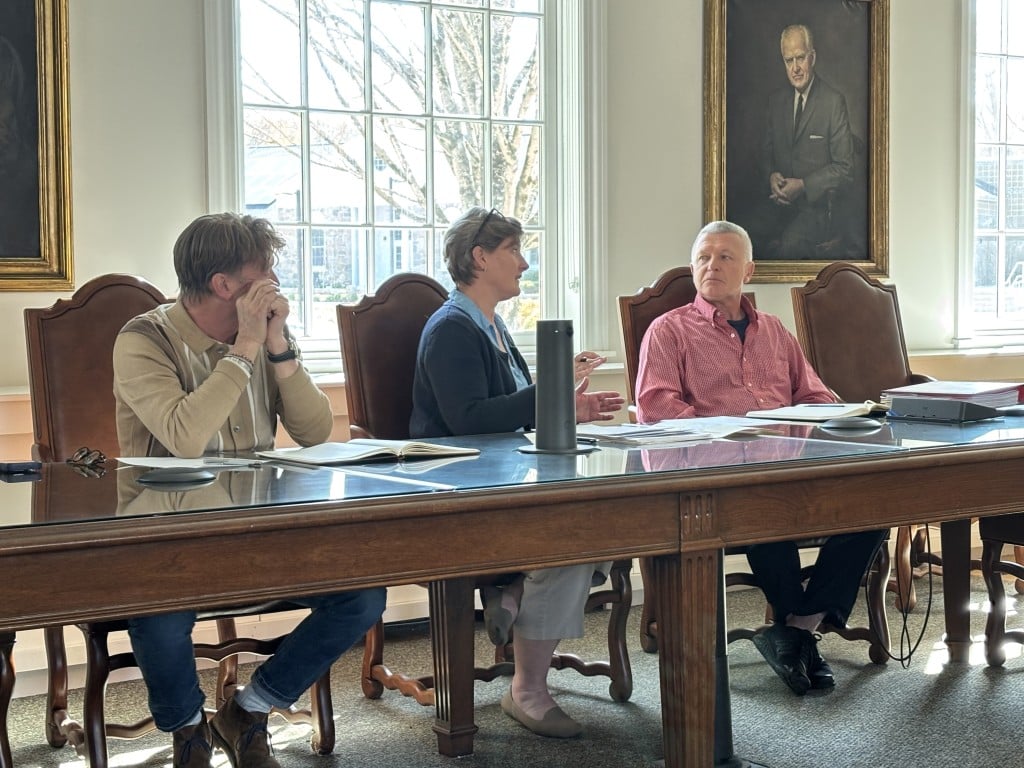
Wells pushed back against a police presence as the main response when the goal is to promote security and prevent intimidation.
“As we found in 2024, even when we’re promised coverage, it’s not always available. It’s incredibly expensive. It can be off-putting to certain people,” she said.
Lyme Constable John C.L. Evans, whose role includes keeping the peace at elections, said he’s more concerned about the “wild card” who hasn’t gone through background checks than someone legally carrying a firearm.
Evans is the president of the Pawcatuck-based Research and Development Solutions Inc., a defense company with services that include advising governments on emergency preparedness.
He said his efforts as constable are focused on protecting town staff if someone comes in with the intent to do harm.
“We’re not talking about concealed carry; we’re talking about someone who’s got a grudge,” he said.
In discussing the motion by St. Louis to continue discussion rather than sending the ordinance to town meeting, Zelek reiterated it’s the selectpeople’s responsibility to listen to concerns from registrars and poll workers.
Zelek, a political newcomer, was elected in November on a platform of collaboration and consensus-building.
“I feel conflicted because I really want everyone to feel safe in this building and everywhere,” she said. “But I do feel like we’re rushing to get to a town meeting, and I want to be sure that we’re doing the right thing.”
‘See Something, Say Something’
After the meeting, Wells said the proposed ordinance was intended to give poll workers clearer guidance and reduce confusion about how to respond to firearms at polling locations.
“One of the things that we talk to our poll workers about is the idea of ‘see something, say something,’” Wells said. “And I think the idea of having an ordinance that we can point to that says ‘no one is allowed to carry’ makes us all safer, because if somebody comes in and we see anything, we can say something.”
Asked why a legally carried concealed firearm would need to be addressed at a polling place, Wells said somebody who doesn’t have a gun isn’t going to be able to use it.
“The presence of guns can also escalate situations,” she said. “And one of the main things that we’re taught as registrars is to deescalate situations.”
She disputed the idea that legally armed citizens are a statistically significant source of protection against active threats.
While Wells said there have been no major violent incidents prompting the proposal, she acknowledged election workers have dealt with angry voters in the past.
She called for being proactive in protecting poll workers and voters from danger and intimidation.
“It’s not just ‘is someone going to get shot?’” she said. “It’s ‘is someone going to be intimidated and feel like they don’t feel safe coming to register their vote?’”
Author

Comments (4)
Comments are closed.
Related Articles
Old Lyme Zoning Survey Finds Support for Flexibility, Not Major Change
Residents want to preserve Old Lyme’s small-town feel by allowing accessory apartments, limiting data centers and ensuring a say in the future of Halls Road.
Berke Wins as Campbell Falls Short in Third Region 18 School Board Bid
Democrat Devin Berke defeated Republican Brandy Campbell in Tuesday’s special election, extending the Democratic Party’s hold on all nine seats.
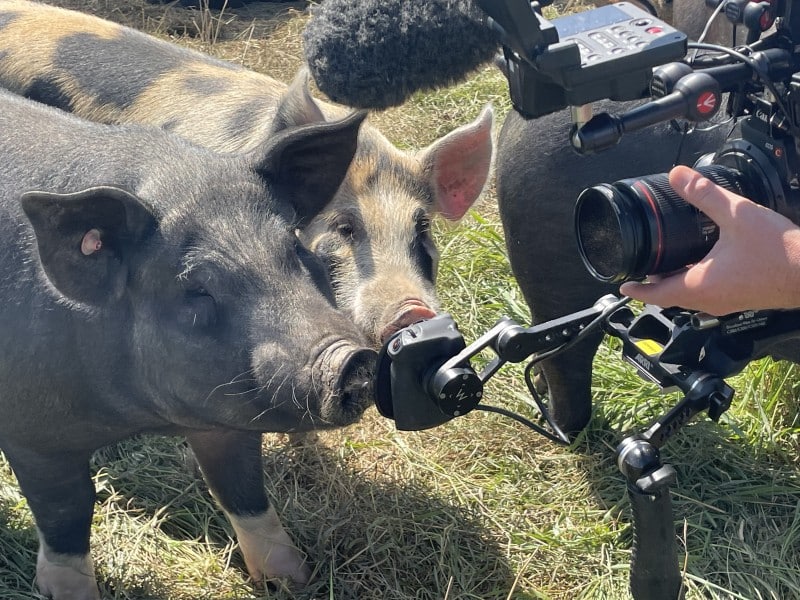
Lyme’s Lisa Holmes Takes Farmers’ Stories From Field to Film
A documentary from Lyme resident Lisa Holmes digs into the challenges facing independent farmers and the changing landscape of American agriculture.
No matter how I try to bend my imagination, or seek out the help of some Absynthe,I cannot grasp what the gun rights people are thinking.What is your purpose in needing a weapon with you?Is it overcompensation for a hidden psychological weakness?A physical frailty?Were you bullied in junior high and are determined to see that it never happens again?Yes,I know it is a right for all Americans.Lunatics like Ted Nugent remind us of this on a regular basis.But as a right,do you need to exercise it constantly?Please,spare me the argument that if one aspect of gun rights is curtailed that the rest will follow.The “slippery slope” argument.That is how we now find ourselves awash in semi-automatic weapons.You certainly don’t require them for Deer hunting.At how many mass shootings has a “good guy with a gun” been present to play the role of Captain America?I will answer that for you…..none.It is usually an off duty police officer who is capable of handling a weapon due to his/her training.I would suggest supporting the police more and allowing them more leeway to protect us, but it is funny,that.Funny in how the same gun rights people usually start to complain about “Tyranny!” if the police are allowed to do their job and have a visible presence.They seem to fear government intrusion in their private lives.How owning a 9mm Beretta will stave off government overreach I’ve no idea.Maybe some angry citizen could enlighten me on this.Especially in regards to the town of Lyme.Lyme,one of the happiest places in America where there is no political argument about much of anything and the natural beauty and quiet is cherished by all.Please people, leave the guns at home.
It’s simple. In Saybrook all the polling places (except early voting – in the Town Hall) are in school gyms.
I always wonder what those who feel the need to bring a deadly weapon everywhere, hope to accomplish? Are they so fearful? Do they hope to be able to shoot and kill or wound one of us, someone else? (Or intimidate an unarmed person, because drawing a weapon on an armed person is a great way to get shot….)
Why else would one want to bother?
I find my phone cumbersome enough. All outcomes involving the use of a weapon seem very bad to me, except perhaps putting wounded roadkill out of its misery. Which is actually a very good and helpful thing.
I hope that this doesn’t become an issue in Old Lyme. I’m certain that I would feel “infringed upon.”