
Old Lyme Grows Emergency Operations Center Into Modern Hub
The new 1,510-square-foot facility, up from 345 square feet, is making it easier for officials to coordinate during major incidents.

OLD LYME, CT – Local officials on Friday welcomed a 1,510-square-foot Emergency Operations Center (EOC) that nearly quadruples the size of the previous civil preparedness hub squeezed into two rooms at the Boughton Road fire station.
Deputy Emergency Management Director Troy Clark joined attendees at the dedication and ribbon cutting for the expansion project led by Emergency Management Director Dave Roberge.
Clark, who helped guide communications planning for the project, described the transformation as dramatic. He said the previous setup forced dispatch operations, a call center and unified command officials into 400 square feet where overlapping radio traffic and phone calls made coordination difficult.
He recalled struggling to hear multiple radios over the sound of hotline operators speaking loudly to elderly residents or an Eversource liaison on the phone with the utility company.
At full activation, roughly 10 personnel – including town officials, first responders and utility representatives – can staff the EOC.
“This expansion really allows us to spread out and to work a lot more efficiently,” Clark said.
An early run during February’s blizzard proved the space was ready, according to the deputy.
With the call center operators in their own room and unified command spread out across the operations area, he described being able to understand all the radio transmissions from the outset rather than asking those on the other side to repeat themselves over the din.
“It’s a big change,” he said. “A big change for the better.”
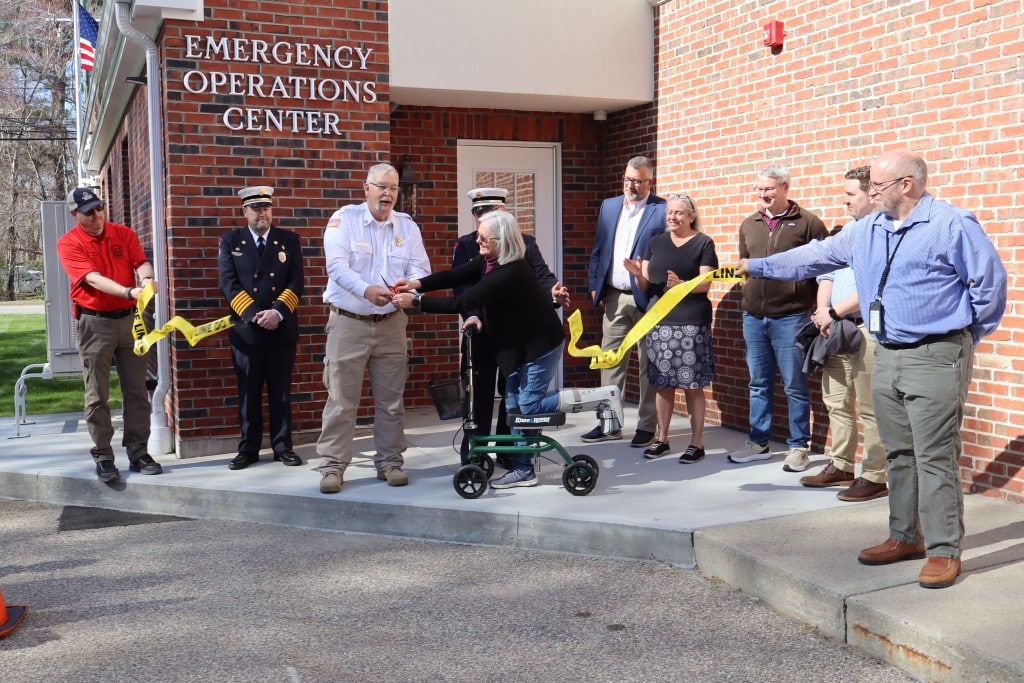
The center in recent years has overseen emergencies including hurricanes, snowstorms, heatwaves, a windstorm, ice jams on the Connecticut River and the COVID-19 pandemic. It also hosts annual drills simulating potential incidents at the Millstone Power Plant, along with state-led exercises.
The addition, designed by Point One Architects of Old Lyme and built by Hartford-based Newfield Construction, separates the center into distinct spaces, including a dedicated call center, operations center, conference room and communications center, each equipped with video screens tied into a digital matrix system.
Other upgrades include storage for emergency equipment and a fiber internet connection backed by Starlink satellite service. Previously, the town relied on less reliable systems, including Comcast service and cellular hotspots.
Roberge, speaking during a ceremony that filled the fire station’s apparatus bay with local, regional and state emergency preparedness officials, recalled how the town’s EOC grew along with a nationwide focus on civil preparedness.
He said the center originated in the 1940s in the basement of Town Hall next to a boiler and surrounded by asbestos pipes before moving to Boughton Road in the 1980s.
The evolution came as civil defense efforts, centered on blackout drills and air raid preparedness during World War II, evolved through the Cold War into formal civil defense systems, then civil preparedness in the 1960s and 1970s, and ultimately into the modern “all-hazards” emergency management model.
He said Hurricane Sandy made it clear the town needed an emergency operations facility where people could work “without being toe to toe and shoulder to shoulder.”
The goal took 13 years to accomplish as Roberge sought outside funding for the project.
The roughly $1.35 million expansion was funded largely by the federal government, which combined with pandemic-relief funds and Millstone Power Plant-related contributions to cover about $1 million of the total cost.
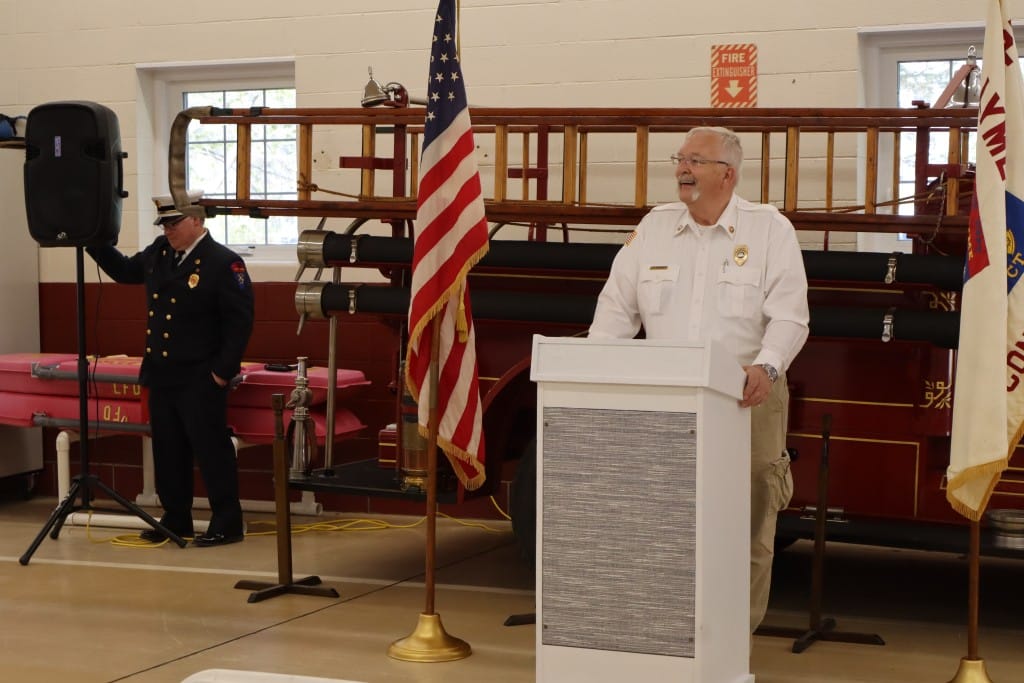
State Sen. Martha Marx told the audience Old Lyme continues to exceed expectations in its public investments.
“Old Lyme punches above their weight,” she said, referencing the EOC and the recently renovated Lymes’ Senior Center.
She said the expansion has helped prepare for an increasingly complex emergency landscape.
“It’s not just hurricanes and blizzards anymore,” she said. “There’s so much that we have to worry about, so much that we have to be prepared for. And the citizens of Old Lyme are ready for it.”
Connecticut Emergency Management and Homeland Security Director William Turner cited threats ranging from severe weather to cyber attacks.
“A lot of times what you don’t see is what’s going on behind the scenes,” he said of local emergency operations personnel. “A lot of times they’re volunteers or part-time. We’re all fighting with very scarce resources. We’re constantly being asked to do more with less.”
He credited Roberge with securing a patchwork of funding from state, federal and utility sources to make the large-scale upgrade possible in a small town.
“I truly do feel confident in saying that Old Lyme is in a much better position, having this facility, to keep their community safe and help them recover from any hazardous incidents,” Turner said.
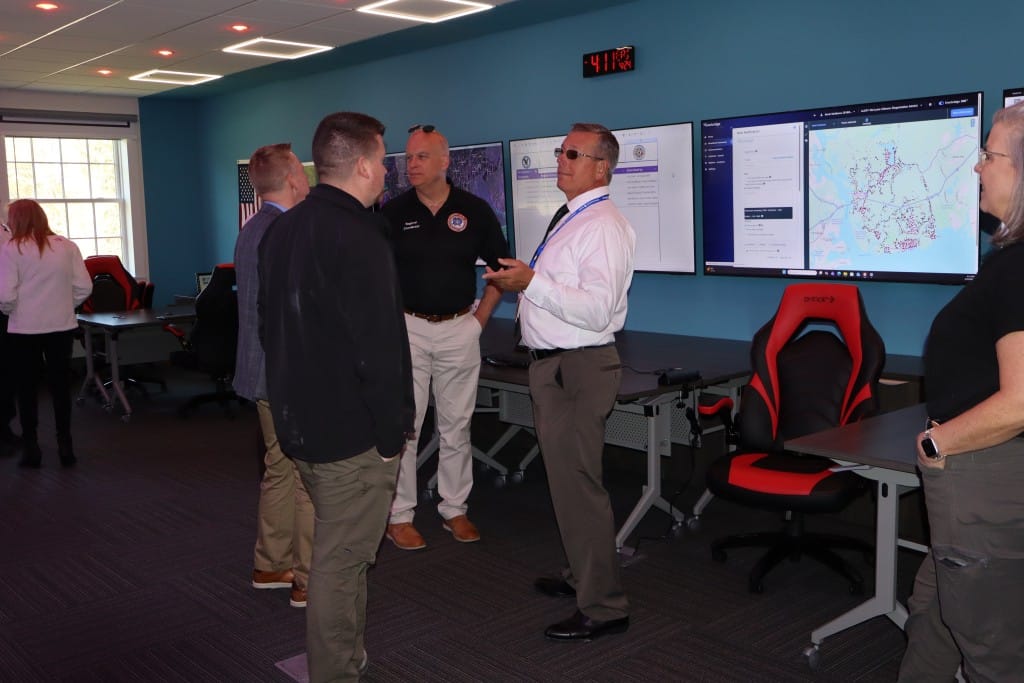
As visitors milled around the new space following the ceremony, building committee member and call center operator Tisha Kirk pointed out upgrades in the Cafe EOC space she helped design.
The kitchen now includes a sink, full-sized refrigerator, microwave and seating area. She said the setup replaces a two-burner electric stove and mini fridge that proved inadequate during prior emergencies.
“It gets very fatiguing being on all the time,” she said. “So it’s important to have a place where people can come in, sit, eat, restore.”
She pointed to colored lighting in the room and throughout the facility that can be used instead of, or alongside, fluorescent lights and adjusted for nighttime operations to reduce eye strain.
Roberge, catching up with guests to showcase the improvements and gauge their reactions, pointed out emergency management artifacts scattered throughout the rooms.
“How do you like the memorabilia?” he asked, referring to items like a 1941 incident sign-in sheet and a CONELRAD (Control of Electromagnetic Radiation) sign predating the modern Emergency Alert System.
Other throwbacks included an early microphone and a paging device from the days when alerts from Millstone came through on beepers.
Author

Related Articles

316 Lyme Acres Now Tax-Exempt After Transfer to RFK Jr.-Founded Nonprofit for Planned Kids’ Nature Preserve
The properties will be used as a nature preserve for children, according to local assessor’s documents. The properties were granted tax-exempt status earlier this year.

Administrator Brings Elementary, Middle School Experience to Region 18 in Dual Role
Andrea Montovani will join the district July 1, succeeding Noah Ventola in the shared leadership position at Center School and Lyme-Old Lyme Middle School.

New Owner Takes Helm at Old Lyme’s Black Hall Marina
Gene Chmiel saw potential in a weathered marina on Shore Road long before it became a destination for paddlers, anglers and tourists. Now he is passing the business to new ownership.