
Young Inventors Put Empathy into Action at Lyme-Old Lyme Middle School
Sixth graders in Lyme-Old Lyme Schools’ Invention Convention program combined creativity and compassion to solve problems at home and across the globe.
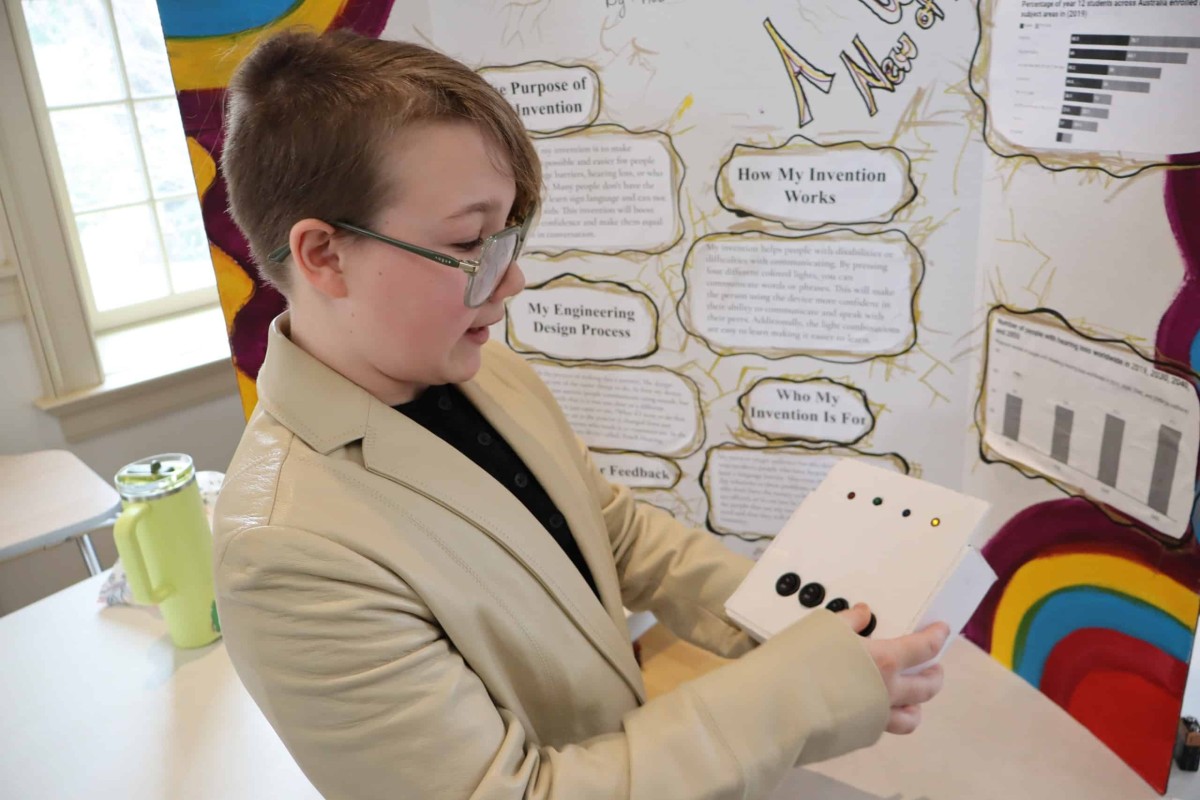
OLD LYME, CT – Lyme-Old Lyme Middle School inventor Rue Zaino speaks with confidence on issues ranging from global autism rates to electronic circuitry to manufacturing.
Her invention speaks for those who can’t.
Created as part of the district’s Invention Convention program for sixth graders, Rue’s “Touch Hearing” device uses a customizable array of colored buttons that can be programmed with different messages. She designed the device to give non-speaking or hearing-impaired individuals a simple, portable way to communicate.
The 11-year-old inventor pitched her product earlier this month to a panel of judges who filed through the Old Lyme Town Hall meeting room to determine which students would go on to the state convention at the University of Connecticut on May 2.
“If you click this twice, it can mean ‘I’m excited,’” Rue explained while toggling one of the colored buttons. “Or if you click this twice, it means, ‘stop, I’m in danger.’ Click blue twice, and it can mean, ‘oh, no, I’m sad.’”
Rue was among 16 students who opted to compete for a spot at the state convention by participating in an afterschool program that built on the general sixth grade Invention Convention curriculum.
Although Rue was not selected to advance to the state convention, sixth grade science teacher and Invention Convention mentor Carly Keith said the project exemplified a focus on empathy that made this year’s class stand out from previous years. Other compassionate solutions to real world problems addressed issues like homelessness, pet safety and aging.
“We planted the seeds of thinking about a problem at home or school,” Keith said. “A lot of students moved toward problems that were bigger than that.”
Rue traced her inspiration back to a first grade classmate who came to school not knowing how to speak English. Later, a fourth grade project taught the class about places where people had to walk miles with buckets on their backs to access water.
“That just really opened my eyes to the diversity in the world,” she said.
Research into autism prevalence and hearing loss worldwide reinforced her idea that a simple, low-cost device — it cost her about $5 to make without batteries — could help a wide range of users.
“I want to make a difference in the world,” she said. “Not everything’s fair, but if I can make things fair, that’d be great.”
She credited her father with helping her devise a basic circuit system with switches connected to batteries and LED lights. Now, she’s thinking about how to use 3D printing as a “fast, cheap and durable” way to produce a pocket-sized communication device.
Rue said her biggest challenge was testing the invention with its intended audience. She cited the town’s small population and lack of diversity as limiting factors.
She was hopeful that continuing in the process would give her the opportunity to interview people with speaking or hearing challenges.
“I’m interested not just about my town and my peers – I want to learn about the world,” she said.
State Convention-Bound
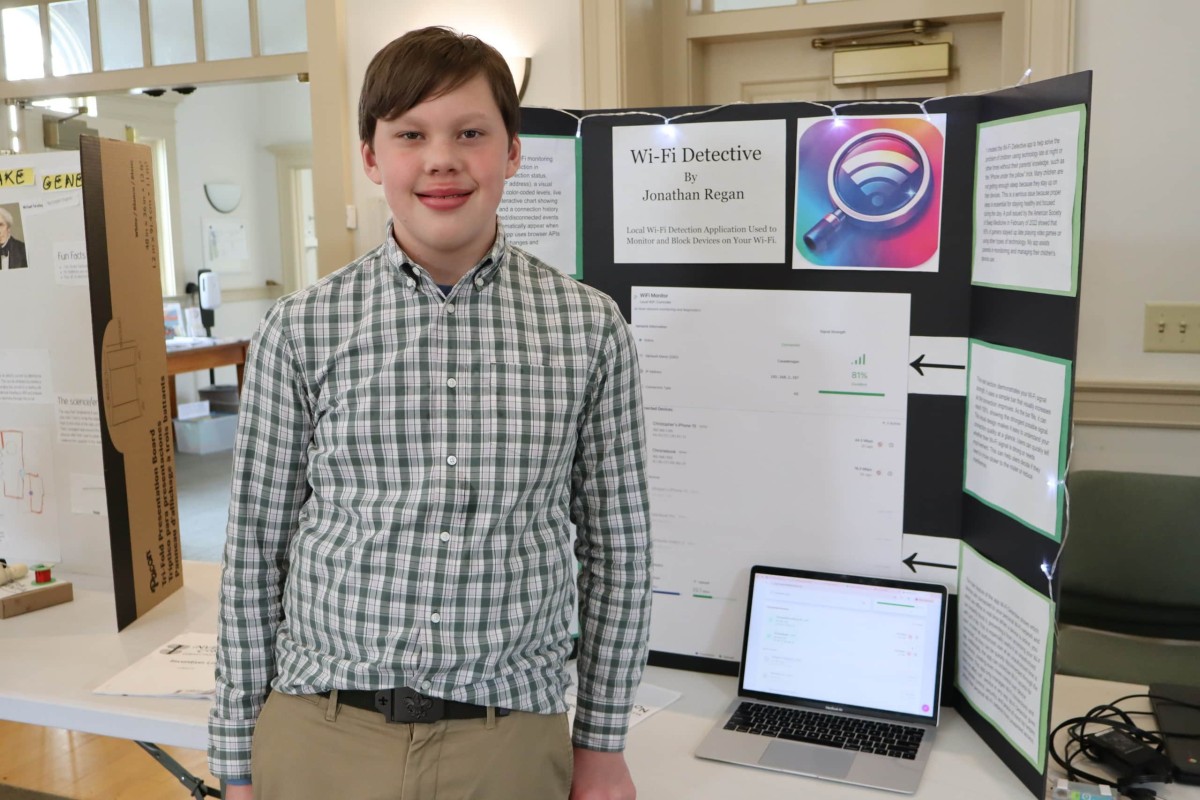
Judges from local community organizations selected Jameson Catucci’s “Sticky Plugs,” Caroline Fuller’s “Netter Getter,” J.R. LaPlante’s “Wallace Safety Mask” and Jonathan Regan’s “Wi-Fi Detective” to advance to the state convention.
Jonathan’s invention gives families a way to monitor their wireless network in an era dominated by screen time.
“People in my generation are staying up until like 3 a.m. playing video games and stuff,” he said. “So, I have made an app to fix this problem.”
The app allows users to block devices from the wireless network or schedule offline times. It also provides detailed network statistics, including signal strength, download and upload speeds, and response time.
The 12-year old, who said he taught himself coding online, is already on his 22nd version of Wi-Fi Detective.
“I’ve made multiple different apps,” he said. “But this is the one that I think can help out people the most.
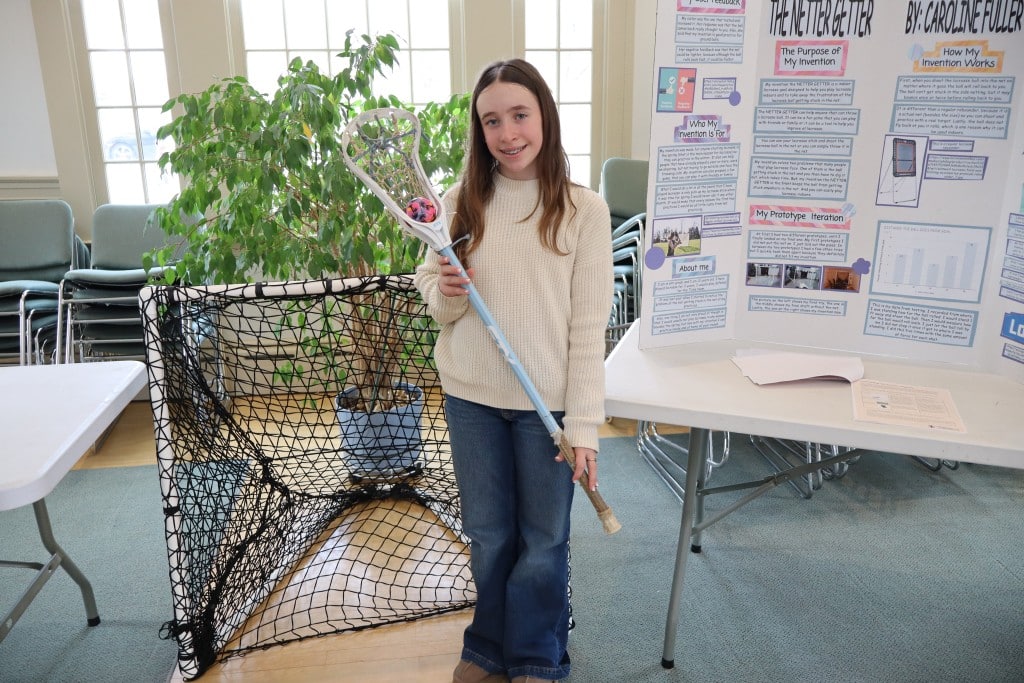
Caroline, 12, is the inventor behind “Netter Getter,” an indoor lacrosse net that prevents balls from getting stuck and gently rolls them back to the player.
“I feel really proud of myself that I built something,” she said. “I wasn’t just like, ‘yeah, I can do this.’ I actually did it.”
Existing products either bounce the ball back too forcefully for enclosed spaces or serve only as a backstop, according to Caroline.
She described building her prototype using PVC pipes and fittings from a local hardware store. She said her father suggested the kind of materials she could use, but she was the one who figured out how to put it all together.
One of the hardest parts was bending the pipes and connecting the fittings in a way that matched her vision. She adapted her design by cutting smaller pieces and adjusting her approach.
“I had ideas in the beginning, but they just didn’t turn out as I actually thought,” she said.
‘Really Big Things’
Keith, the sixth grade teacher and mentor, said members of the local Mentoring Corps for Community Development (MCCD) were instrumental in the program’s success. She said they taught lessons, helped refine ideas and provided supplies so students could build their prototypes at home.
The MCCD is an Old Lyme-based nonprofit organization that matches businesses, nonprofit organizations and schools with retired professionals in various disciplines who can advise them on how to make their ventures successful.
“It’s helpful for the kids to not just hear from their teachers all the time, but to hear from people in these fields,” Keith said. “It’s really, really neat because they tell a lot of personal stories and get the kids excited.”
Glorioso, science teacher and co-mentor, said the Invention Convention framework is unique in extracurricular science, technology, engineering and math (STEM) opportunities because it goes beyond the core subjects to encompass skills like research, writing, public speaking and marketing.
The students have to shine in all areas, according to Glorioso.
“And they do,” she said.
Glorioso cited her experience as a coach for numerous science-based clubs when she said Invention Convention feels less gender-specific than other STEM programs. She pointed to aeronautics and robotics as topics that have tended to draw more boys.
“And that’s why we need clubs like this, because we have to break that generational habit – where people feel like their strengths are in the roles that they’ve seen in their loved ones, in their traditions – so STEM events don’t always feel like a male-dominated field,” she said.
Glorioso noted last year’s sixth grade Invention Convention winner, Natalie Gibbons, is headed to the national event in Michigan this June with an invention designed to filter microplastics from washing machines.
“The fact that she potentially has a product that can remove microplastics from our water is unbelievable,” she said. “It’s a testament to young minds thinking of really big things.”
She paused to acknowledge the irony of talking about the “really big things” in the context of microplastics.
Turns out the Invention Convention is a testament to the small things, too.
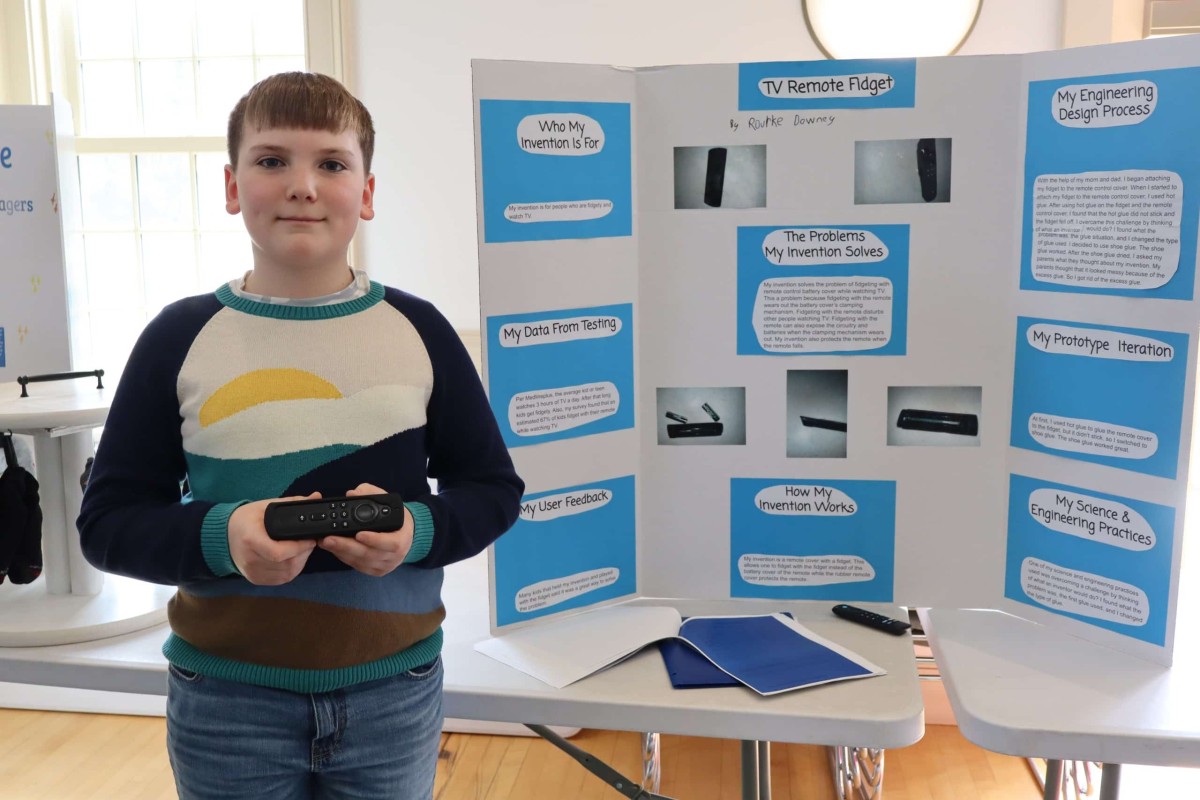
Rourke Downey, 11, noticed his habit of repeatedly opening and closing the battery cover on the TV remote control could damage the plastic. His “TV Remote Fidget” incorporates a rubber case with a sliding component that mimics the opening and closing click.
“It’s just as satisfying — minus the dead remote,” he said. He cited the environmental benefits of preventing plastic and batteries from ending up prematurely in landfills.
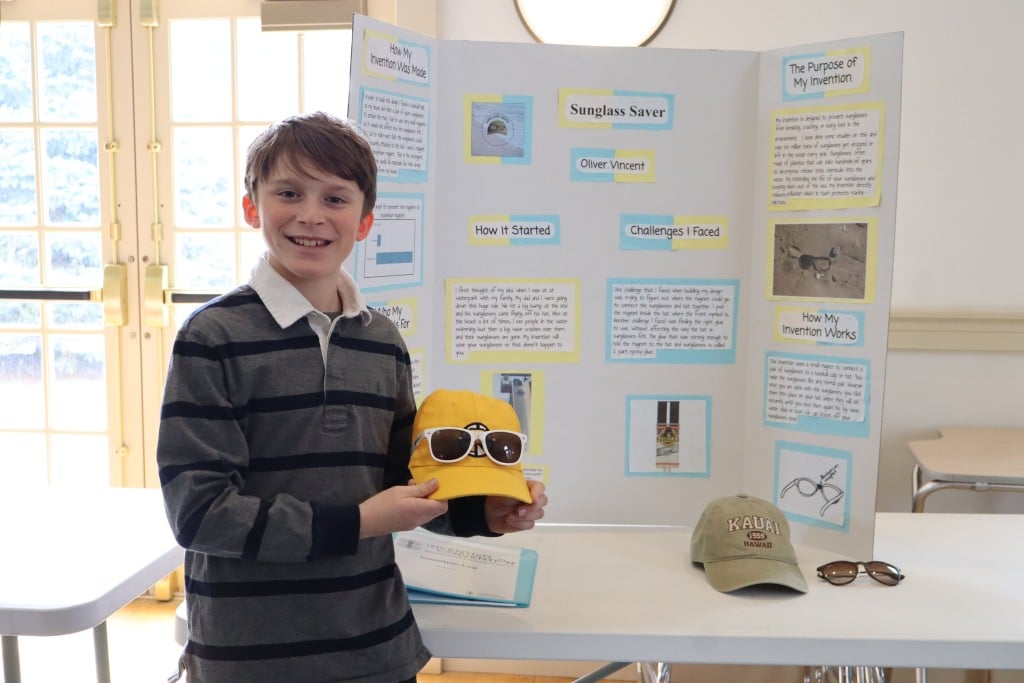
Environmental concerns also drove 11-year-old Oliver Vincent’s “Sunglass Saver,” a simple magnetic system that prevents sunglasses from falling off a hat. He learned the problem contributes to millions of lost pairs each year, including those ending up in oceans.
“I did some studies on it, and 8.8 million sunglasses get dropped or left in the ocean every year,” he said. “I was like, ‘wow, that is a lot of sunglasses.’”
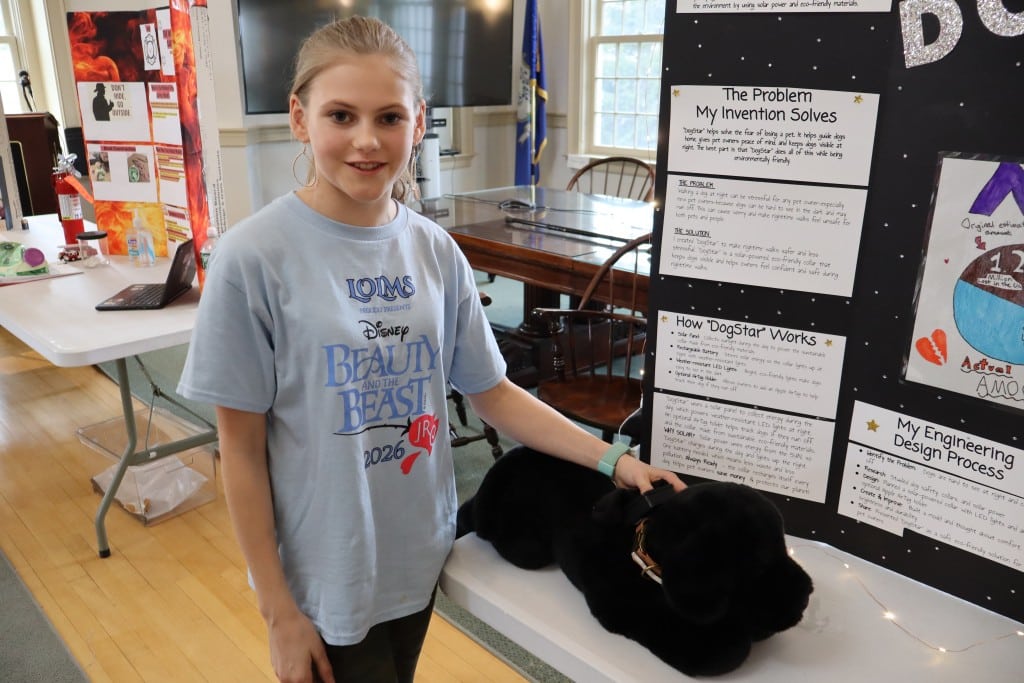
Shea Kelly, 11, turned her attention to missing pets with “Dogstar,” a solar-powered collar equipped with tracking technology and lights. After testing the prototype on her own dog, she saw quick results.
“One night, when she bolted, yet again, around the neighborhood, we were able to track her, and our neighbors found her within 5 to 10 minutes,” she said.
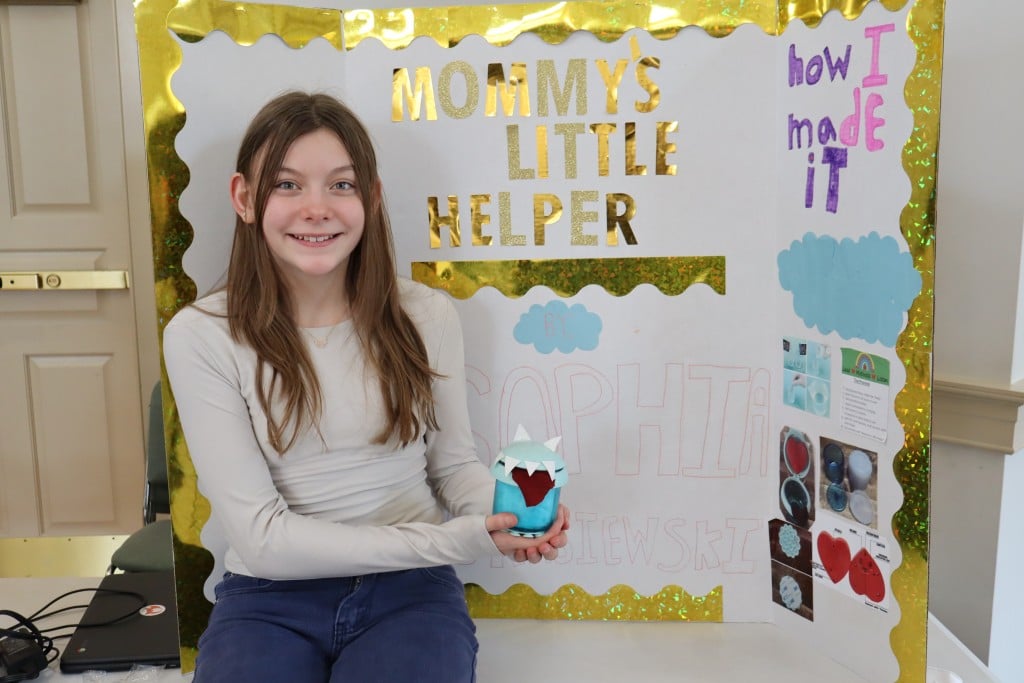
Sophia Lukasiewski’s “Mommy’s Little Helper” is a suction-based cup for toddlers to keep them entertained in their high chairs. It includes a built-in recording device to personalize the experience.
It can be programmed with a song or a “familiar voice for the child,” the 11 year old explained — and it’s quiet enough to use even in upscale restaurants.
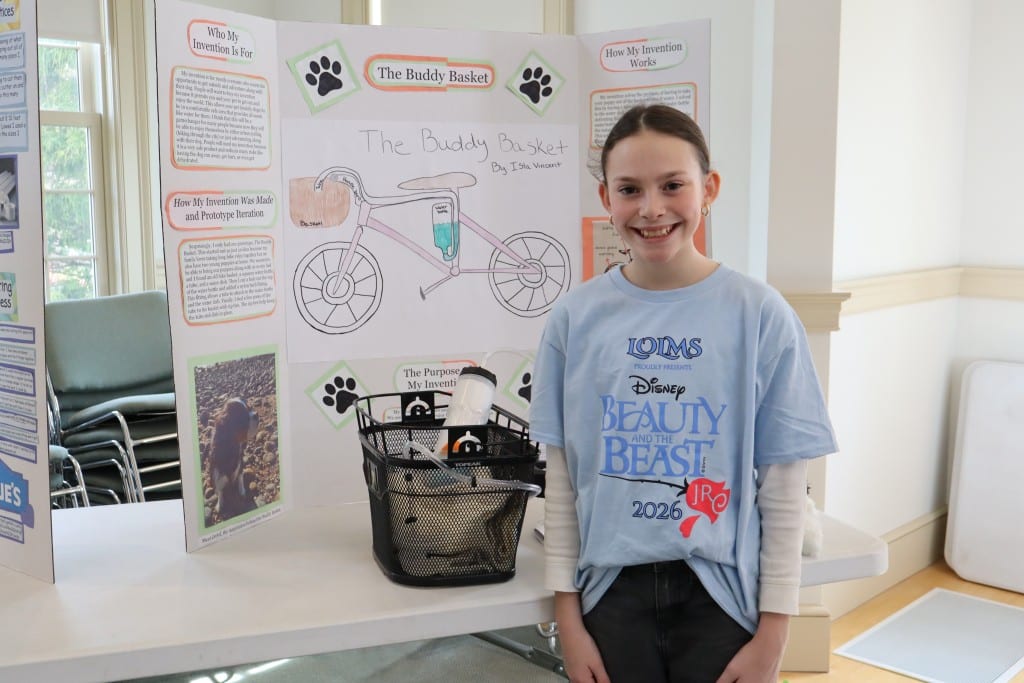
The “Buddy Basket” invented by Isla Vincent, 11, allows cyclists to bring their dogs along — complete with a built-in water system so pets can drink on the go.
“Bike baskets for dogs do exist, but mine adds the feature of having a water bottle,” she said. “That’s very important because if it didn’t have the water bottle, it wouldn’t be my invention.”
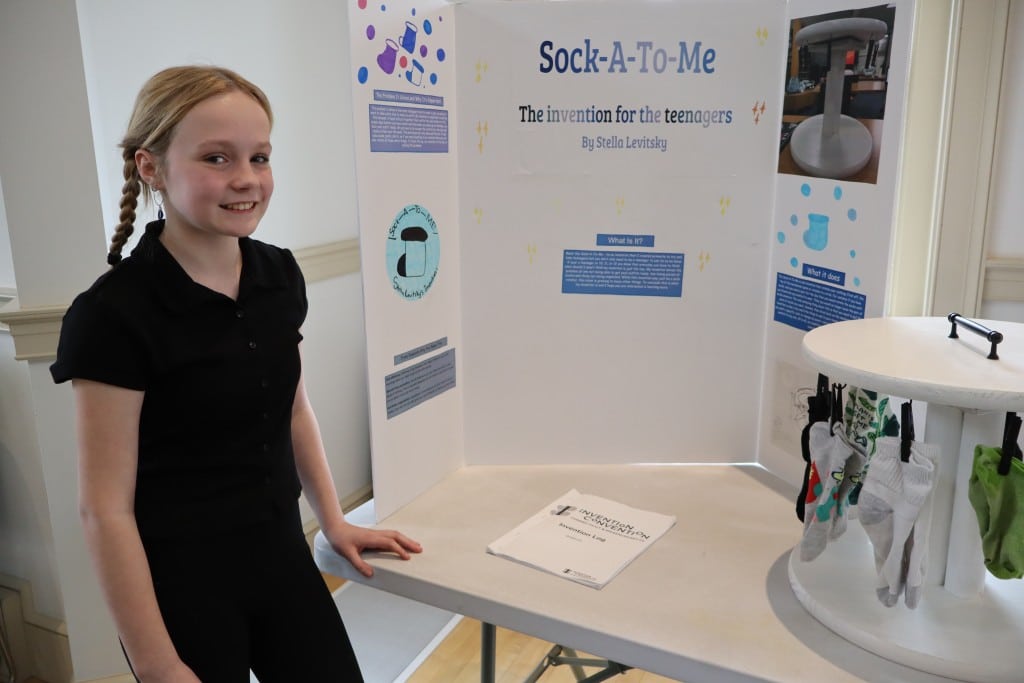
Stella Levitsky, 12, learned about the process of trial and error when designing the rotating “Sock-a-to-Me” display to help keep clothes organized.
“I have many diagrams,” she said. “Many, many diagrams. I changed it so much.”
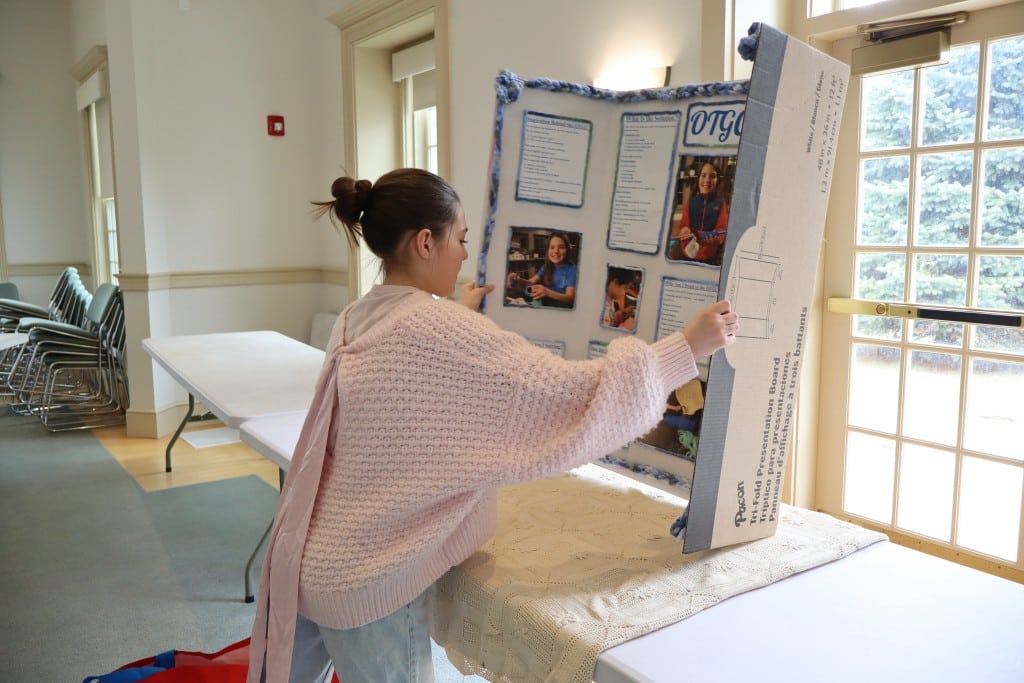
Kaia Vigen, 12, designed an ergonomic crochet hook inspired by her great-grandmother. She used a metal cutter, sander and hockey tape to provide a better grip and a small light to help with visibility.
“I mostly made it for people that have arthritis and are elderly, or anyone that just needs a little bit of help,” she said.
Author

Comments (1)
Leave a comment
Comments are moderated. Please review our Commenting Policy before posting.
Related Articles
Old Lyme Selectmen Seek Feedback on Lieutenant River Walking Bridge
The Board of Selectmen wants to hear from residents on the future of a proposal for a pedestrian bridge and fishing pier.
Automated Speed Cameras May Be Coming To CT Highways
State Rep. Devin Carney said he’s “not a huge fan” of automated speed cameras. He cited underlying issues, like a shortage of state troopers, that need to be addressed.

Selectmen Consider Abandoning Plan for Pedestrian Bridge, Key Feature of Controversial Halls Road Vision
Plans for a pedestrian bridge over the Lieutenant River, now expanded to include a fishing pier, have selectmen questioning whether the project is worthwhile.
Rose invention and this entire project idea brought many tears to my eyes as I read how sensitive our granddaughter Roux is to the challenges of the world and how she is so motivated to help others.