

Selectmen Consider Abandoning Plan for Pedestrian Bridge, Key Feature of Controversial Halls Road Vision
Plans for a pedestrian bridge over the Lieutenant River, now expanded to include a fishing pier, have selectmen questioning whether the project is worthwhile.
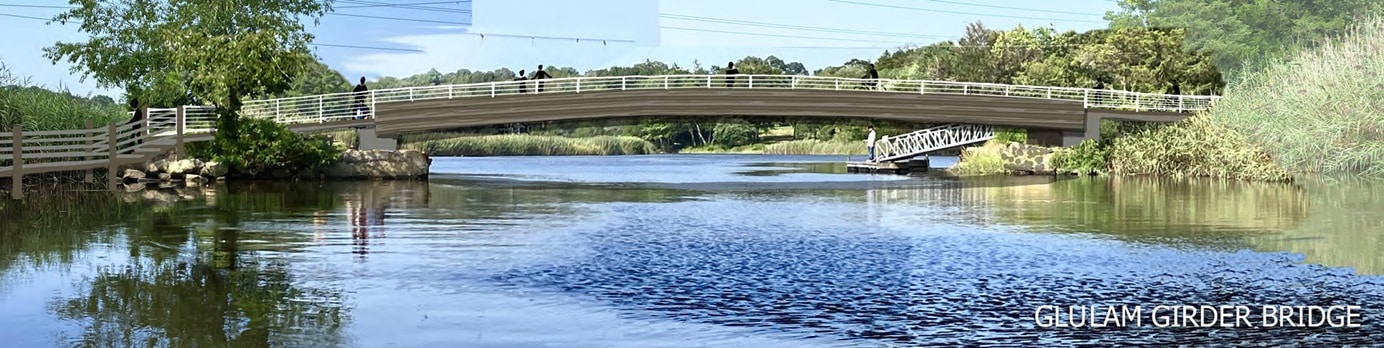
OLD LYME, CT – Town officials are weighing whether to abandon plans for the Halls Road pedestrian bridge amid added state requirements and shifting priorities.
Selectman John Mesham at Monday’s Board of Selectmen meeting said he does not believe residents have the same appetite for the project that they did in 2022, when they authorized using $135,000 of the town’s federal pandemic-relief allocation to design a walking bridge over the Lieutenant River. The state’s Recreational Trails grant program chipped in another $28,500.
The proposal since then has grown to include a fishing pier on land donated by the state.
“This is something that snowballed beyond the initial conception,” Mesham said.
The idea originated with the now defunct Halls Road Improvements Committee (HRIC), which spent more than a decade developing plans to transform the three-quarter-mile commercial corridor between two highway interchanges into a more walkable town center.
Inspired by a bow bridge that carried traffic over the river in the 19th and early 20th centuries, the project has long been expected to rely on grant funding for construction.
But selectmen said the project expanded – or “metastasized,” as described by Selectman Jim Lampos – after an agreement with the state Department of Energy and Environmental Protection (DEEP) to transfer a parcel on the river’s east bank to the town. In exchange, the town must build a fishing pier and parking spaces there.
In separate deeds transferring land on either side of the proposed bridge in 2015 and 2025, the state required the property on the west bank to be used for fishing, crabbing and hand-carried boat access, or revert back to Connecticut.
Lampos put it this way: “Suddenly it’s not just a little bucolic bridge; now it’s this whole production down there.”
First Selectwoman Martha Shoemaker said those additions increased the scope and cost of the project.
“To add another $250,000 to half a million dollars to construct a fishing pier, with more permits and more surveys, was kind of unrealistic,” she said.
Finance director Anita Mancini said the town has used $99,092 of its $135,000 pandemic-relief allocation. Any funds not used by the end of the year for design or permitting fees will go to the town’s social services budget.
Mesham acknowledged the alternative.
“It wouldn’t be a terrible thing for social services to get $35,000 that stays with the town,” he said.
When Lampos asked Shoemaker if there is a chance the “DEEP would back off on this fishing pier stuff,” the first selectwoman said she would reach out to the state agency.
“There’s always a chance,” she said.
Shoemaker also said she would explore potential federal funding through Congress.
Mesham told selectmen he’s open to finding out whether eliminating the pier would change any minds among those who don’t support the project, though he wasn’t opposed to abandoning the project.
Bridge Backers
During the meeting’s public comment period, several residents urged officials not to abandon the project midstream.
Jane Ungemack, a former HRIC member and grant writer, warned that walking away could hurt the town’s credibility.
“I think that is a red flag for future funding,” she said.
Resident Sandra Rueb said the bridge would offer more than a safe crossing.
“It is a landmark that connects the arts, the civic and the commercial centers,” she said.
Resident Evan Griswold cited the site’s historical significance, noting earlier crossings may have been used by figures such as Benjamin Franklin.
But concerns were also raised.
Jim Graybill, owner of the Lieutenant River Center, said the bridge “would be a nice asset” but questioned how parking and liability would be handled if it connects to private property.
Selectman last year turned their focus to sidewalks – rather than changing zoning regulations on Halls Road or pushing through the bridge proposal – shortly before disbanding the HRIC.
Lampos at the time acknowledged the bridge plan, like other elements of the HRIC plan, was controversial.
The HRIC’s call for the creation of the Halls Road Overlay District (HROD) would have allowed as many as 40 housing units per acre to be built above, or behind, ground-floor businesses. The application was rejected by the Zoning Commission last year in a 4-1 vote amid a groundswell of opposition from the public.
“Almost everybody was saying, ‘forget the overlay,’ half the people were saying, ‘forget the bridge’ and just about everyone was saying, ‘but we want the sidewalks,’” Lampos recounted in July.
The town spent a total of $141,322 on Halls Road Improvements Committee expenses since 2015, not including the bridge design covered with federal and state dollars.
The fees incurred by the town, which covered planning, legal services and engineering reviews, were outlined in a committee report submitted by former HRIC Chair Edie Twining earlier this month and a review of committee legal bills previously compiled by Shoemaker.
In a Friday phone call, Twining said completing the bridge would be a “gift to the town.”
“Being able to bring the community to the river is something that would be really cherished, I think, for many years to come,” she said.
Sidewalk Committee
During the same meeting, the Board of Selectmen unanimously appointed members to administer an $800,000 state Department of Transportation grant for sidewalks along Halls Road.
Appointed were former First Selectman Timothy Griswold, Brett Enman, James Glenn, Robert Antoniac, Don Bureau, Frank Morelli, Robin Breeding and Chris Kerr.
The committee includes two Democrats and six Republicans. One seat on the nine-member committee remains open.
Breeding, a Democrat who helped galvanize opposition to the overlay district, was selected for design expertise.
Lampos said he hoped all members would work “in the interest of making this a successful project.”
Mesham’s nomination of Sloan Danenhower, another leading critic of the overlay district, was not seconded.
Author

Comments (2)
Comments are closed.
Related Articles
Old Lyme Zoning Survey Finds Support for Flexibility, Not Major Change
Residents want to preserve Old Lyme’s small-town feel by allowing accessory apartments, limiting data centers and ensuring a say in the future of Halls Road.
Berke Wins as Campbell Falls Short in Third Region 18 School Board Bid
Democrat Devin Berke defeated Republican Brandy Campbell in Tuesday’s special election, extending the Democratic Party’s hold on all nine seats.

Lyme’s Lisa Holmes Takes Farmers’ Stories From Field to Film
A documentary from Lyme resident Lisa Holmes digs into the challenges facing independent farmers and the changing landscape of American agriculture.
It makes no sense that the State gives the Town money to build a sidewalk on State property. Our Selectmen need to take a strong stance against any further State mandates concerning the public use Town land.
While I generally applaud the efforts of those seeking to connect with the natural world through coastal fishing,I don’t understand either the need to have a specific fishing pier built or even allow fishing off of the proposed bridge.Whether at this proposed structure or the existing DEEP walkway at the old Ferry Tavern land,it would be pleasant to walk along and not slip on fish skins or have to climb over fishing poles.One of the draws of taking a date to Old Lyme had always been nearness to the water.Romantic thoughts are often squelched by the aroma of decaying fish.Just an observation.As many people seem to make their way to town for fishing,whether along Route 156,Watch Rock Park or the site of this proposed bridge,are scenic oriented public restrooms going to be put up?I ask this because in the case of Watch Rock,it has become a well used outdoor restroom location.Lovely that.More to ponder before making places accessible to the public at large.