
Old Lyme Historic District to Consider Scaled-Down Service Memorial Plaques at Town Hall Amid ‘Clutter’ Concerns
Because Town Hall sits in the historic district, the project requires a Certificate of Appropriateness before plaques can be installed on the property.
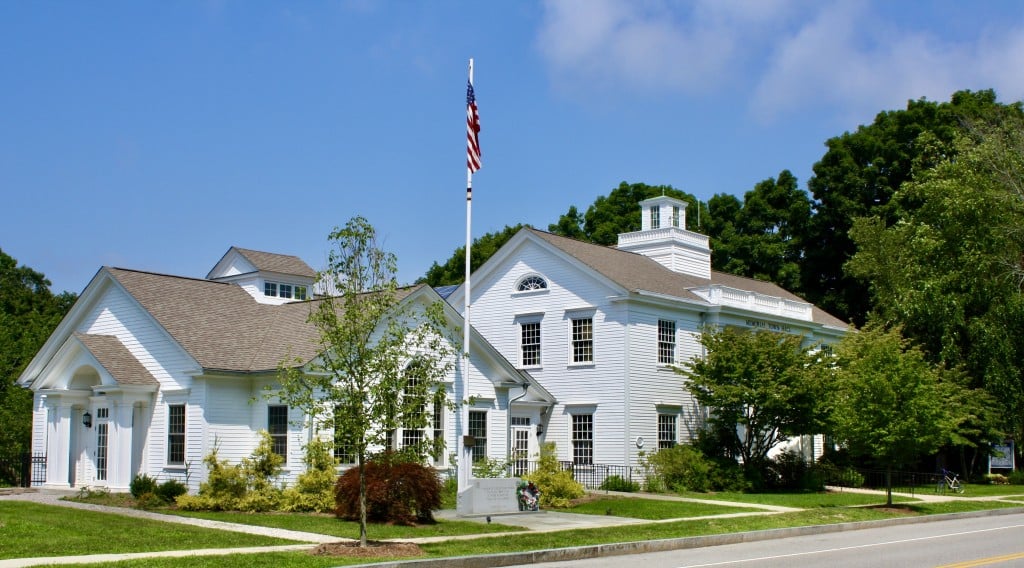
OLD LYME, CT – The Historic District Commission on Monday will consider whether there’s enough space at Memorial Town Hall for Blue Star and Gold Star plaques honoring service members, including those killed in action.
Last month, the commission told the Duck River Garden Club to go back to the drawing board after panning the club’s initial proposal to install two markers, 41 inches high by 45 inches wide atop a 90-inch base, outside the Town Hall. The garden club had proposed placing the signs to the left of the building, roughly 15 feet from the sidewalk.
Commission member Carolyn Wakeman, a writer and historian, told commissioners during their previous meeting that her objections come down to “the notion of clutter.”
She said there is already a monument in front of the building honoring servicemembers killed in action.
“It’s not appropriate to have too many signs in any one location, regardless of the nobility of their intent,” she said. “It’s about the landscape.”
The application for a Certificate of Appropriateness, submitted by First Selectwoman Martha Shoemaker, was withdrawn by the garden club before the commission could deny it.
Now the garden club is back, again with the Board of Selectmen’s blessing, to ask the commission to approve smaller plaques lower to the ground. The markers are 11.25 inches high by 20 inches wide and designed to be mounted on stone, wood or brick.
Selectmen this week voted unanimously to submit a revised application to the Historic District Commission for the smaller plaques, each installed on a stone base. Garden Club member Maryellen Basham suggested placing them near the garden club planting at Town Hall, which surrounds the town’s historical marker, or adding them to the existing military memorial.
Local and state law puts the commission in charge of issuing certificates of appropriateness whenever a structure goes up or comes down – or is significantly altered – in the district. The definition for “structures” includes signs.
The Blue Star and Gold Star programs of the National Garden Clubs, Inc. are a tribute to those who served in the U.S. military and those who died. The programs were inspired by service flags displayed by families during World War II, with blue stars for loved ones serving and gold stars for those killed in action.
Beginning with dogwood trees planted along highways, the garden club initiative grew into the Blue Star Memorial Highway system marked by large signs on interstates from coast to coast. Now, memorials extend to civic locations including cemeteries, parks and gardens.
Garden club President Leslie Groves at the commission’s February meeting said the group hopes to dedicate the memorials during events marking the nation’s 250th anniversary later this year.
“If this isn’t a possibility, then we need to move on because we do want to dedicate this during America’s 250 and we’re running out of time,” Groves said.
Wakeman described research indicating most Blue Star and Gold Star markers in Connecticut are not placed in front of town halls. She suggested it would be sensible to spread out the signs in places that don’t already have memorials.
Other locations mentioned during the discussion included the Sill Lane Green, the garden club beautification site near Exit 70, the newly expanded Boughton Road firehouse, the post office on Halls Road, the transit stop near Hartford Road and other civic sites.
Garden club members and Shoemaker argued that the Town Hall was the ideal choice.
Shoemaker estimated up to 60 people come through the building daily, with more walking by outside.
“You would not believe the number of people who take the Historic District’s walking tour brochure,” she said. “They’re up and down Lyme Street. They’re stopping. They read these signs everywhere. We’re really busy here on Lyme Street.”
Basham said she’d rather install smaller signs at the Town Hall than larger markers elsewhere.
“This should be like a museum to the history of men and women in service,” she said. “This is what the Town Hall is for.”
Author

Comments (1)
Leave a comment
Comments are moderated. Please review our Commenting Policy before posting.
Related Articles

As the Academy Awards Approach, Janet Roach Looks Back on Her Oscar Nomination
Film critic Kevin Ganey’s continuing Oscars coverage shines a spotlight on a local tie to Hollywood: Old Lyme’s own 1986 Academy Award contender for Best Adapted Screenplay.
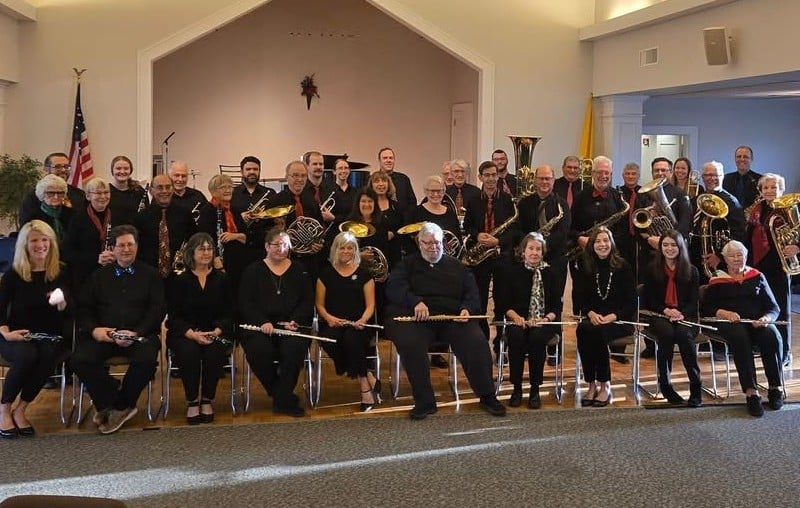
Old Lyme Town Band, High School Wind Ensemble to Perform Friday
The bands will combine for a free concert featuring fan favorites and guest-conductor Anthony Susi’s own ‘Jubilee March.’

Meet Lyme-Old Lyme Wrestler Taiyo Gemme
After starting wrestling at age six, the Lyme-Old Lyme junior has battled injuries and built an undefeated season capped by a 215-pound State Open title.
Christina and I are in support of the Duck River Garden Club’s project to install a series of memorial plaques outside Town Hall recognizing our men and women who served, many of whom found themselves in “harm’s way.”
Given one of the Commission’s stated concerns, I paraphrase the words of civil rights advocate and American statesman, John Lewis’ “good trouble,” and recommend that the Historic District Commission lean towards accepting a little bit of “good clutter.”