
With Old Lyme Zoning Regulations Set for Rewrite, Commission Turns to Public for Input
Town land-use officials want public input to avoid past conflicts (think Halls Road) and align zoning regulations with residents’ vision for the future.
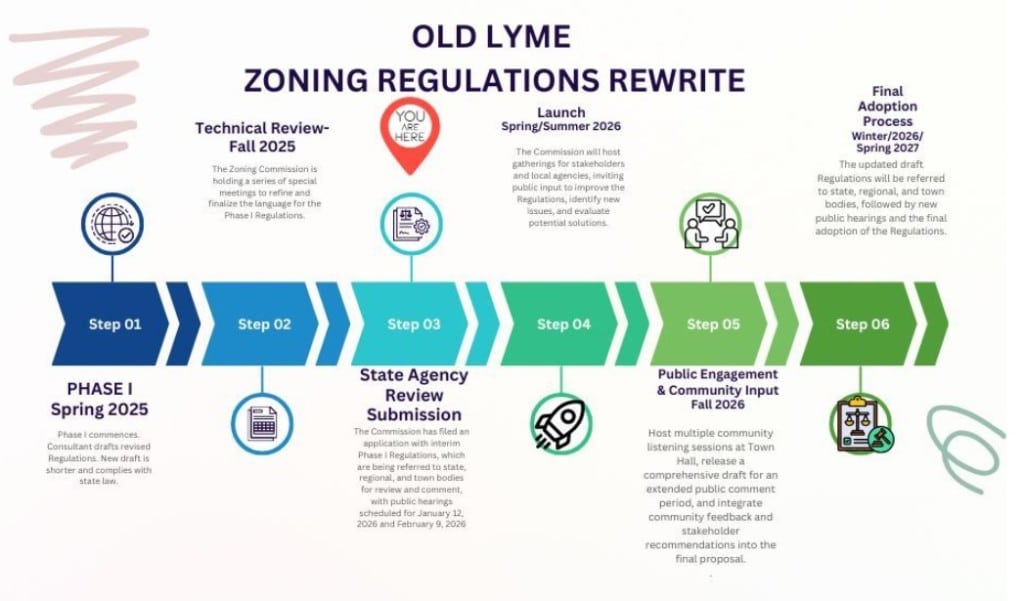
OLD LYME, CT – A comprehensive update to the town’s zoning regulations is entering its second phase as local officials begin seeking broader community input on the guidelines that dictate what can get built, and where, in town.
The upgrade is set against the backdrop of rising sea levels, state directives to expand affordable housing, and efforts to improve the Halls Road commercial district. Land Use Coordinator Eric Knapp said this week addressing those issues depends on zoning regulations that are clear, current and aligned with what residents want for Old Lyme’s future.
The regulations last went through an overhaul in 2008.
The town hired FHI Studio, now known as IMEG, for $129,776 in late 2024 to guide the two-year rewrite process.
Since then, the Zoning Commission and its consultants have worked through the regulations to bring them into compliance with current state law, reorganize sections and remove outdated language. The commission expects to complete that phase at its February meeting, with the revised regulations taking effect March 1.
Knapp said the second phase relies heavily on public input as part of a sweeping review of the rules that dictate how land can be used.
“The Zoning Commission doesn’t get to hear on a regular basis from people who own things here in town or operate businesses,” he said. “So here’s a chance to come in and say, ‘we want this,’ ‘we don’t like this,’ or however it’s going to play out.”
He described a plan for one or more meetings at beach association clubhouses to hear concerns related to Federal Emergency Management Agency (FEMA) requirements and flood zone regulations. Separate workshop-style meetings are also planned for business owners.
He said the process is not about the impossible task of making everyone happy, but about making sure everyone is heard.
He used the example of business signage, a perennial zoning issue.
“Are we going to have 50-foot-tall signs with internal illumination? No, probably not. But at least we can say, ‘look, we want to try and work with you to make sure you get the visibility you need, and we want to try to understand how to make the process easier for you,’” he said.
From Halls Road to Flood Zones
Knapp said the approach is informed by lessons learned from past controversies, including the Halls Road redevelopment debate.
A failed application in front of the Zoning Commission last year for the Halls Road Overlay District (HROD) would have allowed apartments in the commercial zone. The “Overlay? No Way!” crowd was evident in signs across town and at a public hearing that filled the high school auditorium to maximum capacity. A large majority of the 550 attendees came out in opposition.
“I think, in hindsight, one of the things that went wrong with the Halls Road situation was that there was not a sense that the community had the opportunity to come in and be heard prior to the zoning application, and the big hearing we had in the high school with everybody yelling and screaming,” he said.
Knapp pointed to flood zone regulations as a concern raised by the Zoning Board of Appeals (ZBA). Because of height limits and small lot sizes, many homeowners seeking to elevate houses to meet FEMA requirements must apply for exceptions.
He said the frequency of variance requests for home elevations suggests the regulations are not working.
He said the variance process can be costly because property owners often must hire lawyers, engineers, architects and surveyors.
“We’re making it more expensive and more difficult to become flood zone compliant, when the goal should be to get as many people flood zone compliant as possible,” he said.
The review comes as local, regional and state officials work to understand the implications of a wide-ranging housing law signed by Gov. Ned Lamont in November, which includes a provision requiring towns to allow buildings with two to nine residential units – including duplexes, triplexes, cottage clusters, and townhouses – in commercial or mixed-use zoning districts unless public health or safety is compromised. The requirement goes into effect on July 1.
State consultants recently found there are about 120,000 more low-income families than there are affordable places for them to live.
Knapp noted lawmakers are expected to consider revisions during the 2026 legislative session, which ends in May.
“It’s a bit of a moving target,” he said. “We didn’t want to act too soon and then have to go back and revise our regs further based on whatever new changes are coming down the pike on this. The thought was, let’s just be patient, see what the fallout is.”
The second phase of the zoning rewrite is expected to run through the summer, with adoption targeted for late 2026 or early 2027. Knapp said other issues likely to be addressed include accessory apartments, mixed-use development and signage.
Buttoning up Phase One
While most Phase One changes are technical, Knapp said the removal of minimum house size requirements is substantive.
Currently, a single-story home must be at least 800 square feet and a multi-story home must be at least 1,200 square feet. The proposed change eliminates the minimum requirements, which state law no longer allows municipalities to regulate.
“I am sure there are probably residents of Old Lyme that would like to keep the minimum house size,” he said. “It’s just not available to us under the statute anymore.”
Other updates include replacing references to a local health director with the regional health district and updating coastal terminology to reflect current regulations.
The Planning Commission will meet Thursday, Jan. 29, to decide whether the first round of proposed zoning updates aligns with the town’s long-term planning goals. If the answer is no, state law would require a two-thirds majority of the Zoning Commission to adopt the changes.
The Zoning Commission is expected to vote on the changes Monday, Feb. 9. Information about the rewrite is available on the Land Use & Zoning page of the town website, with additional updates planned as the second phase begins.
“We’re trying to be responsive to community concerns,” Knapp said.
A virtual open house on the first phase of updates to the town’s zoning regulations will be held from 9 a.m. to noon Saturday, Jan. 31. Residents and property owners are invited to drop in to ask questions and talk about the proposed changes with the project manager from IMEG, the town’s planning and design consulting firm.
Author

Related Articles

In the LymeLight: Old Lyme’s Tree ‘Commish’ and Academic Accolades
A longtime Old Lyme Tree Commission leader steps aside and local students earn academic honors as we celebrate our neighbors in Lyme and Old Lyme.
UPDATED: Old Lyme Zoning Commission Approves Scaled-Back Riverfront Home in Smith Neck Road Settlement
The move was the commission’s response to a lawsuit filed after members unanimously rejected the controversial housing application one year ago.

Deadline Wednesday: RiverCOG Invites You to Help Shape the Future of Town Centers
The region’s planning organization is seeking local ideas about how to make downtown areas in the Lower Connecticut River Valley more vibrant.