
TOP STORY: Controlling Hydrilla is Critical to CT River’s Health, Best Way to Implement Control Now Heated Discussion Topic
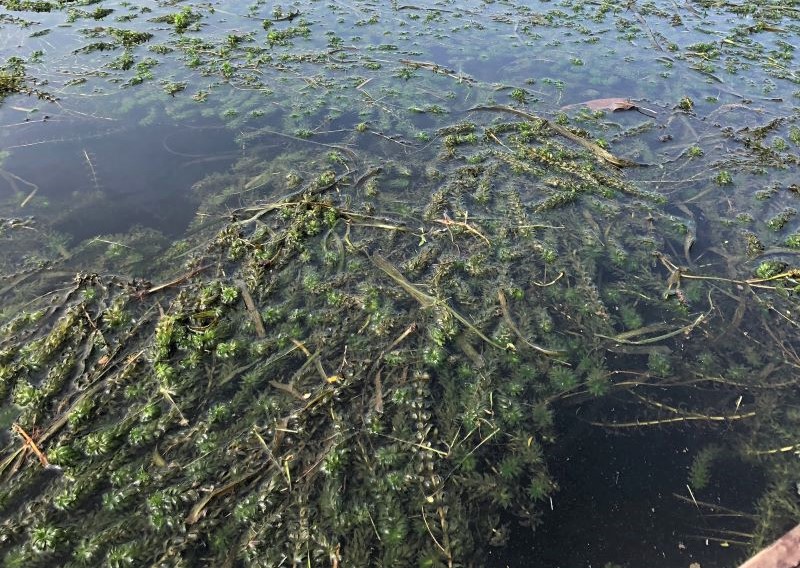
State Legislators say “There has been false and misleading information on social media” about use of herbicide diquat to combat Hydrilla growth in CT River
LYME, CT—Reactions to the use of herbicides in the fight against hydrilla along the lower Connecticut River have only recently begun to spread across social media, but the topic is old news to local property owners long concerned with the pernicious water weed.
Joe Standart, a Selden Cove resident, said the herbicide treatment applied last year as part of a U.S. Army Corps of Engineers (USACE) project worked “beautifully” to rid the cove of a strain of hydrilla unique to the Connecticut River.
“There’s no trace of hydrilla at the moment,” he said in a phone interview Wednesday. For four years prior, fast-growing and thick mats of the aquatic weed had rendered the water body impassable to power boats and inhospitable to many fish and native plants during the height of summer.
Efforts to plan the next phase of the Connecticut River Hydrilla Research and Demonstration Project are ongoing despite federal funding limitations exacerbated this year by the threat of a government shutdown and related costcutting measures.
Keith Hannon, USACE Project Manager, said Selden Cove may get another treatment this summer using money approved by lawmakers in the previous budget. But a proposal to add Hamburg Cove and Joshua Creek to the treatment mix, along with additional chemicals, will not happen this year.
Meanwhile, critics of the state and federal effort to bring hydrilla under control – including a rap artist originally from Fairfield County, whose online petition has amassed 18,839 signatures to date – have gone viral with concerns about toxicity and a lack of government transparency.
The petition calls on authorities to discontinue the use of the herbicide diquat dibromide while focusing on “non-toxic, mechanical and biological alternatives” to manage the plant.
Documents from USACE engineers show the treatment last year in Selden Cove consisted of Dipotassium salt of endothall, while sites in four other towns along the river were treated with chemicals including diquat.
A proposal for 12 additional sites currently under review specifies diquat is slated to be used in Hamburg Cove and Joshua Creek.
Diquat is approved by the U.S. Environmental Protection Agency (EPA) and state Department of Energy and Environmental Protection (CT DEEP), according to Hannon. He said EPA approvals are based on field and laboratory studies that show the active ingredient doesn’t cause unreasonable risk to humans or the environment.
He said the threat of the genetically distinct strain of hydrilla is real.
“It spreads quickly and aggressively, forms dense monoculture mats of the plant that block light which native plants need, prevents fish passage and boat traffic during the summer months, threatens native aquatic plant species by displacing them, and threatens the local river tourism and recreation economy, among other negative effects,” Hannon said.
It can also lower property values and increase an area’s flood risk, the USACE said in a statement.
A Public Statement issued July 8, led by State Representative Renee LaMark Muir and signed by 18 state legislators states, “There has been false and misleading information on social media that has triggered fear among residents about the use of the herbicide diquat to combat the growth of Hydrilla in the Connecticut River.”
The Statement continues, “If we do not act now, the ecosystems of the Connecticut River will be changed forever, and the river may never recover. Understandably, the use of any chemical in our environment causes concern. If we do nothing, the Hydrilla problem will worsen, and other invasives will proliferate.”
Congress allocated $5 million in 2024 and $6 million in 2023 to address hydrilla in Lake Champlain and the Connecticut River, and in 2022 authorized $1 million for the Connecticut River.
At the state level, the Office of Aquatic Invasive Species was created in 2022 with roughly $600,000 in funding annually.
Selden Cove, Pameacha Pond in Middletown and Petzold’s Chester Boat Basin remain the only sites that may be treated this year amid budget constraints, according to Hannon. A public notice will be posted to the project website once a treatment schedule has been determined.
An informational meeting on the proposed modifications affecting Lyme was held at the Town Hall in April. Comments on the project will be accepted through July 13 at CTRiver-Hydrilla@usace.army.mil.
Natural Limitations
The project, overseen by the USACE in partnership with the Connecticut Agricultural Experiment Station and other organizations, began several years ago to figure out which aquatic herbicides ― and how much of them ― are best suited to fighting off the uniquely pernicious aquatic species.
Scientists in 2023 applied red dye to Selden Cove to mimic the flow of herbicide. It was a precursor to last year’s treatment meant to gauge the safest, least toxic way to stem the problem.
Standart, who has spoken with scientists from his property at Selden Cove and has looked into the issue himself, said he was assured herbicides are carefully chosen based on the characteristics of each water body. He has also come to see it as the only effective option.
He said pulling out hydrilla by hand doesn’t work because roots remain in the sediment and broken fragments can rapidly sprout new plants in new locations.
Hannon pointed to the limitations of other natural options.
He said introducing fish like grass carp – which he described as difficult to control, monitor and remove from the system – means beneficial native plants would be consumed in the process. And installing man-made mats to block the light would also kill off native plants – if it were feasible to cover such large areas, which Hannon said it is not.
“Other methods to control the plant have been considered, but they do not work to effectively control hydrilla,” Hammon said.
Standart said all signs of hydrilla disappeared within about a week of the herbicide application last August. But other forms of vegetation beneficial to the cove remained.
“It’s still a very healthy ecosystem with wild rice and other things,” he said.
Editor’s Notes: (i) Visit this link to read more information about hydrilla from the U.S. Army Corps of Engineers is available here. For more facts on the USACE and ERDC’s efforts to eradicate Hydrilla, visit this link.
(ii) The statement signed by the legislators states, “We can all help slow down the spread of this invasive and highly transmissible strain of Hydrilla and other invasive plants. CT DEEP and USACE recommend the best way is to “Clean, Drain, Dry” your boats and any type of watercraft and fishing gear after removal from the river or a lake. Report any sightings of the strain to DEEP at this link or to the Connecticut River Conservancy at this link.”
Author

Related Articles
RiverCOG Lays Out Regional and Local Options Under State Housing Law
Here’s what a new state housing law means for towns like Lyme and Old Lyme, and how they can choose a path for housing growth within their borders.

From Seniors to Families to Pets, Estuary ‘Giving Tree’ Spreads Help Across the Region
The Estuary invites neighbors to make a meaningful impact in local lives by taking part in its Giving Tree initiative, now through the end of the year.
