
TOP STORY: The Ones Who Didn’t Win: A Short History of Electing First Selectmen in Small-Town Connecticut
We take a look at how selectmen are elected in small towns like Lyme and Old Lyme.
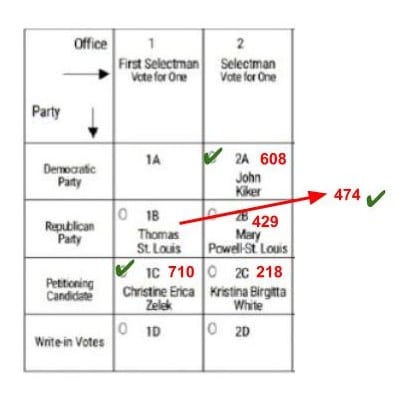
LYME–Some residents may notice a little quirk in municipal election law when it comes to picking the top officials in small towns like Lyme and Old Lyme.
Lyme Town Clerk Linda Winzer has years of experience guiding confused citizens through the ballot that separates the three-member Board of Selectmen into races for “First Selectman” and “Selectman.”
She said the top vote-getter in the first selectman race earns the title, and the other candidates — those who ran unsuccessfully for first selectman and those running for selectman — are counted together to fill the remaining spots on the Board of Selectmen.
Essentially, the loser of the first selectman’s race is thrown into the race for selectman – but Winzer prefers not to describe it that way.
Instead, she said the first selectman candidate “who didn’t win” gets a chance to serve the town in a different role instead.
It’s a distinction that matters in a town where public service and goodwill among neighbors have long trumped competition.
The practical implications of the process were seen this Election Day in Lyme when voters elected Democrat-backed unaffiliated candidate Christy Zelek as first selectman, with opponent Tom St. Louis bumped down to the selectman contest. Of the three remaining selectman candidates — Republican Mary Powell-St. Louis and incumbent Democrats John Kiker and Kristina White — only Kiker won a seat. The third seat went to St. Louis, who outpolled his wife and White.
Kiker was the endorsed Democratic candidate and White, although a Democrat, ran as a petitioning candidate because state law specifies a town committee may only nominate one candidate for selectman when the board of selectmen is composed of a first selectman and two selectmen.
In Old Lyme, the reelection of Democratic First Selectwoman Martha Shoemaker relegated Republican challenger John Mesham to third selectman. That’s where he displaced his running mate, one-term Republican Selectwoman Jude Read, for a seat at the table with incumbent Democrat Jim Lampos.
Eastern Connecticut State University History Professor Tom Balcerski, director of the university’s Center for Connecticut Studies, said the creation of the first selectman position goes back to a state law passed in 1945. The broader selectmen concept, however, is as old as the American colonies.
The postwar law included the provision that votes for the “unsuccessful candidate” in the first selectman contest count toward the selectmen’s race. The state Superior court almost 15 years later upheld the standard on the grounds that it was consistent with the “historical plurality rule,” which essentially says the candidate with the most votes wins. The judge went on to say the logic works down the chain as well, with the unsuccessful candidate for first selectman deserving a seat among the rest of the selectmen if he earned enough votes.
Balcerski postulated that because lawmakers in the post-war era were living in what we now know as a less partisan time, they assumed parties would nominate their strongest public servants to this newly created first selectman role.
“And the idea is that if someone’s running for first selectman, it should not preclude them from still serving,” he said. “There’s this notion of public service on the board itself.”
Balcerski compared it to the similar but much older notion, enshrined in the Constitution until the 12th amendment, that the president would be the highest vote getter and the vice president would be the second highest vote getter. Obviously that didn’t pan out, and now the president and vice president run on a ticket.
He acknowledged the “Jeffersonian problem” of having a federalist as vice president was a real issue in the national setting. But he argued the landscape is different at the town level.
“I think it still has to be argued that in a local setting, where it’s neighbor and neighbor, that two people from different points of view can work together,” he said.
The provision also exists as a check to ensure both parties are represented on the Board of Selectmen, predating state minority representation statute protections that limit how many members of the same political party can serve on one board.
Because neither Lyme nor Old Lyme has adopted a municipal charter, they must follow the state law.
Balcerski, who grew up in New Jersey before becoming an expert on the Nutmeg State, described the arcane first selectman rule as “very Connecticut.”
“It’s quirky, but honestly, good luck trying to get a town to change a tradition,” he said. “It’s been around for centuries.”
No Losers
In the 1970s, towns were given the option to opt out of the first selectman election framework by adopting a charter, special act or ordinance. At the center of the push was the town of Willington in the northeast part of the state.
Willington’s state represenative at the time argued the town should have the right to decide for itself what happens to the unsuccessful first selectman candidate.
Then-state Rep. Robert “Skip” Walsh of Coventry is described in a 1999 Office of Legislative Research report urging the state not to put its thumb on the scale of small town politics.
Walsh said the state statute at the time effectively limited each party to a couple of candidates each for first selectman and selectman – “and then one out of the four loses.”
Willington residents at the public hearing in Hartford at the time said the law requiring a losing first selectman candidate to join the Board of Selectmen creates voter confusion, fosters potential conflict between members, gives the unsuccessful first selectman candidate an unusual advantage, and blurs the distinction between the administrative first selectman role and the legislative selectman role.
Walsh at the time advocated for a more straightforward election approach.
“One shall win; one shall lose,” he said. “And the loser will be out of the picture, and that’s it.”
Balcerski said the partisan language in the Willington case is a sharp contrast to state election law, which does not set up civic duty as a binary choice.
“That’s partisanship creeping into our view of government,” he said. “If you see a world of winners and losers, under no circumstance should the loser be permitted a share in government.”
He reiterated lawmakers’ sense of optimism when they trusted that political parties would put forth their best candidates, and that those candidates could work together in whatever hierarchy the voters decided. That postwar confidence endures in some of the smallest towns of what’s long been called — with both affection and irony — the “Land of Steady Habits.”
“It actually is not necessarily the biggest compliment, because it comes from the colonial revolutionary period into the early republic whereby we just kept electing the same people over and over and over, more even than the rest of New England,” Balcerski said. “But I find that that is just bedrock in this place that we live in.”
Lyme, through it all, has remained rock solid as the ledge it’s built on. The foundation is public service. It’s a point that Winzer, the town clerk, underscored back when she carefully explained how the town’s top board is formed.
“I don’t like using the word loser,” she said.
Author

Related Articles
Start Your Super Bowl Sunday at the Lyme-Old Lyme Lions Club Pancake Breakfast
The annual all-you-can-eat breakfast supports scholarships for graduating high school students and adult first-time college students. It features food, raffles and family fun.
In the LymeLight: Old Lyme’s Tree ‘Commish’ and Academic Accolades
A longtime Old Lyme Tree Commission leader steps aside and local students earn academic honors as we celebrate our neighbors in Lyme and Old Lyme.
Night Out for Adults: Musical Bingo at Old Lyme Library, Jan. 23
It’s bingo with a musical twist for the 21+ crowd at the Old Lyme Phoebe Griffin Noyes Library!