

Talking Transportation: The High-Speed Railroad Never Built … 120 Years Ago
A 10-hour trip between Chicago and New York seemed brilliant in 1905. But when money ran out, the railroad never made it out of Indiana.
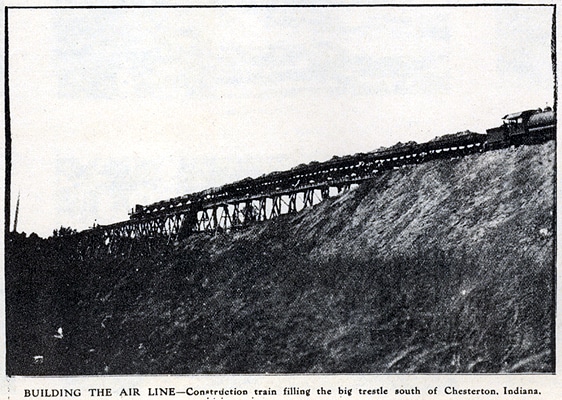
What happens when a great transportation idea gets ahead of itself? Consider the story of the greatest American railroad that never got built.
We are all familiar with The Twentieth Century Limited and The Broadway Limited, the crack trains of the New York Central and Pennsylvania Railroads that ran for decades between New York and Chicago.
Those daily trains defined deluxe, pampering passengers with plush Pullman cars, fine dining and even an on-train barber shop. But they each took up to 20 hours to make the run because they took different, circuitous routes. The New York Central followed the “water level route” north to Albany, then across upstate New York and down the coast of Lake Erie. The Pennsylvania Railroad’s “Broadway Limited” (which would start in 1912) journeyed south to Philadelphia, then west to Pittsburgh and beyond.
But way back in 1905, inventor Alexander Miller had a better idea: build a brand new, flat and straight interurban railroad that would run directly between the two cities. It was the The Chicago–New York Electric Air Line Railroad.
Even over 120 years ago Miller knew the importance of straight-running tracks to achieve and hold high speeds, a lesson we in Connecticut wish they’d learned before building the New Haven Railroad along our winding coastline.
Miller’s train would be “faster than the limited” and make the run between New York City and Chicago in just 10 hours for $10 a ticket (worth about $380 today). Powered by the new marvel of electricity, the train could operate at a third the cost of steam engines. And by running in a straight line, the 743 mile route would be 168 to 237 miles shorter than its competitors. In principle, it was brilliant. And the timing was perfect.
Mind you, this railroad’s interurban cars (think trolley cars on steroids) might not be as plush, but they would average 70+ mph thanks to the almost flat grade of one percent and no pesky grade crossings. There would also be few stops as the route would bypass all major cities. And this train would be fast … 100 mph on the straightaways!
Two million dollars worth of stock was issued with shareholders promised first priority for thousands of potential jobs. Railroads were the dot-coms of the era, and people rushed to invest. With no bonded debt, the company’s prospectus promised stock dividends of 14% on top of the shares’ appreciation. You just couldn’t lose!
Construction began from west to east, as the railroad would open in stages to help pay for itself and fund further construction toward New York. A mighty four track railroad, akin to Metro-North, was envisioned and it was hoped that the project would be completed in just ten years. Spur lines would be constructed to serve the cities bypassed by the “air line.”
Then, reality set in with the depression of 1907–1908.
Construction got as far as Chesterton, Indiana, about 50 miles east of Chicago, when the money started to run out. The engineering of this mighty railroad was just too expensive.
Shareholders revolted when news came that the railroad’s officers were getting fat paychecks as the coffers were drained. A hoped-for bailout by British banks never happened. Those shareholders lost everything. And the impending arrival of automobiles might have doomed the line anyway. Even The Twentieth Century and Broadway Ltd eventually succumbed to the competition of true “air lines.”
But for a brief moment, a century ago, a dream almost became a reality in the greatest railroad that never was.

About the Author: Jim Cameron is the founder of the Commuter Action Group and advocates for Connecticut rail riders. His column is published by several publications in the state.
Author
Related Articles

Talking Transportation: The Drone Delivery Debate
Amazon wants FAA approval for up to 1,000 daily drone flights over North Haven and surrounding communities. Residents are pushing back.

On the Food Scene: Four Ways to Enjoy Apples This Fall
A chef, mixologist, barista and pastry chef share recipes inspired by this classic seasonal staple.

Talking Transportation: The Final Boarding Call
Jim Cameron revisits the airlines of a bygone era, from Mohawk (‘Mad Men,’ anyone?) and Braniff to Hooters Air, when flying was “fun and cheap.”