

Op-Ed: Notes from the Jim Crow North
Old Lyme resident and Connecticut College professor Eileen Kane examines the history of racial covenants in local property deeds and their lasting impact.
Eileen Kane, an Old Lyme resident, is a professor of history at Connecticut College with a doctorate in history from Princeton University.
Recently I went to Old Lyme Town Hall to do an experiment. Using the public computer in the Clerk’s Office, I looked up the deed to my property on Whippoorwill Road. I wanted to see if there were racial covenants on my deed.
Restrictive covenants are legal clauses used to curate the character of a community and to preserve property values. They are designed, for instance, to keep residential and commercial districts separate, to preserve architectural styles, or to ban noisy roosters from neighborhoods. Until 1968 it was legal in Connecticut to also add covenants to control the racial and religious makeup of towns.
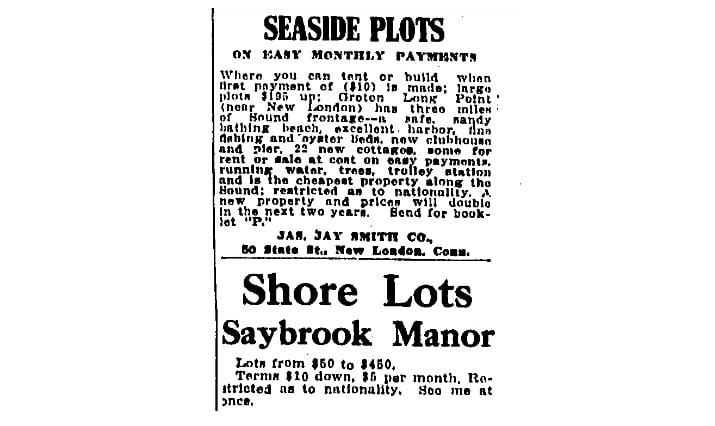
Researchers at Trinity College have begun to map the geography and history of racial covenants in Connecticut, and they have found a pattern of concentration in waterfront and suburban developments built between the two world wars.
1920s Connecticut saw a big construction boom of summer cottages and beach bungalows to serve the emerging community of middle-class workers in Connecticut’s industrial cities who could now afford to buy or rent a summer house. These workers were a mix of immigrants from Ireland, Italy and Eastern Europe; Puerto Ricans recruited from the island to fill local factory jobs in Connecticut’s defense industry; and Blacks who came north in the so-called Great Migration to escape the violence and humiliations of the Jim Crow South.
Not all of these workers got to enjoy the new summer houses. To keep Blacks, Latinos and Jews out developers of places like Old Lyme Shores, Black Point in Niantic and Lake Hayward in East Haddam wrote into deeds that the property must be sold or rented “Only to people of the Caucasian Race,” and to “No one of the Hebraic race.”
I didn’t find a racial covenant on my property deed. But I did find some on beachfront properties, and I expect to find more when I return to continue my research. Property deeds are public records so anyone can do this research; and a 2021 law makes it possible to have the town clerk remove a racial covenant from your deed at no charge.
I grew up in the 1980s in a seaside town north of Boston much like Old Lyme. There was one Black person in the town, a classmate who’d been adopted. And there was one Japanese man married to a white woman. I don’t ever remember wondering why everyone around me was white like me. No teacher ever explained to us why our town looked that way. And in the absence of questions and explanations, I suppose that these assumptions took hold: that Black and Brown people didn’t want to live here, that they chose to live elsewhere, that they couldn’t afford to live in our beautiful town, and that it was normal for small New England towns to be white.
We often think of Jim Crow as a Southern thing. Our kids now taking Advanced Placement U.S. History at Old Lyme High School will learn that Jim Crow was a system of legal discrimination against Blacks in the South, and that anti-Black discrimination outside the South was rarely written into laws. But we don’t know that yet because research into racial covenants and laws in Connecticut and other northern states has only just begun. Also, that’s not how discrimination works; you don’t need a law on the books for access to full rights and privileges to be impossible for some citizens.
Our kids have opportunities to learn what we couldn’t in public school. In 2019 Connecticut became the first state that requires high schools to offer courses on African American, Black, Puerto Rican and Latino Studies. And if the district approves it, our kids can also take the new AP in African American Studies. I just emailed the Board of Education to ask that they make this happen. If you are from town and are interested, you can too: boardclerk@region18.org.
A colleague of mine, a professor of African American history, sums up Jim Crow in one word: theft. I think of this when I remember how my father, a Vietnam veteran, used the GI bill to buy our first house and boost our family up into the middle class, and how one million Black veterans of World War II and the Korean War were denied this intergenerational wealth-producing benefit due to racist housing practices. And I thought of this today when I learned that Point Lookout, Long Island, where I spent summers splashing in the waves at my grandmother’s 1940s oceanside bungalow, was a covenanted community reserved for white people.
Related Articles

Letter to the Editor: Sister Voices Support for Emma Griffith on Region 18 BOE
Abby Griffith cites her sister’s recent experience in the school system, engineering background and understanding of technology shaping students’ lives.
Letter to the Editor: Lodge Endorses Lott for His Former School Board Seat
Former Region 18 Board of Education member Gavin Lodge urges Lyme voters to support Jodi Lott in the special election for his seat.
Comments (0)
There are no comments on this article.