

More Than 25 Years Later, an Old Lyme Teen’s Invention Still Resonates in Mosquito Control
Michael Nyberg’s award-winning invention led to a patent, a company and a mosquito-control device now used in the U.S. and abroad.
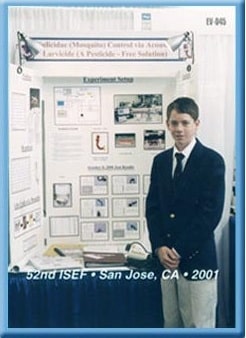
OLD LYME, CT – In 1999, even before entering his acoustic mosquito larvae killing invention in a science fair, a then-ninth grader and later graduate of Lyme-Old Lyme High School received a patent and started a company with his father.
The technology uses sound to kill mosquito larvae and got Michael Nyberg first place in the Connecticut Science Fair.
The young inventor’s father, Herb Nyberg, said the technology, paired with a trap – the Sirenix Mosquito Trap, which attracts female mosquitoes on the verge of laying eggs – is now the focal point of family-run New Mountain Innovations Inc.
Nyberg lived in Old Lyme for 30 years and moved to Marathon Florida in 2022.
Michael Nyberg, who was not available for an interview for this story, lives in Colorado and is a project manager and former U.S. Air Force officer. He went to Clarkson University.
Nyberg said his son’s career endeavors have made it difficult for Michael to work very much with the company.
Nyberg pointed out that the company name comes from their last name. Nyberg means “new mountain” in Swedish, he said.
He also noted that the trap’s name is a play on the siren’s song from Greek mythology. In Homer’s “Odyssey,” sirens sang a melody that lured passing sailors to their death.
Nyberg continues to make advances on Sirenix and said in the next year or so, there will be updates that will tie the devices to cell phones for notifications about the water level in the trap and to locate them on a map, which will come in handy for public health officials using a large number of the devices in an area.
While there is a plug-in version of the device that is used in other countries where mosquitoes in homes are a problem, he said the majority of the devices New Mountain sells rely on solar power.
The creation of the device started when Michael was looking for a science fair project, according to Nyberg. He asked his father – who was an officer on the USS Pargo submarine and lead instructor on sonar at the Naval Submarine School in Groton – if sound could be used to kill mosquitoes. Nyberg’s reply was that acoustics could possibly be applied to killing mosquito larvae.
By that time, Michael had already been to the Connecticut Science Fair with what his father called “a serendipitous discovery on a mechanism of rusting.”
Nyberg had his son seek out the mentorship of his then boss, Jim Fitzgerald, president and founder of The Kildare Corporation, in New London, which has since closed.
After learning from Fitzgerald, Michael made a device that when held in water sends out low-frequency sound waves that kill the larvae. He and his father tried it out, and showed the results to Fitzgerald.
“We just put mosquito larvae in the water and they just kept dying,” Nyberg said.
Fitzgerald pointed out that the device matched vibrations of the breathing system of mosquito larvae, Nyberg said.
With that tidbit in mind, they applied for a patent, he said. A few weeks later, the application and all their claims about it were rejected.
While the patent attorney they were working with was disappointed, Nyberg was certain the rejections were an error. He believed that the person in the patent office saw the title of the invention, and knowing that acoustics previously used to trap mosquitoes had a reputation of not being successful, he simply said “no” without reading further.
Nyberg made a phone call and explained that this invention was different from earlier applications of acoustics to control mosquito populations. Nyberg was already aware those older versions did not work, he said.
A couple of weeks later, the technology was awarded a patent, which was applied to a line of products under the trade name Larvasonic – and New Mountain was born.
Shortly thereafter, Michael won first place at the state science fair, Nyberg said. In 2003, he was a finalist in the Intel Science Talent Search in Washington, D.C.
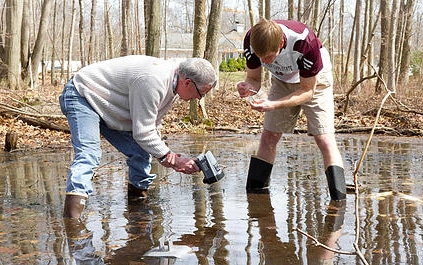
In 2017 the company created Sirenix and patented the Acoustic Lethal Ovitrap, which was designed as a consumer project but is also used by public health officials.
Shaped like a tire and filled with water, the trap lures in females about to lay upwards of 500 eggs. The acoustics device, which is automatically applied every four hours, kills the larvae.
Because the device is reliant on acoustics versus pesticides, the water in the trap is good for wildlife and helpful to butterflies and other pollinators, Nyberg said.
In one video Nyberg sent to LymeLine, a raccoon is sipping water from the trap and in another the sound device is set off while larvae sit on top of the water; the eggs explode and sink to the bottom.
“The resonant sound blows them up instantly,” Nyberg said.
The device also works on other mosquito breeds, including Culex, which can carry West Nile Virus and is prevalent in New England, Nyberg said.
This summer, Nyberg gave a presentation on New Mountain’s research and discoveries at an international conference in Thailand. Most of the other presenters were academics and public health officials. Nyberg, a former nuclear engineer who worked on a submarine, said he offered a different perspective.
The company has learned a lot about the biology of mosquitoes, especially their respiratory systems, he said. Much of the information is counter to what was previously believed by the scientific community.
“Killing (mosquitoes) acoustically brought to life a lot that was not known in the past,” he said.
In 2020 the company published a paper in Nature’s “Scientific Reports.” Titled “Acoustic Tracheal Rupture Provides Insights Into Larval Mosquito Respiration,” Nyberg said it has disrupted over 350 years of established dogma on mosquito larvae respiration.
Prior to the paper, it was believed that mosquito larvae hanging from the water’s surface needed air from above the surface of the water, but observers found that the larvae store air internally.
If that were not the case, the acoustic larvicide would not work, according to Nyberg.
The plug-in adaptation of Sirenix is used in tunnels in Singapore and countries, including China, where Aedes mosquitoes are a very big problem in people’s homes.
“Having traps in houses has proven to reduce some of the dengue in South America,” Nyberg said.
Dengue, a mosquito-borne viral infection found in tropical and subtropical regions, has recently been found in Florida, Nyberg said.
Charlotte Quinn, CEO of Crane Point Museum and Nature Center, which sits on a 64-acre stand of hardwood trees surrounded by wetlands in Marathon, Florida, uses a Sirenix to control mosquitoes in the museum’s courtyard.
“In the courtyard at dusk, mosquitoes were really bad,” she said. “I couldn’t use it for anything.”
She ran into Nyberg, told him about her problem and got one of the devices, she said. As soon as it was installed, the mosquito population diminished.
“Now you can be in that courtyard day and night and there aren’t any bugs at all,” she said “I love that machine. It cleared up everything. I can have parties again.”
Comments (1)
Comments are closed.
Related Articles

Statewide Program Identifies Lyme’s Composting, Conservation Initiatives as Success Stories
Sustainable CT recognized several local initiatives as “success stories” in efficiency, resiliency and inclusivity with the renewal of Lyme’s bronze-level certification.

Lyme Anthropologist Works to Bring Nehantic Story to New and Old Audiences
John Pfeiffer has spent decades researching Nehantic history, archaeology and descendants ahead of Saturday’s Nehantic Heritage Day.

Roger Tory Peterson Estuary Center Draws Record Crowd for Annual Gala
A celebration of the art of bonsai helped make the Roger Tory Peterson Estuary Center’s annual gala fundraiser the best-attended in its 11-year history.
Last summer, we couldn’t use our 60 foot deck at dusk overlooking the lake, but this year with sireniX, we never had one bite! We enjoyed summer evenings on the deck all summer this year! Thanks, Herb!