

In Old Lyme, Town and Private Beach Associations Clash Over $1.5 Million Sewer Bill
The town says it never became a party to an agreement requiring it to share sewer project costs. Three beach associations disagree to the tune of $1.5 million.
OLD LYME, CT – Three private beach associations say Old Lyme owes at least $1.5 million toward a shared shoreline sewer project, a dispute that could land the town in court.
First Selectwoman Martha Shoemaker earlier this month told members of Old Colony Beach Club Association in an email that the town never officially signed onto the cost-sharing agreement originally executed by the beach associations in 2016.
The beach associations governing Old Colony, Old Lyme Shores and Miami Beach are moving forward with the project despite a failed December referendum that left the town without authorization for additional sewer spending in the Sound View Beach area.
Old Colony is the administrator of the loan for a $27.02 million pump station and pressurized pipe designed to serve sewers in the four beach communities. Federal Clean Water Act funds and a $15 million forgivable loan from the state reduced the total cost to $5.38 million.
Shoemaker’s Aug. 5 email responded to an April memo from Old Colony Beach Club Association Water Pollution Control Authority member Stephen J. Humes, who briefed the WPCA members on what he believes are the town’s obligations under the project. The memo was copied to Old Colony Board of Governors Chairman Douglas Whalen.
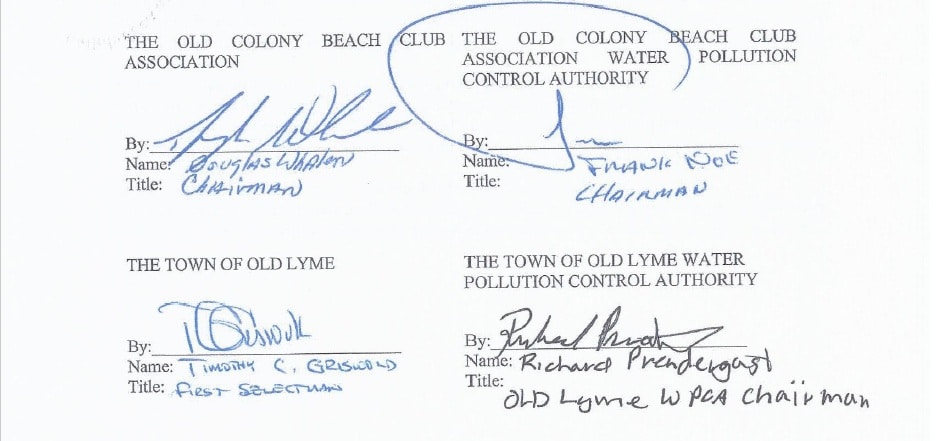
The beach associations maintain the town is responsible for 29.7% of the cost as outlined in the 2020 document titled “Agreement to Add Town of Old Lyme to Beach Associations’ Cost-Sharing Agreement for Sewer Project.”
The agreement also calls for the town to share the same proportion of the system’s ongoing operation and maintenance costs. That means the town’s obligation could extend beyond construction.
But Shoemaker argued the 2020 document was predicated on a formal amendment to the 2016 cost-sharing agreement that “never came to fruition.”
Shoemaker told Humes and Whalen in her email that the town “rejects any information” suggesting the town has a financial obligation under the cost-sharing agreement. The
Whalen on Wednesday said the 2020 agreement was contingent on several conditions, the last of which was satisfied when the town paid $66,000 for its share of project costs incurred up to that point.
“They signed the document, and the document states that as soon as they meet all the qualifications, they are part of the process,” he said. “They met all the qualifications, so they’re part of the process.”
Whalen said equipment is being staged on Route 156, a system is being installed to pump groundwater out of the shoreline construction area and supplies are being purchased. Work is set to begin in earnest after Labor Day.
The timeline remains unaffected by the dispute, according to Whalen.
“The attorneys will have to handle it, but we are moving forward with the project,” he said.
He cited legal action against the town as an option currently under discussion.
“There’s a good chance that we may have to go after the town for their share of the program,” he said. “We hope we don’t have to get to that point, but it’s approximately $1.5 million that they’re responsible for.”
Editor’s Note: This article was updated with context on the April memo from Humes and copies of the April and August documents.
Author

Comments (3)
Comments are closed.
Related Articles

Labriola Calls for Common Sense Approach in 23rd District Run
The Old Saybrook treasurer is running for the 23rd District seat on a platform of affordability, local control and bipartisan cooperation.
Old Lyme Library to Lend Laptops to Eligible Residents
Libraries are partnering with the state to close the digital divide. The goal is to expand access to the tools people need to use important services online.
Old Lyme Zoning Survey Finds Support for Flexibility, Not Major Change
Residents want to preserve Old Lyme’s small-town feel by allowing accessory apartments, limiting data centers and ensuring a say in the future of Halls Road.
The Town (miss)Leadership, Martha and Jim, lied to the the citizens of Old Lyme during the process of referendum approval. While feigning support for the sewer project once all new hurdles they required were achieved, they were meeting with State leaders requesting the project be killed. The total cost to the Town will only grow as long as there are no users from Sound View to pay for the agreement. Jim Lampos lied to the public by including finance costs in his analysis of potential liability, in spite of the fact that the governing state documents specifically indicate finance fees shall be excluded.
Now Martha and Jim have loaded the Old Lyme (or should I say Sound View) WPCA with members that take orders from Town Leadership, thus placing politics above public health. With a sewer system and a pump station designed to handle flow from Sound View, does anyone really think the DEEP will accept an alternative? The sewer project was started by Bonnie Reemshnieder and continued under Tim Griswold. I find it concerning that the Town now wants to kill the project: Who will trust the Town of Old Lyme if they do not feel obligated to honor legal agreements made by previous administrations?
Perhaps Mrs. Shoemaker and Mr. Lampos wanted the system to be built and have external infrastructure paid for by the Town, thus reducing costs to Mr. Lampos and other residents once the DEEP finally forces the Town to install sewers. I believe it is quite telling what most long term members felt about the referendum process when they expressed their dissatisfaction and lack of confidence with the current administration by resigning together in February.
As former Chairman of the WPCA, I can state I believe the Town will be forced into installing sewers in Sound View and believe costs will only increase due to placing politics above public health.
So – Republican First Selectman Tim Griswold puts the town on the hook for millions of dollars — while, of course, failing to actually create the deal or agreement that would have actually met the town’s legal and ethical and environmental obligations.
And this steaming hot mess falls into the laps of Dems — who, to be fair, aren’t covering themselves in glory here either, largely because they suck at basic comms.
But hey — if all these private communities want to suckle at the teat of taxpayer dollars? Great! Make all the beaches public access.
Public money == public access.
The outstanding issue, that could resolve this dispute, is the yet to be plan for the town to resolve the pollution issue at Soundview. Is it possible that the town will ultimately determine the only and least expensive option is to join the shared sewer project?
The DEEP is not going away, time for some adult leadership in town hall. Elections have consequences.