

A View from My Porch: America’s Quarter Millennium – The Summer the Declaration of Independence Took Shape
Between Evacuation Day and the signing of the Declaration of Independence lay 109 days that transformed rebellion into nationhood, and reconciliation into revolution.
This is the third of my Views on the circumstances that led to the Declaration of Independence, the “birth certificate” of the United States as a sovereign nation. In my last View, I considered the strategic actions taken by General George Washington and colonial leadership after the battles at Lexington and Concord that forced the Redcoats and the Loyalists to withdraw, after eight years of occupation, from Boston to Nova Scotia on March 17, 1776. This marked a turning point in the Revolutionary War. After the evacuation, the Second Continental Congress shifted from pursuing reconciliation with Britain to focusing on the war effort and laying the foundation for independence.
In this View, I examine the remarkable events that occurred in the 109 days between Evacuation Day and the signing of the Declaration of Independence on July 4, 1776.
The Lee Resolution: On June 7, 1776, Richard Henry Lee of Virginia proposed that the colonies become “free and independent States,” and sever all political ties with Britain. John Adams seconded Lee’s proposal, indicating Massachusetts’ strong support. However, many delegates lacked guidance from their home colonies on the split with Britain, so Congress delayed a vote for three weeks. Adams later described the Lee Resolution as “the moment Congress began to seriously consider and take steps toward separation.”
The Committee of Five: On June 11, 1776, Congress charged a committee of five delegates with drafting a formal declaration that justified the colonies’ separation from Britain. The committee consisted of John Adams of Massachusetts, Benjamin Franklin of Pennsylvania, Thomas Jefferson of Virginia, Robert Livingston of New York, and Roger Sherman of Connecticut.
Although Jefferson was one of the youngest delegates to the Congress, he was chosen by the committee to write the first draft of the Declaration of Independence. He was widely regarded as a skilled writer and may have had the fewest political enemies in Congress. He had written A Summary View of the Rights of British America in 1774 for the delegates to the First Continental Congress that presented a set of grievances against King George III and Parliament regarding the king’s response to the Boston Tea Party. In 1775, in collaboration with John Dickinson of Pennsylvania, he prepared the Declaration of the Causes and Necessity of Taking Up Arms, defending the colonies’ armed resistance to British policies. This was adopted by the Congress on July 6, 1775. Moreover, Jefferson represented the interests of Virginia, an influential southern colony, and his leadership would provide regional balance and generate a more united front against Britain. Jefferson was a scholar of the Enlightenment and profoundly influenced by the political philosopher John Locke. The Enlightenment movement emphasized the use of reason and rationalism to challenge traditional authority and established doctrine. Enlightenment thinkers believed in the potential for human progress through reasoned action and scientific discovery. Locke contended that all individuals are born with God-given rights that include the right to life, liberty, and property. He argued that government should derive its authority from the consent of the governed rather than from divine right or hereditary power.
Jefferson’s “Original Rough Draught”: Jefferson rented the second floor rooms of the Jacob Graff house in Philadelphia for himself and his enslaved valet, Robert Hemmings, while attending the Second Continental Congress. It was in this space that he began composing the initial draft of the Declaration of Independence on June 11. He completed his draft on June 28, 1776 and presented it to Adams and Franklin for review. Historical accounts indicate that Adams and Franklin only made stylistic and grammatical edits to the language and tone of Jefferson’s draft to improve clarity and flow, and make it more persuasive. They did not make substantive structural revisions or change Jefferson’s central philosophical arguments. Livingston and Sherman also provided feedback, and then the committee submitted the edited document to the Congress on June 28, 1776, where it was further debated and revised.
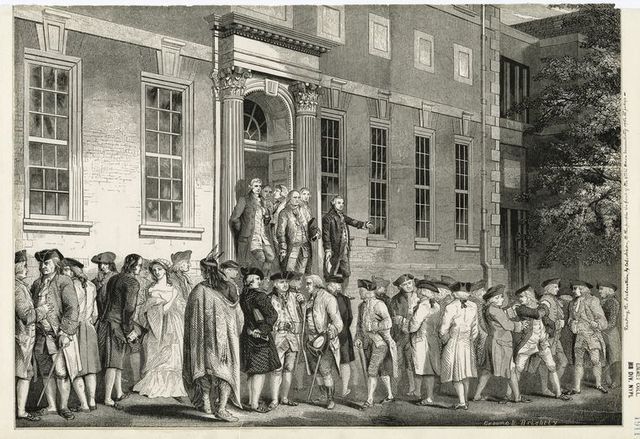
Ratification: The Declaration of Independence was unanimously ratified on July 4, 1776 by the Second Continental Congress. Delegates added their signatures, affirming their commitment to independence. As president of the Congress, John Hancock was the first signatory and his bold signature was notably large and flamboyant. While some have viewed this as an act of defiance against King George III, Hancock claimed that he signed his name as such so that “the King could read it without spectacles.” The Declaration was published by The Pennsylvania Evening Post on July 6, and on July 8, it was read aloud by Colonel John Nixon at noon before a crowd gathered in Philadelphia’s Pennsylvania State House yard. The reading was one of only three simultaneous public readings outside the Congress (public readings also occurred in Trenton, New Jersey, and Easton, Pennsylvania). This was significant because it marked the Declaration’s transition from a formal document to a public proclamation of freedom.
Structure: The Declaration of Independence consists of three sections: 1) the “Preamble” (or introduction), 2) “A Statement of Grievances,” and 3) the “Resolution of Independence.” The “Preamble” serves as the opening statement of the Declaration and lays forth the philosophical foundation for a new nation. In it, Jefferson articulates the principles of the Enlightenment with the opening lines, “We hold these truths to be self-evident, that all men are created equal, that they are endowed by their Creator with certain unalienable Rights, that among these are Life, Liberty and the pursuit of Happiness.” It continues, “That to secure these rights, Governments are instituted among Men, deriving their just powers from the consent of the governed,” and it further asserts, “That whenever any Form of Government becomes destructive of these ends, it is the right and duty of the People to alter or to abolish it, and to institute new Government, laying its foundation on such principles and organizing its powers in such form, as to them shall seem most likely to affect their Safety and Happiness.” The “Statement of Grievances” details twenty-seven specific complaints against King George III and the British government regarding the repeated violations of rights and acts of tyranny. Congress cast “the causes which impel them to separation” in universal terms, targeting an international audience. The most important and dramatic statement comes in the “Resolution of Independence”: “the good People of these Colonies, solemnly publish and declare, That these United Colonies are, and of Right ought to be Free and Independent States; —and that all political connection with Great Britain is totally dissolved.” It is noteworthy that is the first time the colonists explicitly and collectively labeled the king as a tyrant.
The Greatest Sentence Ever Written: In his book of the same name, distinguished journalist Walter Isaacson designates the statement that begins “We hold these truths to be self-evident” as “the greatest sentence ever written.” Jefferson had captured the fundamental ideals of the new nation and stated the principles on which our government, and our identity as Americans, would be based. “It encapsulates the foundational ideals of the United States and expresses a universal aspiration for human equality and rights; and has become a symbol of liberty, justice, and the American Dream, inspiring generations to pursue freedom and equality,” Isaacson writes. He also addresses the contradictions inherent in the founding ideals, particularly regarding slavery and the apparent exclusion of women and Native Americans from the rights it professes. He acknowledges the moral complexities—forty-one of the fifty-six delegates were slave owners—while defending the sentence’s aspirational nature.
Historian David Armitage has written in his book The Declaration of Independence: A Global History that “not only did the Declaration announce the entry of the United States onto the world stage, it became the model for other countries to follow.”
In my next and final View on the Declaration of Independence, I will examine the document as a model for other countries and how the words in the “Preamble” have been echoed by various statesmen throughout the decades.

About the author: Tom Gotowka spent his career in healthcare. He will sit on the Navy side at the Army/Navy football game. He always sit on the crimson side at any Harvard/Yale contest. He enjoys reading historic speeches and considers himself a scholar of the period from FDR through JFK. A child of AM Radio, he probably knows the lyrics of every rock and roll or folk song published since 1960.
Author
Comments (1)
Comments are closed.
Related Articles
A View from My Porch: America’s Quarter Millennium – From Whence We Came
As the United States approaches its 250th anniversary, Thomas Gotowka looks back on the American Revolution and the ideals that shaped the nation.

A View from My Porch: On Surrendering the Mantle of ‘Leader of the Free World,’ Part II
Thomas D. Gotowka delves into claims of election fraud by the Trump administration in this installment of his two‑part series examining unfounded allegations and their impact on democracy.
A View from My Porch: On Surrendering the Mantle of ‘Leader of the Free World,’ Part I
From public health concerns to political spectacle, Thomas D. Gotowka examines a turbulent year in American life and its implications for the country – and the world.
Thank you sir for writing these educational articles, very timely and well written. I have enjoyed them very much!