
State Clears Old Lyme Sewer Project Without Old Lyme
As private beach associations advance a state-approved sewer project, town leaders are reassessing the WPCA’s role.

OLD LYME, CT – Three private beach associations along Old Lyme’s shoreline have been cleared by the state to move forward with a long-delayed sewer project, but questions remain about the town’s financial obligations and next steps.
Doug Whalen, chairman of the Old Colony Beach Club Association Board of Governors, said contracts have been awarded for internal sewer systems in Old Lyme Shores, Old Colony Beach and Miami Beach, as well as for a shared pump station and force main.
He said the goal is to get shovels in the ground for the 18-month construction period before May 1.
The project is moving forward with the three private associations despite a failed referendum vote in December that left the town without authorization to install sewers in the public Sound View Beach area.
State Department of Energy and Environmental Protection (DEEP) spokesman Bill Flood said Friday that the agency gave the go-ahead for the project on Jan. 31 to allow the three beach associations can address their pollution issues.
“The town similarly will need to address its areas of pollution caused by substandard and/or failing septic systems,” he wrote in an email, “and the department continues to believe that connection to the sewer system is the most feasible solution.”
Opponents from the Sound View area have long decried the rising project price tag and the lack of transparency about how much individual homeowners would be required to pay. They’ve also questioned the state’s contention that Sound View septic systems are causing pollution and that sewers are the only way to prevent it.
Whalen said the beach associations continue to invite town officials to project meetings and want Old Lyme to remain involved.
“Our goal is to work with the town to get them up and operational,” he said. “Our goal is not to leave them out.”
For decades, the state agency has pushed for an end to pollution emanating from local beach communities. More recently, a DEEP-mandated consent order involving the three private beach communities led to the current sewer plan, with the town signing on voluntarily in 2019 after voters at a referendum agreed to spend $9.5 million on Sound View’s share.
The town was slated to share the cost of the pump station and force main with the three beach communities.
But voters in December declined to spend an additional $11.03 million on the project, which was added to account for increased costs after years of inaction. About half was to be covered by federal grants and a forgivable loan from the DEEP, according to written information provided by the town prior to the referendum.
Whalen said the town remains obligated for its portion of the pump station and force main under a cost-sharing agreement signed in 2020. Old Lyme Water Pollution Control Authority (WPCA) documents presented in August estimated the town’s cost for the shared infrastructure project at $3.3 million after state funding.
“It is our belief the town is still responsible for their share,” he said.
Scott Boulanger, chairman of the Miami Beach WPCA, was more blunt about the town’s responsibility.
“They can’t wiggle out of what they’ve already been told,” he said.
In a December letter to First Selectwoman Martha Shoemaker following the failed referendum, DEEP Bureau Chief Graham J. Stevens signaled that voluntary cooperation was coming to an end and that a legally enforceable consent order would likely be issued.
Boulanger said he believes the state will ultimately require sewers in Sound View, so the “smart solution” is for the town to honor its cost-sharing agreement now and address construction of the internal Sound View Beach system separately when voters approve it.
He said the worst case scenario would require taking the issue to an attorney if no resolution is reached.
Shoemaker was not available Friday to comment.
Selectmen Seek WPCA Reset
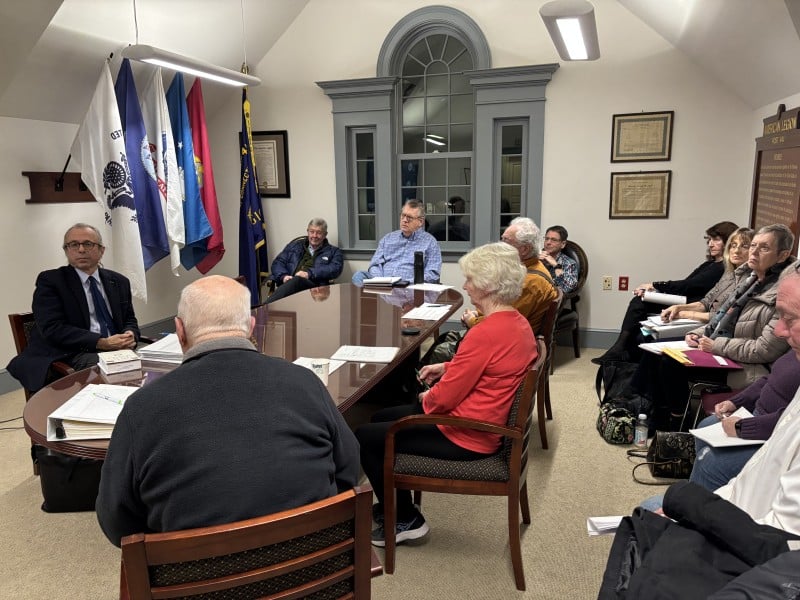
Meanwhile, the Board of Selectmen is slated to hold a joint meeting with the Old Lyme WPCA on Tuesday at 6:30 p.m. before the authority’s regular meeting.
The WPCA is empowered by a town ordinance adopted in 1995 to regulate underground wastewater systems and to implement sewer avoidance plans.
Shoemaker at Monday’s Board of Selectmen meeting said she’d like selectmen to meet with WPCA members to “put them hopefully on a path for success.”
Selectman Jim Lampos noted the disconnect that arises when an agency originally focused on sewer avoidance ends up having to plan a sewer system.
He argued that the WPCA has been consumed with the sewer project rather than regulating septic systems, conducting surveys of existing septic systems or doing groundwater testing.
“And it’s not their fault,” he said.
Shoemaker told selectmen she plans to look into the price of groundwater testing to help get the WPCA started.
Opponents of the sewer plan have long highlighted a lack of current testing to prove the pollution problem exists.
Over the years state officials have reiterated that septic systems are ineffective at preventing sewage from getting into the groundwater when there are many houses, small lots and sandy soil. They’ve pointed to groundwater testing results, including a 2013 report produced by the Woodard & Curran engineering firm, that indicated the presence of raw sewage.
Shoemaker said she agrees with people who don’t understand why the town hasn’t conducted groundwater testing. She described the tests as a necessary step to prove to the DEEP that local water supplies are not being contaminated.
Selectman John Mesham agreed it’s time to provide the WPCA with additional guidance on its role.
“I think it’s time to look at their charge, and maybe tweak, alter, or corroborate as to which direction they should be going,” he said.
He said the WPCA has been taking “a lot of heat” for its sewer plan.
“I think people forgot that that was the task the Board of Selectmen, not necessarily us, started years ago,” Mesham said. “That was the task that was at hand. They shouldn’t be viewed as bad guys because they did what was asked of them.”
Editor’s Note: This article was updated to remove a quote for clarity.
Author

Related Articles
Old Lyme WPCA Debates Direction, Elects New Chair, Amid Shift Toward Sewer Alternatives
With direction from selectmen, the Old Lyme Water Pollution Control Authority is reassessing its responsibilities beyond sewers and debating wastewater strategy, testing data and long-term costs.

Lyme-Old Lyme Boys, Girls Basketball Earn Sweep Over Old Saybrook
A one-point boys victory and a second-half girls rally led Lyme-Old Lyme past Old Saybrook in the Shoreline Conference matchup.

Lymes’ Senior Center Artists Present ‘Golden Age’ Exhibit at Old Lyme Library, Reception Feb. 14
Senior center artists are exhibiting mixed-media work at the Old Lyme Phoebe Griffin Noyes Library through March, with a portion of sales supporting programs for seniors.
Comments (0)
There are no comments on this article.