
UPDATED: Old Lyme Zoning Commission Approves Scaled-Back Riverfront Home in Smith Neck Road Settlement
The move was the commission’s response to a lawsuit filed after members unanimously rejected the controversial housing application one year ago.
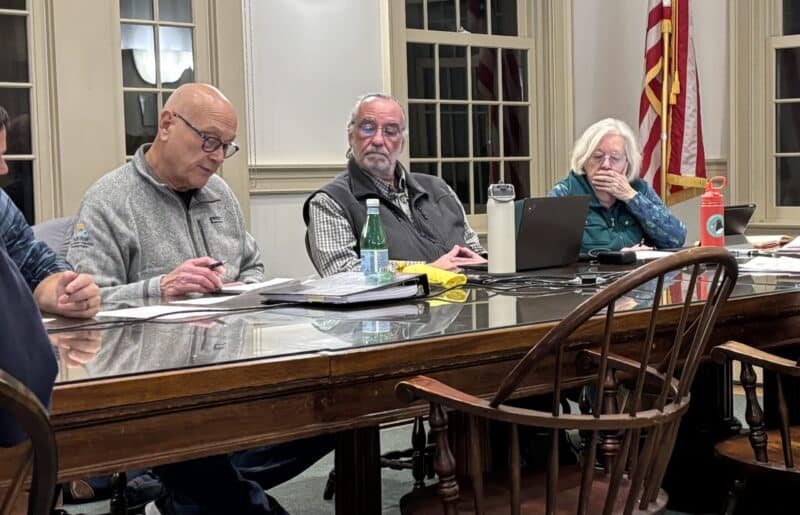
OLD LYME, CT (Updated 4:30 p.m., Jan. 14) – The Zoning Commission on Tuesday approved a legal settlement authorizing a special permit for a scaled-back site plan at 43 Smith Neck Road after the controversial housing application was unanimously rejected one year ago.
Commission Chairman Paul Orzel said the revised plan reduces by roughly 3,000 square feet the size of the house, previously proposed at 10,598 square feet, and moves it further from the river.
The decision came despite requests from residents, an attorney for abutting neighbors, and the chairwoman of the Connecticut River Gateway Commission to delay the vote until the revised plans were made public. The plans had remained confidential under a state Freedom of Information law exemption covering pending litigation.
Property owners Jeffrey and Emily Merriam filed a state Superior Court lawsuit against the commission in February after members denied the initial plan over concerns the project would harm the area’s natural resources. At the public hearing leading to the zoning decision, more than a dozen residents complained about the scope of the project and its impact on views, wildlife, area wells, and the Connecticut River.
Orzel called for a motion to approve the settlement agreement after members met behind closed doors to review the plans. He said the smaller house sat 35 feet back from its initial proposed location, with fewer site impacts and more vegetation.
The motion passed 5-0.
During the meeting’s public comment period, abutting neighbor Alex Richardson criticized the Merriams for taking the case to court rather than submitting a revised plan through the usual public process.
“Instead of filing a revision for their plans, like hundreds of other Old Lyme citizens, including me, they took a very expensive litigation approach with their new hometown,” he said.
Legal Challenge and Public Concerns
State law, codified in section 8-8 of the General Statutes, allows people adversely affected by a zoning commission’s decision to challenge it in court by showing that the commission acted illegally, improperly, or without sufficient evidence.
Merriam submitted a Jan. 9 letter to the editor in LymeLine that said the revised plans address all the issues cited by the commission in denying the original application.
“If the Commission approves the modified plans, the settlement agreement, allowed by state law and encouraged by the judge, will end the litigation.”
The lawsuit claimed that zoning rules for the conservation zone — comprising areas along the river’s hillsides, shoreline, and marshlands mapped out in local regulations — are “illegally vague and subject to subjective interpretation.” It also said the commission’s decision lacked supporting evidence and was inconsistent with approvals for similar projects.
Gateway Commission Chairwoman Suzanne Thompson spoke during the public comment session to highlight the group’s role since 1973 in protecting the lower Connecticut River’s scenic and ecological resources. The agency, which is empowered by state law and local regulations to oversee development in the Conservation Zone, requires a special permit for homes larger than 4,000 square feet.
The gateway commission last year recommended denying the Merriams’ application and asked to review any revised plans before local approval.
Thompson acknowledged the state law doesn’t carve out a role for the gateway commission once a judge gets involved, but said the group would welcome the opportunity to review the revised plans before local approval.
“We’re here,” she said. “I’m not quite sure how we fit in the process under Section 8.8, but we’d love to be a part of the consideration.”
Owners Hope for ‘Constructive and Collaborative’ Future
Revised site plans submitted by land use coordinator Eric Knapp after the vote show the 7,439-square-foot residence and garage reach a maximum height of 30.7 feet. The property also includes a tackle room, garden shed, and boat house, bringing the gross area to 8,354 square feet.
The existing bungalow on the property is 3,018 square feet, according to the plans. Assessor’s records show it was built in 1930.
The Merriams bought the 2.8-acre property for $2.7 million in 2023.
The documents specify the proposed house will be about 288 feet from the river, compared to 330.5 feet currently. Local regulations require structures to remain at least 100 feet from the river or nearby wetlands.
On Tuesday, Richardson said he is still reviewing the results of Monday’s meeting and was not prepared to comment.
Jeffrey and Emily Merriam in a Wednesday statement expressed relief the approval process had concluded.
“Throughout this journey we experienced an unexpected level of scrutiny from neighboring residents, including harassment, related to our decision to build our dream home,” they wrote.
The couple said they were grateful the town approved the project and look forward to building a positive, respectful relationship with their neighbors.
They identified Richardson and Elizabeth Karter, who have been vocal opponents of the project in public meetings and letters to the editor.
“We did not anticipate receiving this level of opposition from Mrs. Karter and Mr. Richardson, and we are hopeful that this next phase will be more constructive and collaborative,” they said.
Editor’s Note: This article was updated with a statement from Jeffrey and Emily Merriam and a corrected purchase price for 43 Smith Neck Road.
Author

Related Articles

Start Your Super Bowl Sunday at the Lyme-Old Lyme Lions Club Pancake Breakfast
The annual all-you-can-eat breakfast supports scholarships for graduating high school students and adult first-time college students. It features food, raffles and family fun.

In the LymeLight: Old Lyme’s Tree ‘Commish’ and Academic Accolades
A longtime Old Lyme Tree Commission leader steps aside and local students earn academic honors as we celebrate our neighbors in Lyme and Old Lyme.

Night Out for Adults: Musical Bingo at Old Lyme Library, Jan. 23
It’s bingo with a musical twist for the 21+ crowd at the Old Lyme Phoebe Griffin Noyes Library!