
TOP STORY: Affordability Questions Linger as Sound View Sewer Referendum Heads to Dec. 16 Vote
With a referendum on the Sound View sewer project set for next week, WPCA Chairman Steve Cinami pushed back on the cost implications for the town as members made another adjustment to the numbers.
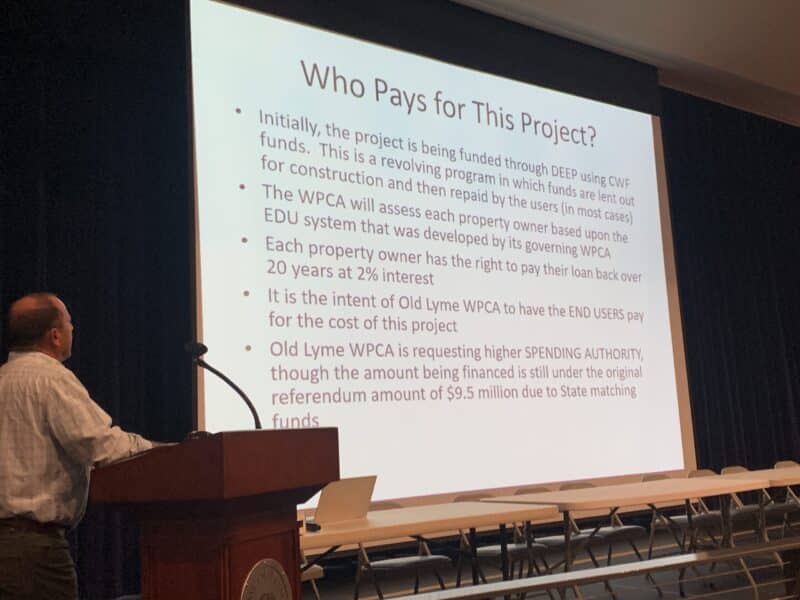
OLD LYME, CT – With a townwide referendum on the $20.5 million Sound View sewer project set for next week, Water Pollution Control Authority (WPCA) Chairman Steve Cinami on Tuesday pushed back on the cost implications for the town as members made another adjustment to the numbers.
Cinami told WPCA members he disagreed with figures presented by Selectman Jim Lampos late last month when the Board of Selectmen and Board of Finance voted to send the project to referendum. Lampos at the time calculated the cost for the typical Sound View user would amount to $62,413 over 20 years – a cost he warned could violate state limits on how much a property owner can be required to pay for a sewer project.
Section 7-249 of the state’s general statutes specifies towns cannot assess property owners for any amount higher than the percent increase in the property value attributed to the sewers.
Lampos said exceeding the so-called “betterment assessment” cap could leave a shortfall of approximately $4.7 million, based on current project costs and home value assumptions, that would have to be made up elsewhere. He cited local taxpayers as the likely source.
Cinami said the selectman’s estimates of the total cost per user, which included interest payments over 20 years, was misleading because interest isn’t a factor in the state law. The law specifically pertains to the costs to construct the project, according to Cinami.
He said users who pay the bill right away would owe $38,711.
“So, if you choose to pay interest, it’s because you feel it’s a better financial decision to pay over time at 2%,” Cinami said. “It’s your choice.”
When the first iteration of the Sound View project was approved in 2019 at a cost of $9.5 million, the town said costs will be borne by those in the impacted beach neighborhoods. But an informational sheet approved by town bond attorney Michael Botelho acknowledges taxpayers “should be aware of potential benefit assessment considerations” in the state law.
The second referendum is necessary because the cost has more than doubled since 2019. But state and federal funding is expected to cover approximately 46% of the new $20.5 million total, according to the information sheet.
In a Wednesday phone interview, Lampos stood by the estimated total cost of $62,413 for a typical household, which he said was intended to illustrate how much the project would cost the majority of people in the Sound View area.
“This is, for the most part, what most people are going to end up paying,” he said.
The average person is going to finance the project over time rather than showing up at town hall with tens of thousands of dollars “in a suitcase,” according to Lampos.
He agreed interest is not a factor in the state betterment assessment law determining whether a project is affordable for users. He confirmed he did not include interest costs when he estimated taxpayers could be responsible for repaying several million dollars.
But he acknowledged there’s no way to get a concrete idea how much the project will cost taxpayers until an appraisal can be done after the sewer system is in the ground.
“And if it is lower, that would be great,” he said. “But I don’t think it’s going to be zero.”
He said his intent was to give people enough information to be able to come to their own conclusions.
Tuesday’s WPCA meeting followed a procedural town meeting, which officially adjourned to the Dec. 16 referendum vote after members of the public had the opportunity to speak.
Reducing the Assessment
The WPCA meeting became increasingly contentious with a motion from member Randy Nixon to charge users a $6,000 municipal hook-up fee, which he said, “would reduce the betterment assessment by that same number.”
The motion passed in a 5 to 3 vote, with Brian Cornell, Mary Daley and Dimitri Tolchinski opposed.
Those behind the no votes suggested the move was an attempt to reduce the betterment assessment so taxpayers wouldn’t have to pay the difference and would be more likely to support the project at referendum.
Members discussed the possibility of lowering the fee but did not act on it.
Cinami said the hook-up fee, which covers administrative and inspection costs incurred by the town after the system goes in, is not considered a cost of construction. He told members the hook-up fee had been talked about in the past but hadn’t come up for a vote.
He cited a wide range of hook-up fees charged by other towns based on his own research, but said he relied on earlier local discussions to settle on his recommended amount.
“Ever since I’ve been on the WPCA and sewers were being discussed, there was a number thrown out that a connection fee could be $6,000,” he said. “That’s what I put in there.”
After the meeting, Cinami said the WPCA previously decided to hold off on setting the hook-up fee. The chairman, who announced last month he is resigning on Dec. 31, said he wanted to get everything in order in the event the referendum is approved.
“I chose the December meeting as I wanted to leave with everything in place after the referendum passes,” he said.
Cinami told WPCA members that state law and the town’s informational sheet on the referendum acknowledge hook-up fees are separate from construction costs.
The typical user will still owe $38,711, but only $32,711 will be recognized as construction-related in the eyes of the law governing affordability.
In 2020, an appraiser for the grassroots Sound View Sewer Coalition, which is opposed to the sewer project, estimated the sewer system would increase residential property values by 7% and commercial properties by 10%.
Cinami provided examples to show how the state law could come into play. Based on the $32,711 figure, he said a property value increase of 8.2% on a $400,000 home and 6% on a $550,000 home would keep the project within the affordability threshold.
But applying the same calculations to a $38,711 assessment, the $400,000 home would need to be worth about $472,305 for an 8.2% increase to fully cover the cost of the sewers. The $550,000 home would need to be worth $645,183 for a 6% increase to cover the cost.
Daley called out the $6,000 hook-up fee as arbitrary. She was also critical of the move to categorize it outside of the betterment assessment.
She said legal opinions secured by project opponents and shared with the commission have made it clear that “any attempt to reduce the cost by pushing things over into user fees or connection fees” will be legally challenged.
“So, again, this is going to be a court matter,” she said.
Cinami didn’t dispute the likelihood of lawsuits.
“Well, that’s why we put extra money in the budget for attorneys, I guess,” he said.
The townwide referendum will be held from noon to 8 p.m. on Tuesday, Dec. 16. in the Old Lyme Memorial Town Hall Meeting Room. Absentee ballots are available online and in the town clerk’s office. Anyone who is a registered voter in Old Lyme or who owns property assessed at $1,000 or more is eligible to vote.
Author

Related Articles
Two Years Later, Lyme Settles Bridge Dispute with Contractor for $40,000
Lyme has paid $40,000 to settle a lawsuit lodged by Suchocki & Son over a 2023 bridge project.
Old Lyme Grand List Up 0.36%, Eversource and Halls Road Plaza Lead Top 10 Taxpayers
The 2025 grand list is up 0.36% over the previous year due to higher motor vehicle and personal property values. Real estate values dipped slightly.

A 257-Year Tradition Continues With the Arrival of the Chester-Hadlyme Ferry
The current vessel carries up to nine cars and as many as 49 passengers, with propellers and rudders at both ends that allow it to reverse course without turning.