
TOP STORY: With State Support and Local Giving, LYSB Renovates Headquarters
Lymes’ Youth Service Bureau this week unveiled renovations to its headquarters, creating a more welcoming space for staff and families at the same time the nonprofit organization adapts to reduced federal funding.
Federal Prevention Education Funding Remains on Shaky Ground

OLD LYME—Lymes’ Youth Service Bureau (LYSB) this week unveiled renovations to its Lyme Street headquarters, creating a more welcoming space for staff and families at the same time the nonprofit organization adapts to reduced federal funding.
The 1850 building at 59 Lyme Street, which anchors the small campus, was updated with a streamlined layout and new features through a state grant and donations, according to LYSB Executive Director Mary Seidner.
The organization received $400,256 grant through the Connecticut’s Nonprofit Grant Program. Donations made up the remaining 25% of the project budget, or about $133,000.
“What I find so amazing about the whole project is the community partnership,” she said.
She credited general contractor Steve Wood of Steve Wood Design Build of Lyme, architect Christopher DeFiore of Old Lyme, Project Manager Bob Cope and Project Advisor Steve Hallahan, both of Lyme, with making the renovation possible.
Former LYSB Board member Hallahan helped Seidner write the original grant to apply for the funds and he, along with Cope and DeFiore, donated their services pro bono. Seidner said, “They were all so generous with their time. It’s because of them that we were able to complete the project ahead of time and under budget.”
She added, “Our architect lives in town … Our designer lives in town. Our project manager is on our board, and he practically lived here,” she said. “It’s just beautiful.”
Meanwhile, a desk for the full-time, grant-funded LYSB Prevention Coordinator sits empty after The White House late last month announced its Drug Free Communities grant program has been put on hold. Seidner said the loss of $125,0000 in federal funds annually required her to lay off the coordinator while the grant award process remains in limbo.
Staff from LYSB greeted members of the public at Wednesday’s open house to show off the renovated space that included upgrades and a reconfigured floor plan to allow confidential workspaces and to ensure the space is accessible to everyone who enters.
The renovation, which gutted the interior of the 1,836-square-foot building, also adddressed crumbling plaster ceilings, walls with newspaper insulation, aging wiring and plumbing, a lack of ventilation, the dirt floor in a portion of the basement, inefficient and inoperative windows, and a stone foundation in need of repair.
“The building before needed a lot of help,” Seidner said. “Our staff spent a lot of time fixing things and dealing with stuff that didn’t work.”
Improvements include kid-friendly spaces for counselor Kelly Lydiksen to meet with young clients and their families. The licensed marriage and family therapist associate said the renovation had been completed for some six weeks when she joined LYSB about two weeks ago.
“There was a lot of ability to make it exactly what I needed it to be, which is great,” Lydiksen said. “I’ve been able to get a lot of resources and tools for kids specifically.”
In addition to Lydiksen’s second-floor office, there’s a room across the hall outfitted with a magnetic easel, books, crafts and seating that can be used as additional meeting space or a waiting area when needed.
Seidner cited privacy as a key concern in the renovation. Moving the staircase from the back of the house to the front has helped to accomplish that.
“Clients who are coming here for counseling can go right up the stairs,” she said. “They don’t have to walk through my staff break-room, which is what they used to have to do.”
LYSB uses a sliding scale based on the client’s ability to pay for each counseling session. The fees are subsidized through donations.
“About half of our clients are paying us $5, or zero,” she said.
Shay Cantner, who serves as LYSB Board of Directors Chairwoman, said board members had no difficulty getting behind the renovation project for the old house purchased in 1978 as the burgeoning organization’s headquarters.
Cantner, who is in her fifth year on the board, cited inconveniences like broken chairs in Seidner’s office and temperatures that always seemed too hot or too cold.
“I think all the staff work so hard and they deserve to be in a place that is at least updated, so they can focus on the work, and serving the children and families. That’s where their focus should be,” she said.
The youth center and early childhood center, located in the property’s former garage and barn, were not affected by the renovation.
Seidner recalled three of the organization’s four full-time staff members worked out of an eight foot-wide trailer on the site during the renovation.
“We were very close together, but it was an adventure,” she said. “That’s the way we looked at it.”
Federal Funding Delay Results in Staffing Cut
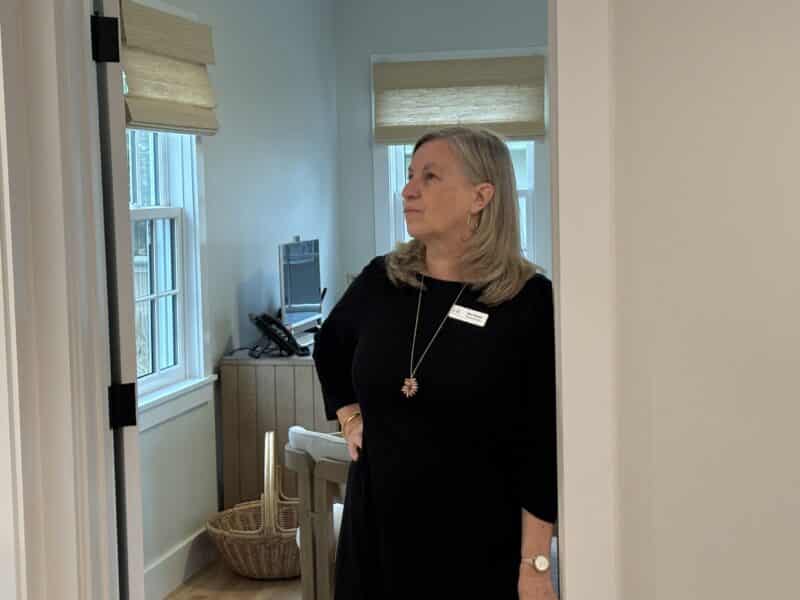
Seidner on Wednesday said she laid off prevention coordinator Antoinette Thuillier, who holds a master’s degree in public health and had been in the position for 11 months, after the grant funding to renew the position did not come through by the end of the federal fiscal year on Sept. 29.
The renewal would have extended the five-year Drug Free Communities grant to 10 years. LYSB was finishing its fifth year in the program, which provided $125,000 annually.
Seidner said LYSB had received pre-approval and was awaiting final confirmation when The White House on Sept. 26 announced it would “recompete” the award process, essentially canceling existing proposals and reopening a new round. The surprise decision affected six prevention coalitions in Connecticut, according to Seidner.
The federal grant program supports work to reduce drug, alcohol and tobacco use among children.
The White House in its announcement said the move was necessary to ensure applicants are in compliance with recent executive orders from President Donald Trump.
“Our team is working aggressively to put safeguards in place towards advancing President Trump’s America-First policy agenda and mission,” the announcement said. “We are performing due diligence to ensure that absolutely no taxpayer dollars go to furthering the radical left’s agenda.”
LYSB’s prevention coordinator runs the Lyme-Old Lyme Prevention Coalition and the high school Youth Prevention Coalition. Other responsibilities included working with the Old Lyme Police Department DARE program as well as participating in driver’s education and health classes at the high school, Seidner said.
Seidner emphasized LYSB’s prevention work will continue in a modified way as the remaining staff members take on additional duties.
“I don’t want to give anyone the impression that we’re in trouble, because we’re not in trouble,” she said. “But it hurts.”
She said spending would get “very tight” with the loss of funding amounting to a quarter of the overall budget. She said it’s unclear when the government will resume awarding grants.
“That’s why I’m saying national politics have hit Lyme Street,” she said. “The children of Lyme and Old Lyme are being affected by this decision.”
Author

Related Articles

From Family Forts to Funny Films: There’s an Activity for Everyone in the Week Ahead
Wildlife programs, robotics workshops, and history talks are among the options for residents ranging from young children to older adults.

Death Announced of Nancy Cass Strohla, Lifelong Learner Who Cultivated Connections
A celebration of Nancy’s life will be held at the First Congregational Church of Old Lyme on Saturday, Feb. 28.

Death Announced of Alison Mitchell, Born on Lyme Street, Devoted to History
Alison C. Mitchell, a lifelong activist for women’s rights and health, died Jan. 28 in Mystic.