

TOP STORY: Failed Halls Road Overlay Makes Way for Election Day in Old Lyme
OLD LYME–When Democratic First Selectman candidate Martha Shoemaker beat Republican challenger John Mesham by 123 votes two years ago, plans to transform Halls Road into a livable, pedestrian-friendly village center were still being hashed out in committee meetings and consultants reports.
Now, following the defeat earlier this year of a Zoning Commission application for the Halls Road Overlay District (HROD) that would have allowed developers to build apartments in the commercial zone, the issue has become a flashpoint in the rematch between Shoemaker and Republican challenger John Mesham.
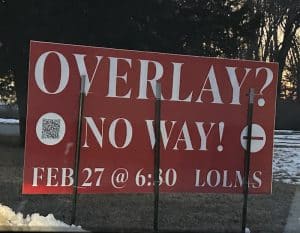
The “Overlay? No Way!” crowd was evident over the winter in signs across town and at a Zoning Commission public hearing that filled the high school auditorium to maximum capacity. A vast majority of the 550 attendees came out in opposition.
According to Mesham, it never should have gotten to that point.
“If I was on the Board of Selectmen, I would definitely not have ever voted to present that project to Planning and Zoning,” he said last week in an interview at the Republican headquarters on Halls Road.
Mesham, who spent 29 years in law enforcement before retiring from the Connecticut State Police in 2020, said experience as an executive officer in the Bridgeport and Montville barracks has prepared him to run a public agency like the Town Hall. His current term on the Inland Wetlands and Watercourses Commission has taught him about the regulatory process.
Shoemaker is a retired 35-year teacher, 12-year union president, and two-term member of the Region 18 Board of Education. She was selectwoman from 2021-23 before being elected first selectwoman.
The overlay proposal drafted by the Halls Road Improvements Committee (HRIC) was submitted to the Zoning Commission late last year by Shoemaker after a 2-1 vote of the selectmen. Shoemaker and fellow Democrat Jim Lampos were in support; Republican Jude Read cast the lone nay vote.
Lampos and Read are both running for reelection as selectmen.
Part of the Process
Shoemaker at the Town Hall last week said she followed statutory guidelines and local precedent for submitting the proposal to the Zoning Commission.
The first proposal in 2021 was submitted, and then pulled, by then-First Selectman Tim Griswold after critics described it as an overreach, and a revised 2023 version that first floated the overlay zone was later rejected by the Zoning Commission. Members cited concerns about its effectiveness and the lack of water and sewer infrastructure.
The commission is empowered to approve, deny or modify applications. Shoemaker said she put the proposal in their hands so they could do their job.
“And I know that the zoning board would have moved and pulled things out of it, or tweaked it to something that they could have been more comfortable with, because they weren’t going to put Old Lyme in jeopardy,” Shoemaker said.
Asked if she would have done anything differently in retrospect, the first selectwoman said she said she would not have delayed the continuation of the public hearing for as long as she did.
The hearing, which began in January, was initially continued to the end of February. But the meeting was postponed to April at the request of Shoemaker and the HRIC, who informed residents the move was prompted by “strong interest” in the topic that required a larger venue and more time for the commission to review communications from residents.
“I think there were a group of people who sort of defined it as something that it wasn’t, and placed fear into the minds of some of the people in this town,” she said.
Critics said the plan had the potential to create more than 1,000 apartments on 40 acres if it went through. Proponents argued topography and regulatory realities would effectively limit development to under 400 apartments at the most.
Shoemaker said she should have educated the public more about the project instead of letting misinformation spread.
“I think the most important thing is providing the facts,” she said.
Mesham during his interview disputed the idea that forwarding the project to the Zoning Commission was largely a procedural issue bound by statute and the other applications that have come before it.
“So, you know, you can say it’s part of the process, but really, part of the process is the Board of Selectmen reading the room and saying ‘we’re not gonna move ahead with this,’” he said.
Sidewalk Consensus
He said his first order of business if elected will be to call for a “shovel-ready” plan for sidewalks, lighting and “probably some greenery” to improve Halls Road.
“I think people move to Old Lyme because they like Old Lyme,” he said. “And we don’t need to drastically change Old Lyme.”
Sidewalks, too, are at the top of Shoemaker’s priority list for a second term. In May, she signed off on a grant application to the Connecticut Department of Transportation (DOT) for $800,000 to install sidewalks on the north half of Halls Road.
“I think there’s total consensus on sidewalks,” she said.
Less clear is the future of a pedestrian bridge – sometimes referred to as the bow bridge – proposed by the HRIC, according to Shoemaker.
“It’s something that’s nice to have, but is it a need or a want? And we have to weigh that out,” she said.
The state Department of Energy and Environmental Protection this year transferred ownership of the state’s property on the east bank of the Lieutenant River to Old Lyme, as long as the town puts a fishing pier and parking spaces there. The land swap is a necessary component of designs for the walking bridge and trail system funded with $135,000 in federal American Rescue Plan money and a $28,500 state grant.
“If we want the walking bridge, we have to do the fishing pier,” she said. “So do we want the fishing pier? What do we do to the environment if we start to build a fishing pier? There’s a lot of questions that still need to be answered.”
Mesham reiterated it’s time to get back to basics on Halls Road.
He said what started as a call for greenery, signage, and lighting “spun out of control” with efforts to attract developers and add large-scale improvements like the bridge.
“It clearly got too big for what people want, so I think we need to get back to the original intent of the Halls Road Improvement Committee,” he said.
Author

Related Articles

Happy New Year!
After a year of big changes at LymeLine, including longtime publisher/editor Olwen Logan’s fond farewell and the creation of the nonprofit LymeLine Inc. to carry on her work, we look ahead with gratitude and excitement to 2026.

Lyme-Old Lyme Boys, Girls Basketball Teams Win Over Old Saybrook
The Lyme-Old Lyme High School girls and boys basketball teams were victorious against Old Saybrook High School in a pair of games Tuesday afternoon.

In the LymeLight: A Legal Victory and a Scholar-Athlete
Lawyers from Old Lyme who recently won a Connecticut Supreme Court victory on behalf of Groton said the ruling brings important clarity to public sector labor agreements and protects taxpayers from unintended expenses.