
TOP STORY: Rare First Selectman Contest in Lyme Pits Corporate Experience Against Volunteer Approach
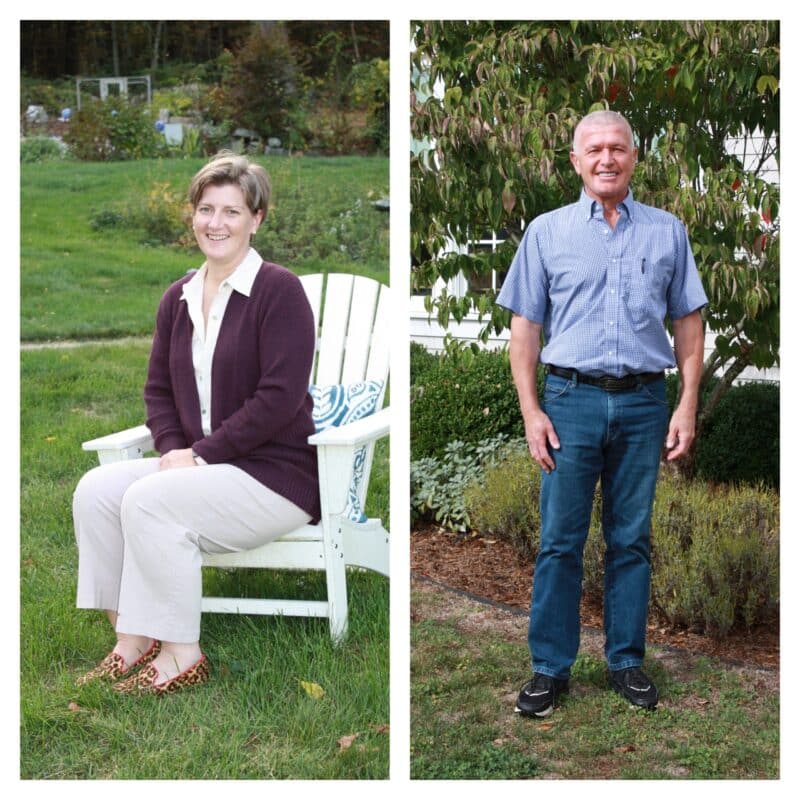
LYME–In a rare contested race for the town’s top office, a retired pharmaceutical manager intent on keeping zoning decisions local faces a political newcomer emphasizing collaboration and consensus.
Going back 25 years, only the 2001 and 2017 elections included a challenge for first selectman. This year’s opening emerged after an announcement from current Republican First Selectman David Lahm that he would not be running for another term.
Republican-endorsed First Selectman candidate Tom St. Louis, who appears on the ballot with wife and (also Republican-endorsed) selectman candidate Mary Powell-St. Louis, brings experience from a career at Pfizer and four years as an appointed alternate member of the Lyme Planning and Zoning Commission.
He said managing budgets and staff while building a professional network has prepared him to focus on his main priority: ensuring development decisions stay in local hands as the state calls for more affordable housing.
“If we don’t have control over how we use land in town, the very fabric of Lyme is at risk,” he said.
Democrat-supported unaffiliated candidate Christy Zelek said she is running out of a sense of civic duty on a record of volunteerism, including service on the Lyme Ambulance Association Board of Directors, multiple parent-teacher organizations and the local Boy Scouts.
Zelek works as an administrative assistant at Westbrook Middle School.
She described herself as “people oriented,” an attribute she said sets her apart from the corporate experience St. Louis has made a pillar of his campaign platform.
“I just listen to what everyone has to say, and I don’t go in with my set of ideas and push them through,” she said.
Zelek appears on the ballot as a petitioning candidate and is running with the support of the Lyme Democratic Town Committee (DTC). The Democrats have also gotten behind incumbent selectmen John Kiker and Kristina White.
Due to state minority representation law prohibiting more than two members of any political party from serving on the three-member Board of Selectman, Kiker is once again running as the DTC-endorsed candidate while White petitions for a seat.
The candidate, who finishes second in the first selectman race, is automatically considered for one of the two remaining selectmen seats. Those two seats are filled by the next highest vote-getters overall, in accordance with Connecticut’s minority representation rules.
The potential makeup of the Board of Selectpeople includes notable combinations this election season. It could end up in the hands of a trio of Democrat-supported candidates; It could also result in a husband-and-wife Republican majority.
Both candidates are seeking elected office for the first time. St. Louis ran for a Board of Finance alternate position in 2021 but lost to Democrat Jim Miller.
Prepared to ‘Go it Alone’
St. Louis in an interview at the Lyme Public Library earlier this month said he is a 27-year resident active in coaching, Scouting, and local organizations. He worked as an engineer and in management at Pfizer for 37 years before retiring in 2023.
He and Powell-St. Louis have three sons between the ages of 23 and 17.
He cited budget oversight, personnel management, and strategic planning as key skills he would bring to the position of local CEO.
“The town budget is about $12 million, roughly,” he said. “That’s fairly consistent with the size of the teams that I was managing for the last 12 years of my career at Pfizer.”
Experience on the Planning and Zoning Commission gave him familiarity with town operations and how land is used in town. It’s also where he learned earlier this year about the local implications of a comprehensive affordable housing bill that made it through the state House and Senate before it was vetoed by Gov. Ned Lamont.
Among the provisions in the failed bill was the “fair share” framework, which would have required municipalities to plan for a prescribed number of affordable housing units within their borders. Data from the state Office of Policy and Management shows projections call for somewhere between 122 and 346 affordable housing units in Lyme, depending on the variables.
The CT Mirror reported the subject is likely to show up in a special session of the state General Assembly slated for Nov. 12 and 13.
He said the bill takes control of zoning decisions away from the town.
He suggested one way to address the problem is to form alliances with other small towns similar to Lyme – like Redding in the southwest corner or several towns in the northeast – that share more in common with Lyme than its immediate neighbors.
Another way to defy the state mandate is to accept the consequences, according to St. Louis. That means forfeiting eligibility for many types of state funding if the town refuses to make progress on affordable housing.
The “fair share” provision of the housing bill rewards participating towns by giving them priority access to state grants, including those offered through the Small Town Economic Assistance Program (STEAP), the Clean Water Act, and the Main Street Investment Fund.
He acknowledged that several major projects on Lyme’s horizon, such as bridge replacements and fire station upgrades, could qualify for those grants.
““You’ve got this situation where Lyme may be reluctant to go after this (fair share) target because it represents such a dramatic change in our land use decisions, but then we would also have to be prepared to essentially go it alone on a revenue piece,” he said.
He emphasized that kind of decision shouldn’t be made unilaterally.
“That’s a pretty important decision that you’re going to need town engagement on,” he said.
He called for revenue diversification to make up for any loss of state funding. That could mean looking at ways to utilize the town’s existing commercial zones more fully without expanding them, and exploring land leases for technologies like solar energy.
“You’re not going to take an open field along a major stretch of road and turn it into a solar farm. There will be zero appetite for that,” he said. “Now, whether or not there are, on our town conservation lands, some areas that, to a great extent, are shielded and would present us the opportunity to do some lease, I think that we would have to engage in a conversation about that.”
He would also explore ways to seek reimbursement from the state to help offset the loss of taxable income on town land conserved as open space.
Husband and Wife
St. Louis acknowledged Democrats have been critical of the Republicans for running a married couple at the top of the ballot. But he said he and his wife have different backgrounds and make their own decisions.
“We’ve been married for 31 years and raised three boys together. But, in that, we have lived very different experiences, actually,” he said.
He pointed to a disagreement at a recent Republican forum on how to deal with the infestation of the invasive plant known as hydrilla that is overtaking the Connecticut River.
The forum was organized by the Republicans after Zelek and the Democrats declined to participate in a debate sponsored by LymeLine and the Greater Old Saybrook of Commerce. When the Democrats declined the Republicans’ forum as well, it was up to St. Louis and Powell-St. Louis to spar among themselves.
“You know, I think it was pretty apparent at the open forum that there are issues that we don’t see eye to eye on, but we can do that and engage in civil conversation, and maybe not influence each other towards the same outcome, but we can have that respectful conversation,” he said.
A Collaborative Approach
Zelek, a 17-year resident of Lyme, has volunteered in leadership positions with the Lyme Ambulance Association — where she was vice president and helped recruit members and secure a new ambulance — as well as the Boy Scouts, multiple parent-teacher organizations, and a high school ‘Safe Grad’ committee.
She spoke to LymeLine earlier this month from an Adirondack chair in her front yard overlooking Tiffany Farm. Multiple drivers over the course of the interview waved or honked their horns as they drove by.
“Anything that I join, I tend to be in a leadership role, from small things to big things,” she said.
Zelek was raised in a military family that settled in Massachusetts when she was 10 years old. She attended Alfred University in New York, where she graduated with a double major in English and communications. She has held jobs in insurance, event planning and real estate, and is employed currently as an independent consultant with the health and wellness company Arbonne in addition to working at Westbrook Schools.
She is divorced with three sons aged 19, 16 and 15.
Knocking on doors at homes across town, she said she’s heard residents’ concerns about traffic, bicyclist safety, and keeping taxes low.
She said attending town board and commission meetings, including the boards of selectpeople, education, finance, and planning and zoning, has shown her those groups play a crucial role in shaping Lyme’s future.
“We have an incredible community of people that have backgrounds that are amazing,” she said. “And it’s such a gift that they’re willing to keep sharing their knowledge and their time.”
Zelek said a growing sense of collaboration has been evident in Lyme lately. She cited examples ranging from the fire department and ambulance company beginning to work more closely, to library leadership engaging the wider community in talking about the impact of loneliness and possible solutions.
“I feel like that’s what we all have to be doing, is working together,” she said.
If elected, Zelek’s top priorities would be enhancing public safety, including safer conditions for bicyclists, and improving communication with residents. She supports a balanced budget and careful spending.
She described herself, like the Scouts she leads, as thrifty.
“I do clip coupons and return my cans,” she said.
Zelek cited her open mind and collaborative approach as the biggest strengths.
“I don’t have an agenda; I really just want to get out and help people come together to get to the solutions that are best for the town,” she said. “I’m not going in thinking I have any one way to do anything. Everybody has a different issue and a different way to come to a solution for issues, but somehow we can come together and maybe not come up with a perfect answer, but a pretty good answer for the majority of the people.”
The Trump Effect
St. Louis recalled meeting people on the campaign trail with people who had little patience for Republicans.
Some of them would shut the door in his face, according to St. Louis. Others would refuse to engage with him unless he denounced President Donald Trump. That’s when he’d tell them he prefers to focus on local issues rather than national politics.
He reiterated his top issue is zoning control, which he described as unrelated to national politics.
“I see it in their eyes that they’re worried about how the national politics might play at the local level,” he said. “ But that’s not why I’ve lived here for 27 years and raised a family here. I love the community and I love the rural aspects and the small town feel of it all. And I just don’t see national concerns playing out in our day-to-day lives here. But I respect that some people do.”
He acknowledged some national issues do hit close to home. He said he disagrees with Trump’s decision to halt the offshore wind projects because of the effect on State Pier in New London, but supports Trump’s recent agreement with Pfizer to expand U.S. investment.
“There are things he says that I’d prefer he not say, but when I look at the actions, I’m trying to look at the local impact here,” he said.
Zelek is among those who have seen national political divisions become more pronounced locally in recent years. But on a personal level, she said she maintains friendships across the political spectrum and values differing views.
The lifelong unaffiliated voter said she votes for the person, not the party.
Asked for her thoughts on Trump, she said she does not believe he is a positive role model for young people.
“He’s not what we’ve taught our children to be,” she said. “And that’s a really simple line for me.”
She counted taking care of others and being kind as ideals she’d like to see instilled in her children.
“If it looks like someone needs help, just reach out,” she said. “Just saying hello, I think, is a huge thing. A simple hello can lead into more of it. And treat people how you want to be treated. I also say repeatedly, ‘the only person you have control over is yourself.’”
Author

Related Articles

Happy New Year!
After a year of big changes at LymeLine, including longtime publisher/editor Olwen Logan’s fond farewell and the creation of the nonprofit LymeLine Inc. to carry on her work, we look ahead with gratitude and excitement to 2026.

Lyme-Old Lyme Boys, Girls Basketball Teams Win Over Old Saybrook
The Lyme-Old Lyme High School girls and boys basketball teams were victorious against Old Saybrook High School in a pair of games Tuesday afternoon.

In the LymeLight: A Legal Victory and a Scholar-Athlete
Lawyers from Old Lyme who recently won a Connecticut Supreme Court victory on behalf of Groton said the ruling brings important clarity to public sector labor agreements and protects taxpayers from unintended expenses.