

TOP STORY: All-Volunteer Lyme EMS Begins Shift Toward Paid Staff, Eyes Long-Term Station Improvements
LYME–At the helm of one of the last all-volunteer ambulance corps in the state, Lyme Ambulance Association officials say hiring paid responders for two shifts per week is a necessary change that requires a new outlook for the 50-year-old organization.
In the short term, it means coming up with temporary places in existing facilities where the new hires can bunk and members can gather. In the longer term, it means the ambulance association will need a place at the table as officials discuss a formative plan to rebuild the Hadlyme Fire Station and expand the Hamburg Fire Station in the coming years.
Steve Olstein, chief of the independent, nonprofit ambulance service now rebranding itself as Lyme EMS, told LymeLine the group held out longer than most before deciding to add paid staff members to its volunteer ranks.
“We had a very stable cadre of very experienced people living in town, and so we always had responders,” he said. “We just always did.”
The ambulance service is licensed by the state to respond to 911 calls and to carry out basic life saving functions. Advanced care is provided by professional paramedics with Middlesex Hospital or Lawrence + Memorial Hospital.
Lyme EMS owns two ambulances, with the town providing shelter and fuel for the vehicles and workers compensation insurance and a pension plan for qualifying volunteers.
Olstein estimated that the service’s 12 volunteers cost the town roughly $2,400 each annually.
Now, Olstein said the town’s ambulance volunteers are aging out—and most volunteers introduced to the service as young adults end up leaving town.
He referenced a current 16-year-old volunteer whose training is viewed more as a broad investment in the public good than a local business decision.
“It’s expensive when we invest a lot of time and some money in them, and the only way we can justify it is that the world is a better place with another EMT,” he said.
On the other end of the age spectrum, Olstein recounted experienced volunteers, who would go on as many as 85 of the typical 300 calls per year before aging out of the retiree-dominated field.
“We couldn’t find a replacement for every person who left and we lost,” he said.
Recruiting paid responders is going to require a shift in attitude in an organization where volunteers going back a half century have been happy to wait for calls at home rather than carve out space at any of the firehouses.
He said hiring staff members requires a more professional, but also more social, approach.
“If you want to recruit, you really should have an esprit de corps,” he said. “You should have a place where you can say: ‘This is ours. This is what you’re joining. We have substance and pride and a place where we can meet, where we’re not asking somebody else’s permission.’”
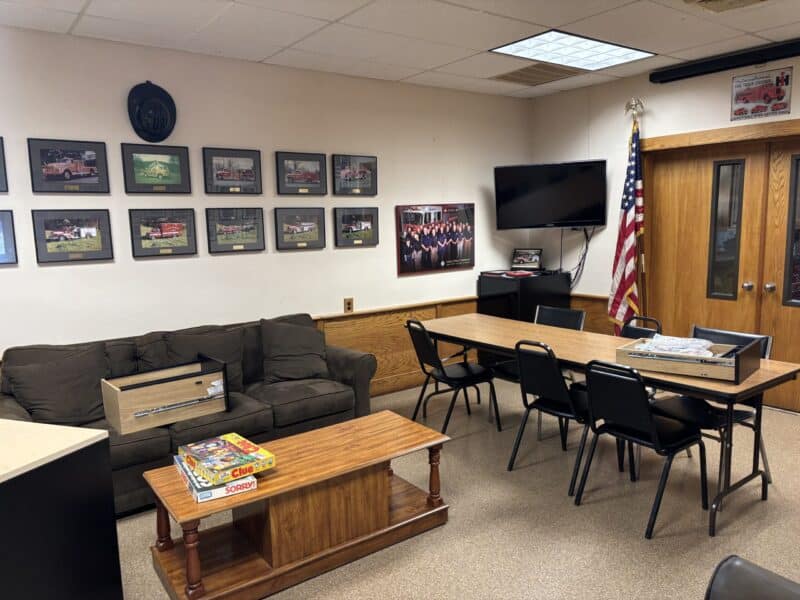
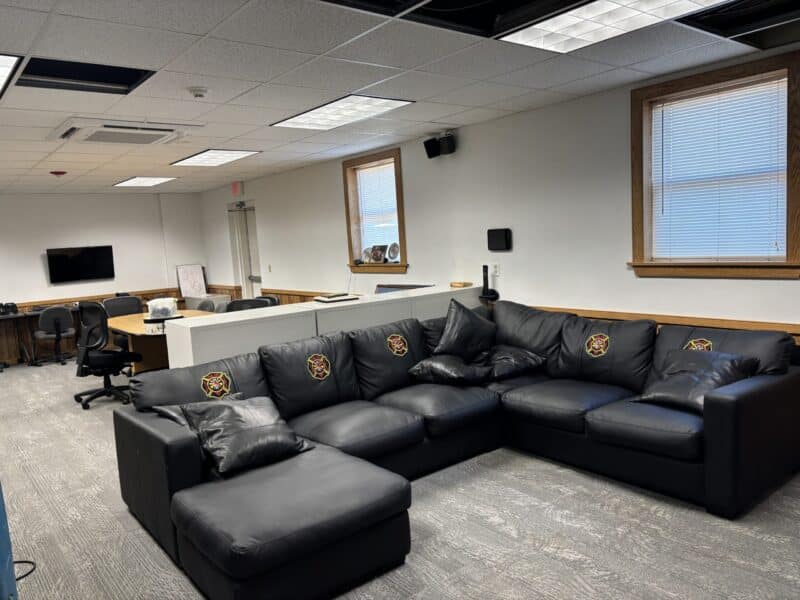
He said the temporary change would allocate space in the emergency operations center lounge in the Hamburg station for sleeping quarters, as well as a room at the back of the Hadlyme station to serve as Lyme EMS headquarters.
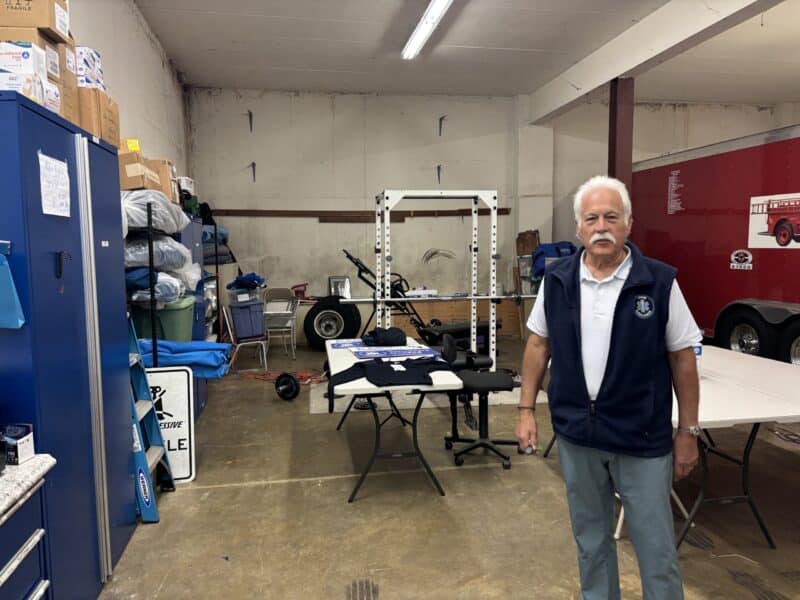
The ambulance company’s current dedicated personnel space—set up haphazardly in a back bay of the Hamburg first station basement garage with a few folding tables, four file cabinets and a weight-lifting station—is substandard, according to Olstein. While acknowledging EMS members are already welcome to use the emergency operations lounge as a place to relax, he added they’d prefer to have a space they could customize to their needs.
He estimated it would cost about $30,000 to install two bunk beds along with partitions in Hamburg station lounge and make cosmetic changes to the 60s-era kitchen, bathroom and gathering space in the Hadlyme station. He cited potential improvements like painting the wood paneling, updating the industrial bathroom, replacing the mustard yellow kitchen counter and adding a couple small appliances.
“We don’t have anything,” he said. “We don’t have a refrigerator. We don’t have a microwave. We don’t have a coffee-maker. So to have a place where we can store and heat up our food and make a pot of coffee, to me, is a real plus.”
‘Band-Aid’ Approach
At a Board of Selectpeople meeting last week, Lyme Facilities and Emergency Management Director Josh Adams used the term “band-aid” to describe the Lyme EMS plan for the Hadlyme and Hamburg fire stations.
He said the temporary, three- to five-year fix is meant to last until the proposed overhaul of the 60-year-old Hadlyme facility provides a new, permanent headquarters for the ambulance company and sleeping quarters for firefighters and EMTs.
Adams and Board of Finance Chairman Alan Sheiness agreed it was realistic to believe shovels could be in the ground in about three years. Sheiness emphasized the importance of careful planning and budgeting in the near and long term, while Adams said the return on investment would come immediately in the form of better response times.
The emergency management director said stationing responders with the ambulances, rather than having volunteers first retrieve them, can save crucial minutes during emergencies.
“The quicker the ambulance can get there, with the people and equipment to get them in and out, makes a huge difference,” he said. “If you’ve ever had to call 911 and wait, you know how long five minutes seems when you’re waiting for someone to get there.”
According to the 2024 Office of Emergency Medical Services Annual Report from the state Department of Public Health, Lyme Ambulance has a mean response time of 16.26 minutes. The mean response time in rural towns statewide is 9.74 minutes.
The response times for area towns include Chester at 14.77 minutes; Deep River, 13.67 minutes; East Haddam, 13.32 minutes; Salem, 12.63 minutes; Old Lyme: 12.08 minutes; and Essex at 9 minutes.
Olstein said Lyme EMS response protocol dictates that the assigned crew member closest to the medical emergency reports directly to scene so that any time sensitive treatments can be started as soon as possible, while the other crew member gets the ambulance and then goes to the scene. The mean response time for responders going directly to the scene is approximately 11 minutes.
Lyme Ambulance Association Board of Directors President George Mooney at the selectpeople’s meeting said discussion about the group’s evolving needs is not new.
“Two years ago, Lyme EMS started a conversation with the town leadership because we saw potential long-term issues with our all volunteer staffing model,” he said. “…This is really the next phase of the dialogue.”
Olstein said Lyme EMS plans to hire the paid EMTs for Saturday and Wednesday night shifts, which have proven the hardest to fill. The shifts at first will run from noon to midnight, but will change to 6 p.m. to 6 a.m. once the temporary sleeping quarters are installed.
The first new hires will be funded by the ambulance service, Olstein said. But EMS officials have been warning the town that declining volunteer numbers and increasing expenses could change the equation in the future.
In a memo prepared for the selectpeople’s meeting, Lyme EMS officials said the initial discussions about staffing stemmed from a promise to keep the town informed if changes to the organization’s volunteer model were being considered.
“Based on recent challenges trying to support 14 shifts with 12 responders when we really need 20, the initiative to hire part-time paid staff was taken by Lyme EMS as a means to provide a stop-gap in staffing but also to see how it could work longer term for our town an organization,” the document said. “This proposal is primarily to help us deal with the current situation but also to inform and advise the town of the longer term commitment that will have to be framed and negotiated in the upcoming financial planning cycle.”
First Selectman David Lahm last week emphasized the proposal to demolish and rebuild the Hadlyme station while expanding the Hamburg station will require a building committee. Members will include officials from the fire department, Lyme EMS and the town, as well as residents.
The outgoing first selectman said he plans to install the building committee before he leaves office in mid-November following the municipal election.
Designs and cost estimates for the long-term vision at the two fire stations have not yet been created. Fire Chief John C.L. Evans told selectpeople the department has authorized funding to develop a preliminary document outlining space and equipment needs to help guide architects when the project moves forward. Grant funding opportunities are also being explored.
Who’s Paying?
The ambulance service until about two ago didn’t bill customers for calls, according to Olstein. He credited a philanthropic population willing to answer each fundraising appeal with a check, but said the demands of keeping current with ambulance technology finally caught up with the community’s generosity.
The chief of service described an evolution that has taken the ambulance company from a 1971 Cadillac ambulance – built on the same chassis as a hearse – to the current iterations outfitted with state-of-the-art power loading systems for stretchers that can go for about $60,000 a time.
“The cost of everything has increased so much that it really became impossible for us to exist strictly on donations,” he said.
But even with the new revenue source, he said this year marks the first time that there is more cash going out than coming in.
“We have a very strong reserve, so there’s no financial stress. It’s just nobody, who’s involved in a business, wants to see it have negative cash flow, because of the implications for the future. If you’re always negative, sooner or later you’re going to have a problem.”
He said billing rates set by the state have been slow to address the rising costs of ambulance service in the town with an aging population, where many rely on federal Medicare benefits. Data from the 2020 U.S. Census puts the number of residents over the age of 65 at 31.6%.
In between the near and the long term, he said it remains critical for the ambulance service to become more involved in the local emergency management planning framework and to help officials understand how the historically insular ambulance service operates.
“We don’t need anything today. We’re fine,” Olstein said of the group’s bottom line. “But you need to know that the way things are going, there’s going to come a time when we will.”
Editor’s Note: This article was updated with information subsequently provided by Olstein about the mean response time for individual responders going directly to the scene.
Author

Related Articles

Old Lyme Property Transactions, 5/27/26
Recent Old Lyme property transfers included several transactions over $1 million, while the median sale price was $699,000.

Death Announced of Alan Bradford of Old Lyme, Connecticut College Professor Whose Life Was a ‘Masterclass’ in Fulfillment
Bradford, 89, passed away peacefully on May 3. A Memorial Service will be held May 30 at the First Congregational Church of Old Lyme.

Death Announced of George Michael Graham Furgueson, U.S. Navy Veteran of Essex, Formerly of Lyme
The devoted husband, father and grandfather is remembered for his down-to-earth demeanor, humor, good cheer, warmth and height.