
TOP STORY: Sound View Residents Urgently Call for Alternatives to Sewer Project as Potential Referendum Looms

OLD LYME–As a decades-long effort to clean up Long Island Sound by getting rid of septic systems continues its slow slog in Old Lyme, residents of Sound View Beach are calling for town officials to fight back against state pressure to install sewers or to spread out the cost throughout the town.
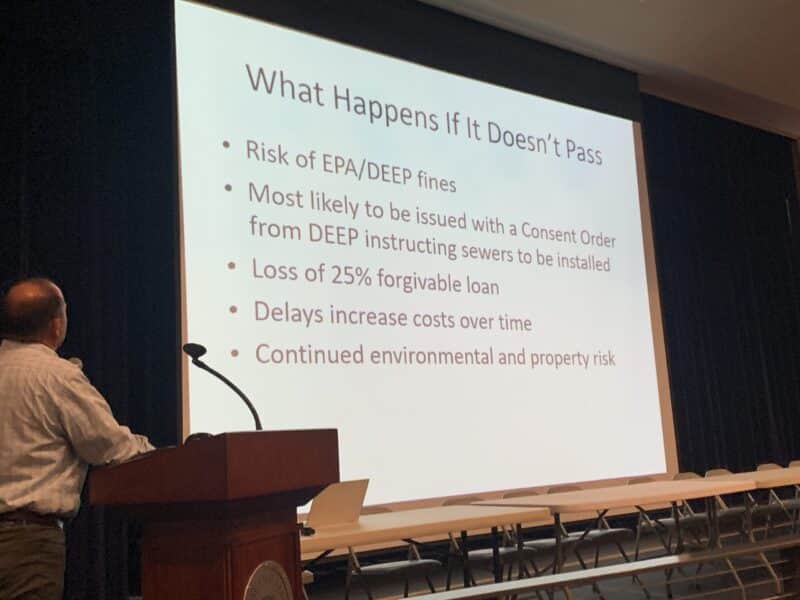
Upwards of 60 people gathered in the Lyme-Old Lyme High School auditorium Tuesday evening for a contentious back-and-forth between Old Lyme Water Pollution Control Authority (WPCA) Chairman Steve Cinami and residents of the Sound View Beach area. The subject was Sound View’s portion of a $70 million plan that would require residents of the town owned beach area to foot the bill along with residents of three private beach associations.
Meanwhile, a call from town leaders and Sound View residents for up-to-date pollution statistics and detailed financial information is meeting with pushback from the Connecticut Department of Energy and Environmental Protection.
Sound View residents on Tuesday decried the lack of solid figures when it comes to how much each homeowner will have to pay. Numbers provided by the WPCA, which drew skepticism from some in the audience as artificially low, added up to about $50,000 for the typical homeowner over the proposed 20-year life of the project loan. The calculation includes construction and annual fees.
Included in construction costs are Sound View’s share of a pump station and force main for the four beach communities, as well as the internal infrastructure necessary to serve the town’s beach View area. Homeowners additionally are responsible for tying into the system and abandoning their septic systems.
Sally Woitowitz, a 28-year resident of Sound View, said the annual cost effectively doubles her taxes. She said she will have to move if the project goes through.
“I have nowhere else to run to,” she said. “A lot of people here, these are cottages for some people. For some of us, it’s our home. It’s all we have.”
She challenged the state’s “rule of thumb,” as articulated last year at a public meeting by DEEP project engineer Carlos Esguerra, that says a project is affordable to residents if it does not exceed 2% of the town’s median household income (MHI) which he identified at the time as $122,000. That equated to $2,440 a year.
The cost to construct the system is slated to amount to $1,939 annually over 20 years for a typical user.
Cinami has said annual operations and maintenance fees are not factored in when calculating affordability. Those fees will add an additional $565 to Sound View users’ annual payments, based on estimates compiled by the state.
DEEP Spokesman James Fowler this month would not provide the updated median income for Old Lyme or specify which source the agency uses to determine the figure. But a review of the U.S. Census Bureau’s most recent American Community Survey puts the median at $126,904, which would bring the affordability threshold to $2,538.
Woitowitz pointed to a unique demographic profile that differentiates Sound View from other parts of town known for affluent and refined beauty.
“They don’t have $120,000 a year income,” she said of the Sound View residents, many of whom she described as senior citizens.
Woitowitz and other impassioned members of the audience reacted most strongly to what they said is a lack of current scientific evidence that a pollution problem exists. They also called out the perceived unfairness resulting from the exclusion of Hawk’s Nest Beach and White Sand Beach from the project.
Cinami said White Sand Beach was excluded from the project because the cost was “unaffordable” to the small community.
Esguerra, the CT DEEP project engineer, has said the state in 2016 authorized additional testing at Hawk’s Nest Beach, with the WPCA at the time agreeing to monitor the area but not to include it in the sewer plan.
Cinami on Tuesday said the WPCA did further testing.
“And the test results are with the state,” he added.
Fowler on Wednesday declined to coordinate a phone interview with any DEEP project officials but accepted questions in writing.
“The Department understands that some residents have questions about how the proposed project may impact other areas of Old Lyme, such as Hawk’s Nest and White Sands,” he wrote in an email response to a question from LymeLine. “Those areas are outside of the scope of this project and have different considerations, such as site use and subsurface conditions. It is important to note that the town decided to prioritize and include Sound View/Misc. Area B in the project since there was an opportunity to both address pollution to groundwater and surface water and realize financial benefits through cost-sharing with private associations.”
He did not comment on the status of the data from Hawk’s Nest.
Least Expensive in the Long Term
Cinami, the WPCA chairman, told attendees the Old Lyme WPCA spent funds from its general fund budget to look at alternatives to sewers, including single-septic systems as well as a community leaching field design that would have been located at the abandoned Cherrystones restaurant on Route 156.
Detailed plans from the Middletown-based Woodward & Curran engineering firm were published in 2017 and 2018 under the leadership of then-First Selectwoman Bonnie Reemsnyder.
In a Frequently Asked Questions document produced for the WPCA, Cinami said the state did not accept any alternative proposals, and indicated that they believed sewers were the only “long-term, least expensive” solution.
“Perhaps the Old Lyme WPCA should have fought back, but at the time, sewers were in favor with Town leadership, and we were requested to investigate installation of sewers,” he said.
Fowler, the CT DEEP spokesman, reiterated the agency’s longtime stance in his email to LymeLine when he said alternative technologies like code-compliant septic systems and mini-wastewater treatment plant-type systems aren’t feasible due to the need for consistent upkeep, chemical additions, routine maintenance, year-round electricity and regulatory reporting in perpetuity.
“While certain property owners may have or be able to install a code-compliant septic system on their property, it’s not a community level solution and would result in all costs being paid by the homeowner,” he said.
The spokesman described sewers as a “comprehensive, permanent solution for the community” eligible for public infrastructure funds.
“The sewer project would also remove the uncertainty that a patchwork approach brings, as the patchwork approach could be deemed to be insufficient in the future,” he said.
The data underlying the state’s pollution concerns goes back to a period spanning 1998 to 2013. In the meantime, residents argue many septic systems have been updated or demolished, while a 1997 ordinance requiring systems to be pumped out periodically has reduced the potential for pollution.
Esguerra, the CT DEEP project engineer, and DEEP water planning and management division Director Nisha Patel at last year’s public meeting at the Old Lyme Town Hall admitted to a room of roughly 100 Sound View residents that the data is old. But they maintained the conditions making septic systems ineffective at stopping sewage from reaching the groundwater – including densely packed homes sitting on unfavorable soil and rock – haven’t changed.
Shoemaker on Tuesday harked back to that meeting with the DEEP officials.
“I said that I thought that the data that they were using to determine that (the beaches) were polluted was outdated, and I asked Nisha and Carlos what’s the possibility of getting it re-tested,” she told the audience. “They both pooh-poohed it and said they did not feel that it was necessary to do that.”
Shoemaker last year also told the DEEP officials she thought it was inappropriate for the state to put people in the position of losing their homes.
Fowler in the CT DEEP email again reiterated the dated data points “remain relevant.”
“The subsurface conditions and uses (soil type, condition of existing septic systems, depth to groundwater and distance to sensitive receptors such as water bodies and drinking water wells) within the project areas have not been addressed, and continue to exist,” he said. “It is also important to consider the modern public health code requirements for on-site septic systems and septic system setbacks from private wells across all properties, not just those with advantageous conditions. The solution must protect our public trust waters (groundwater and surface water) and should eliminate uncertainty for property owners that a wait-and-see or piecemeal approach may not address.”
No Action
The Sound View residents called on town officials to fight back against the state or come up with the money through taxation.
Shoemaker on Wednesday provided the tax implications for property owners in response to a question about how much it would cost residents across town if the cost was absorbed by all taxpayers rather than the Sound View ratepayers alone.
She said calculations from the town assessor indicate it would cost $96.63 in taxes per year for each real estate parcel in town. That’s based on the $521,795 expense for the Sound View portion of the project over 20 years.
Cinami during the presentation predicted that further delays will turn the town’s voluntary compliance into a consent order from the state.
“I’m responsible when I take my oath as a WPCA member to uphold the state laws and town ordinances,” he said. “No one has told me to not continue along this process. And so I’m supposed to continue on this. If an administration told me ‘forget about sewers, we’re gonna fight it,’ that’s their call. It’s not my call, it’s a town call. I don’t have any any dog in the fight.”
Selectman Jim Lampos, a Sound View resident, took the microphone to blast the state for its rigid stance on outdated information.
“They’re pushing us very hard,” he said. “And they’re not listening to what I think are reasonable arguments.”
Old Lyme resident Martin Merritt brought up situations in towns like Clinton and Old Saybrook, where residents have had some level of success fighting mandated sewer installation in parts of their towns.
“How come we’re not fighting hard for what these other towns are doing successfully?” he said.
The CT DEEP spokesman did not comment on the situation in Clinton, where the Water Pollution Control Commission on the town website said “areas of concern are being refined, and through communications with the DEEP, the WPCC and its consultants were able to take a fresh look at the study area, and further investigate which neighborhoods are truly in need of off-site wastewater treatment and which neighborhoods can support continued on-site septic systems with proper management.”
Merritt in his lengthy criticism of the project also pointed to financial figures that he said exceed the affordability threshold, resulting in a project he said will become “the most expensive sewer system that the residents have paid for, ever, in the state of Connecticut.”
“And we are just rolling over and taking it,” he said. “We’re not doing anything. We’re just sitting here and taking it, and saying, ‘charge us whatever you want and we’re not fighting.’”
Dennis Melluzzo, an outspoken Sound View resident appointed to the Old Lyme Water Pollution Control Authority by the current selectmen, put it this way in his comments to the WPCA chairman: “You can charge us. You’re just going to meet us in court – plain and simple, cut and dry.”
Shoemaker said the next steps will be mapped by the Board of Selectmen at a special meeting.
“You have given the Board of Selectmen a lot to think about,” she said.
Shoemaker on Wednesday said selectmen will meet early next week to discuss sending the bonding authorization to referendum. The Board of Finance is also required to make a recommendation before the question can go to a public vote.
Editor’s Note: This article was updated to correct the estimated project cost per user over 20 years.
Author

Related Articles

Happy New Year!
After a year of big changes at LymeLine, including longtime publisher/editor Olwen Logan’s fond farewell and the creation of the nonprofit LymeLine Inc. to carry on her work, we look ahead with gratitude and excitement to 2026.

Lyme-Old Lyme Boys, Girls Basketball Teams Win Over Old Saybrook
The Lyme-Old Lyme High School girls and boys basketball teams were victorious against Old Saybrook High School in a pair of games Tuesday afternoon.

In the LymeLight: A Legal Victory and a Scholar-Athlete
Lawyers from Old Lyme who recently won a Connecticut Supreme Court victory on behalf of Groton said the ruling brings important clarity to public sector labor agreements and protects taxpayers from unintended expenses.