
Halls Rd. Overlay District Proposal Faces Uncertain Future in Old Lyme, Overflow Crowd Overwhelmingly Opposes Project
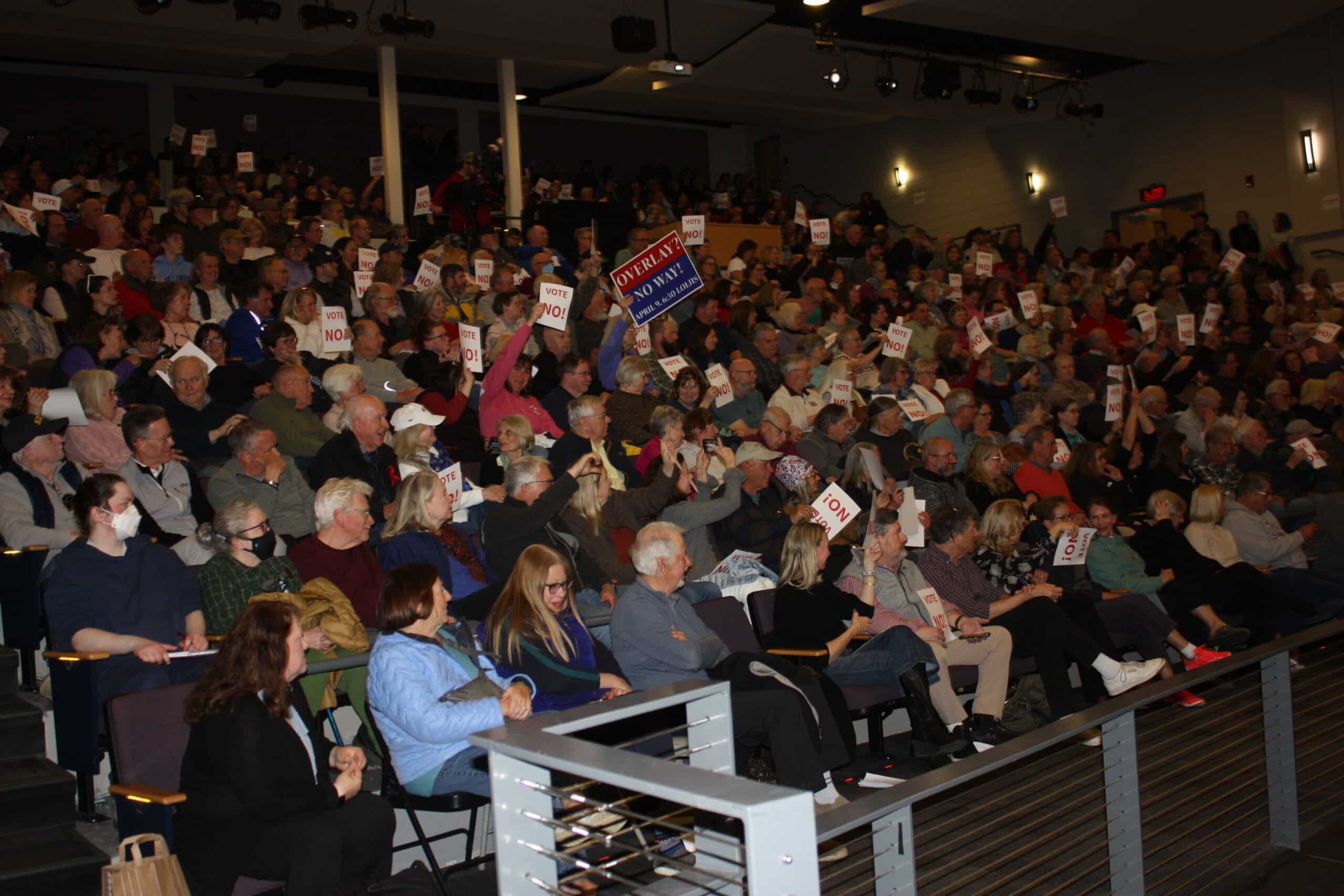
OLD LYME—About 550 people converged in the Lyme-Old Lyme High School auditorium Wednesday evening, many of them armed with “Vote No” signs and deeply-held ideals about preserving their small town’s character, as they fought a plan to bring apartments and condominiums to Halls Road.
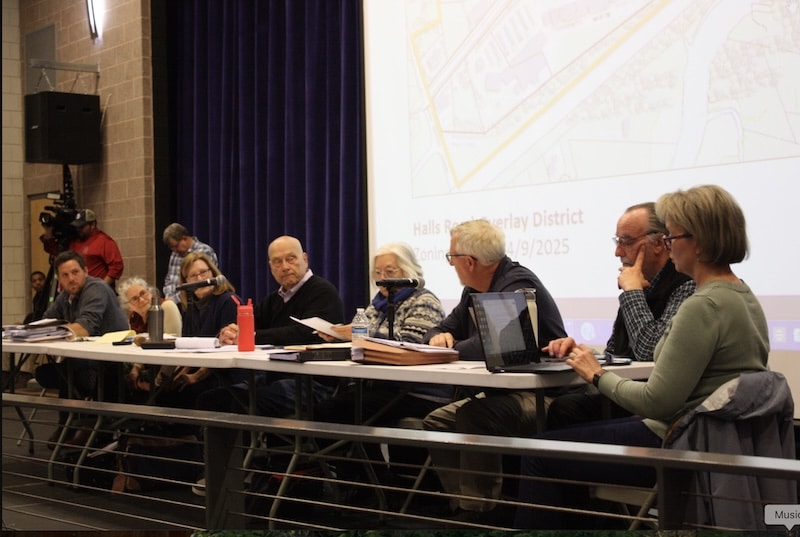
The Old Lyme Zoning Commission voted unanimously to close the public hearing on the Halls Road Overlay District around 9:45 p.m. after roughly 40 people got up to speak. The subject was a highly controversial application for the creation of an overlay district on Halls Road that could allow as many as 40 housing units per acre to be built above, or behind, ground-floor businesses set close to the street in the 40-acre zone.
Residents and vocal project critics Ron and Julie Malloy said they had about 500 of the “Vote No” signs printed. By the start of the meeting, only a few were left in their stack. There were also up to 100 people waiting in the hall because Old Lyme Fire Marshal Dave Roberge, per state fire code, could let no more people inside the room.
The intent of the proposal, which has evolved over multiple years under the guidance of the Halls Road Improvements Committee (HRIC) and its chairwoman Edie Twining, is to create over time a vibrant, walkable neighborhood where strip malls now stand.
The overlay district proposal, created by the HRIC, was approved by the Old Lyme Board of Selectmen in a 2-1 vote in November. The application to the Zoning Commission was signed by First Selectwoman Martha Shoemaker.
The HRIC was represented at the hearing by Attorney William Sweeney, who told the commission he’s been working with the group since 2022.
The long-awaited meeting was the culmination of a process that had invited public input since January. No new information can be presented now that the hearing has concluded. The commission has 65 days to consider the evidence and reach a decision.
While demands for a town wide referendum on the issue have been a popular refrain on social media and in public meetings, Land Use Coordinator Eric Knapp said that’s simply not possible.
Once a town creates a zoning commission, according to Knapp, state law is clear that only the zoning commission has the power to make or amend regulations.
“You can’t call a referendum on this. The only choice you have at this point is abolish the zoning commission, abolish zoning regulations and start over,” he said, adding, “Which I don’t recommend.”
Opposition Arguments
Differing interpretations of the overlay proposal estimate there could be anywhere from 200 to 1,200 apartments built if the plan goes into effect. But even on the low end, opponents decried what they characterized as a disastrous effect on the environment, school enrollment, traffic and their overall quality of life in the rural community of 7,628 year-round residents.
The lack of sewer service in the area was also cited as a roadblock by many residents.
Proponents argued the proposed district would bolster the local economy and meet a vital need in a state where demand for housing exceeds the supply — and in a town where a vast majority of places to live are single-family homes. They said young adults, who grew up here, can’t afford to come back and older people looking to downsize, can’t stay.
The arguments in favor of the overlay district didn’t sway an immigrant from Argentina, a young adult living with her grandmother, and a San Diego transplant who each called for Old Lyme not to change.
Elizabeth Rex said she couldn’t afford to live in California again—even if she wanted to.
“I couldn’t even afford a studio apartment there now. But I’m not going to go home and demand that housing is built to accommodate me because I want to move back,” she said. “No! I moved to glorious Connecticut, which I love. I love this small town. It’s stunning. I love the farms nearby. I love the rivers. It’s gorgeous. Keep it this way.”
Maddie Sylvestri came to Old Lyme to live with her grandmother after growing up in Pittsburgh. She said the component of the overlay plan, which calls for 10% of the housing units to be rented out at rates considered affordable by state standards, won’t make a dent in the housing problem.
“Only 10% affordable living is just not going to meet the needs of young people in this economy,” Silvestri said.
Under the affordable housing provisions of the proposed overlay district, a single person making $69,840 a year would qualify for a rent of $1,746 per month for a studio apartment, according to the most recent rent limits set by the US Department of Housing and Urban Development.
Resident Russell Todd, a member of the Historic District Commission who said he was speaking only for himself and his wife, said the proposal, “Represents a significant shift toward urbanization.”
He said the amount of housing, the size of the buildings and the lack of attractive green space threaten Old Lyme’s small-town identity that drew the couple to Old Lyme in the first place.
Robin Breeding, a familiar name on social media in posts bringing attention to the overlay district proposal, said the plan is full of contradictions.
“On one hand, advocates of the overlay say their plan calls for only a couple of hundred new apartments on Halls Road. On the other hand, they insist again, against the advice of this commission, to include parking garages,” she said. “That would only make economic sense if they build over a thousand units.”
She also argued against the contention that the overlay district would prevent construction of new gas stations and highway services. That’s because the underlying commercial district is still in place as an avenue for those who don’t want to build mixed-use developments on Halls Road.
The Pros
Proponents of the plan outlined a vision for a Main Street-type feel that was characteristic of nearby Lyme Street before most commercial offerings were pushed off the historic, tree-lined expanse and onto Rte. 1. They said the proposed regulation includes more modern requirements to protect the environment and relies on design guidelines that go further to enhance the town’s rural feel than the existing commercial zone.
In similar fashion to Breeding—but this time, supporting the proposal—Kimberly Thompson, chairwoman of the Old Lyme Democratic Town Committee, spoke of contradictory information from those against the plan.
She cited concerns from opponents about the lack of space for septic systems, proximity to the river and ensuring that open space remains protected.
“By definition, those things are going to limit the development in this area,” she said. “And I support the overlay district because those things exist, because there’s going to be review of septic and wastewater plans, because The Lieutenant River is governed by the Gateway Commission, and they are going to have input on what can go there. And because the land trust owns spaces here and their mission is to preserve that space.”
Alex Twining, a successful real estate developer and brother of the Halls Road Improvements Committee Chairwoman, said Halls Road is currently functional but not inviting.
“Imagine a better vision: A tree-lined Halls Road with sidewalks, bike paths, and shops you can stroll between, park once, stop in a few stores, meet your friend at a cafe, and maybe keep walking to the river or boat landing. Less driving, less hassle, and more pleasant,” he said.
This vision won’t happen overnight, and places like Big Y will be there for a long time. But with time, new shops and restaurants can begin to open along the street,” he added.
The businessman invoked the ire of the raucous crowd, which was again reprimanded by Zoning Commission Chairman Paul Orzel, to be respectful.
Edie Twining has been the subject of speculation on social media by those, who accuse her of seeking financial gain for her family, by advocating for the overlay district.
Nell Twining stood up to defend her husband and sister-in-law against what she described as, “Paranoid speculation, conspiracy theories, and repulsive accusations.”
“Neither Alex nor I own property nor have any financial interest on Halls Road or in the proposed overlay district,” Nell Twining said.
“And to those who express suspicions of why my sister-in-law has worked so hard as a volunteer on the Halls Road Committee: Volunteer community service has been important in the Twining family for generations,” she added.
Being Heard
The public hearing had been open almost three times as long as the 35 days authorized in state statute. The commission was forced to close it when an extension already granted by the applicant was not renewed Wednesday.
Multiple people had called for the hearing to remain open so those who had been turned away would have time to hear and be heard.
Knapp, the land use coordinator, explained early in the meeting that technological limitations at the high school made it impossible to broadcast the meeting remotely.
The move to close the hearing came after Zoning Chairman Orzel, at the request of member Michael Miller, asked if the applicant would be willing to extend the public hearing. State statute specifies all extensions must be approved by the applicant.
Sweeney said his client was “not interested in extending” the hearing.
Edie Twining could not be reached for comment Thursday, and Sweeney said he was not authorized to speak for the committee.
Shoemaker, Old Lyme’s First Selectwoman, on Thursday acknowledged calls by residents like Shaun Mastroianni for her to withdraw the application she’d signed in November.
Mastroianni ran an unsuccessful campaign for state Senate as the Republican candidate in the 20th District race against Democrat Martha Marx.
Mastroianni used his two minutes at the microphone during the public hearing to emphasize he does not want to see Old Lyme become another Mystic and to ask residents to reach out to the Board of Selectmen to get them to withdraw the application.
“I urge you, tonight, tomorrow, to write to your first selectwoman that is sitting – hiding – in the back,” he said.
Shoemaker said she was in the first row of the balcony.
“I wasn’t hiding,” she said. “I was listening.”
Shoemaker said she would hold off on making any decisions on rescinding the proposal until Thursday’s 7 p.m. meeting of the Halls Road Improvement Committee was over.
“I’m waiting to hear their thoughts,” she said. “And I think that because they had put so much time and effort into it, I owe them the time for discussion.”
Editor’s Notes: i) Visit this link for our brief story published earlier today shortly after Wednesdays’ meeting ended.
ii) Visit this link to read our preview story of Wednesday evening’s meeting, which contains a great deal of background to the current situation.
iii) Visit this link for a reminder of Our Policy on Comments.
Author

Related Articles

Happy New Year!
After a year of big changes at LymeLine, including longtime publisher/editor Olwen Logan’s fond farewell and the creation of the nonprofit LymeLine Inc. to carry on her work, we look ahead with gratitude and excitement to 2026.

Lyme-Old Lyme Boys, Girls Basketball Teams Win Over Old Saybrook
The Lyme-Old Lyme High School girls and boys basketball teams were victorious against Old Saybrook High School in a pair of games Tuesday afternoon.

In the LymeLight: A Legal Victory and a Scholar-Athlete
Lawyers from Old Lyme who recently won a Connecticut Supreme Court victory on behalf of Groton said the ruling brings important clarity to public sector labor agreements and protects taxpayers from unintended expenses.