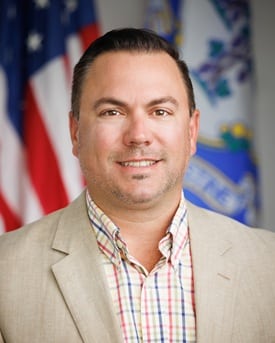
Jarod Bushey (R): Old Lyme Candidate for Region 18 Board of Education
Biography:
I am a married father of two children in LOL schools and a resident of Old Lyme since 2020. I have worked for both Sikorsky Aircraft and Pratt & Whitney over my 20-year aerospace engineering career. My family enjoys outdoor activities, boating, exploring new cuisine, and popcorn & movie nights.
I am a strong advocate of public education, passionate about the arts and music, and committed to preserving the high quality of LOL schools. I have prior experience serving on the BOE in East Hampton, CT; and I will always put students and families first.
1. Why are you running for the Region 18 Board of Education, and what skills or experiences make you the right candidate for that role?
I grew up in a small rural town in northern Vermont, surrounded by a diverse mix of families from different socioeconomic backgrounds. I was the first person in my immediate family to attend both university and graduate school. A quality public education provided me with the opportunity to succeed and has allowed me, along with many others, to genuinely pursue the American Dream.
This is why I strongly advocate for Region 18 schools to fulfill their promise of delivering “A Private School Experience in a Public School Setting.” My public education played a vital role in the success I have enjoyed as a professional aerospace engineer for the past 20 years. Throughout my career, I have had the privilege of working on many complex projects that required both creativity and detailed analytical skills. I have collaborated with talented colleagues from diverse cultural backgrounds, experiences, and abilities.
The skills I will bring to the Region 18 Board of Education include the ability to listen, synthesize knowledge, collaborate effectively, weigh risks and opportunities, and reach agreements on solutions. My previous experience serving on the Board of Education in East Hampton, CT, taught me that unity of purpose and collaboration for the benefit of all students is the core focus of the Board. If elected, I promise to advocate for students and families above all else.
2. In order of importance, what do you see as the top three challenges facing Region 18 over the next four years?
Budgets and Spending: For my family, two key factors in deciding to move to Old Lyme were the excellent reputation of the public schools and the relatively low tax rate compared to other shoreline towns. Education spending accounts for about 70% of the total budget in Old Lyme, which means it has a significant direct impact on taxpayers’ finances. The Board of Education (BOE) has a responsibility to manage taxpayers’ money wisely while continuing to provide a high-quality education for our students. We must avoid a situation where rising tax rates drive current residents away and discourage new residents from moving in.
Special Education: In recent years, we have witnessed an increase in the demand for special education services for students with conditions such as Autism Spectrum Disorder (ASD), Attention Deficit Hyperactivity Disorder (ADHD), dyslexia, and other learning delays. Regardless of the diagnosis, our most disadvantaged students deserve the support they need to catch up, overcome challenges, and adapt to their individual circumstances. As a father of neurodivergent children, I am committed to fully funding special education services to ensure that students can reach their full potential. Region 18 must also learn from past mistakes by proactively assisting families in identifying the correct diagnoses and providing the necessary interventions and supports that students are lawfully entitled to receive.
School Safety: There is nothing more important than the safety and security of our students. Continuous improvement and investment in physical security measures, training, and security staff are critical. I recently reviewed the list of security improvements that have been implemented at our schools and was quite impressed with what has been done to date, and I would assess Region 18 to be above average in this area. I was pleased to see that over the summer there were additional improvements to secure school entry vestibules at some of our schools, and I want to see these improvements continue. As a community, let’s continue to make sure our schools are protected to the best of our ability.
3. How can the school board help keep costs under control while maintaining the district’s reputation for academic excellence and extracurricular opportunities?
This is always the million-dollar question – Pun intended!
To control costs, we need to consistently monitor certain areas closely. For example, we should look at the size of the administration staff, the ratio of certified to non-certified staff, class sizes & enrollment, facilities maintenance costs, and budget set-asides for the reserve fund. I believe it’s better to have a lean, well-managed system than to balance the budget by making cuts to essential areas of the curriculum that would negatively impact students.
It certainly requires significant funding to support a quality school system, but can we find a better investment for the next generation? I don’t think so. The key is to balance a hierarchy of needs against wants. Here is my ranked priority list, which suggests we should invest from the top down and scale back from the bottom up as necessary:
- Achieving broad excellence in the core curriculum
- Meeting or exceeding special education needs
- Providing a wide range of enrichment opportunities in sports, music, and the arts
- Offering interesting and challenging elective courses
- Sponsoring clubs and after-school programs
- Staffing levels
- Capital projects
This is my list, but I am committed to working closely with all Board of Education members to build a consensus on where and how to reduce spending as needed.
4. Amid the ongoing national debate over parents’ rights, how should the Board of Education handle conflicts between parents and the district over curriculum, instruction, learning materials or student support?
The active participation of parents in their children’s education is a fundamental right. We have collectively established a public education system to efficiently allocate limited resources for the education of our children as a community. However, it is essential to recognize that the school system must foster a trusted partnership between families and educators.
The primary focus of local public K-12 education should be on achieving excellence in core curriculum fundamentals, teaching children to be critical thinkers, and preparing them to participate effectively in our society as healthy, thoughtful, and intelligent adults. Part of education involves learning about diverse perspectives, challenging biases, and being able to defend one’s own arguments. I believe most would agree with this principle.
That said, I understand that conflicts may arise when certain areas of instruction clash with the deeply held moral or religious beliefs of families, or for other valid reasons. In such instances, I believe reasonable accommodation can and should be made. Parents should first work with their child’s teachers, department heads, and principals if they have such concerns. The BOE is more policy focused, so I would support looking into whether there are policy areas we can change to help address these situations.
Ultimately, I believe that parents are the primary authority responsible for their children’s education. Discrimination or retaliation against families and students who choose to opt out of specific lessons or pursue alternative learning plans should be strictly prohibited. The BOE can help guide curriculum decisions to avoid overly sensitive or controversial topics while also establishing reasonable policies to mediate conflicts when they arise.