

A View from My Porch: America’s Quarter Millennium – From Whence We Came
As the United States approaches its 250th anniversary, Thomas Gotowka looks back on the American Revolution and the ideals that shaped the nation.
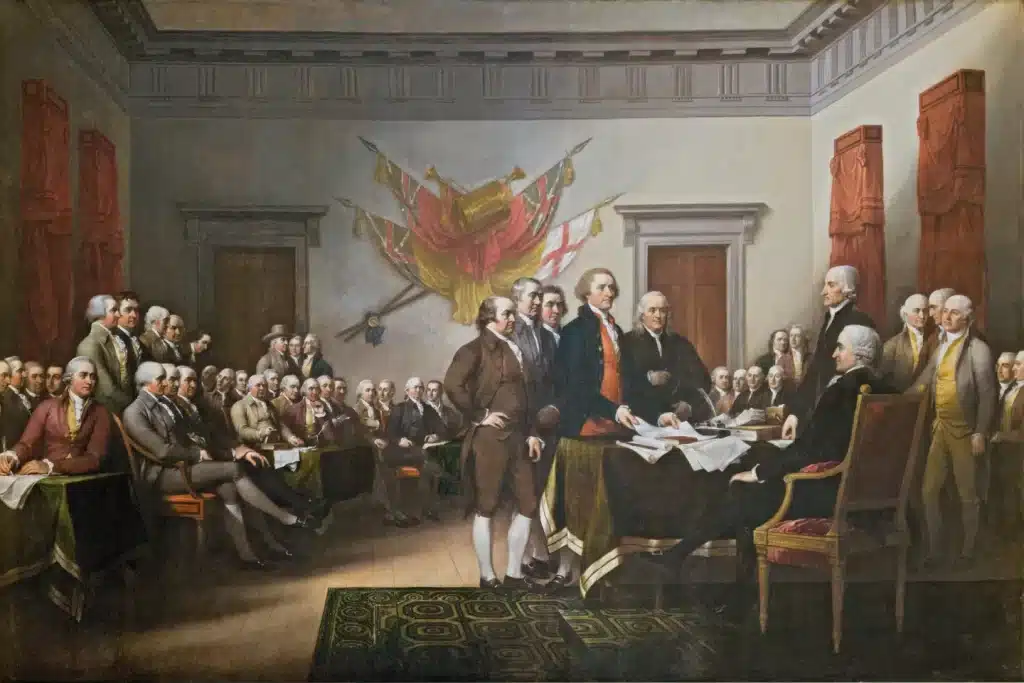
“By the rude bridge that arched the flood;
— from “Concord Hymn” by Ralph Waldo Emerson, composed for the dedication of the monument commemorating the battles of Lexington and Concord
their flag to April’s breeze unfurled.
Here once the embattled farmers stood; —
and fired the shot heard round the world.”
On the threshold of America’s 250th, I devote this View to the Declaration of Independence, the “birth certificate” of the United States as a sovereign nation. Several momentous events, such as the introduction of new taxes and the uncompromising actions of King George III’s government, created significant unrest and resistance among the colonists, originally loyal Englishmen and women who became American patriots determined to separate from Britain at any cost, thereby making George III the last king of America. Note that “Colonies” refers to the thirteen original British settlements along the Atlantic coast of North America, extending from Maine to Georgia, and “founders” refers to the prominent leaders who unified the Colonies and influenced the fight for independence and the establishment of the United States of America.
The Last King of America and the British Monarchy: George III, who reigned from 1760 to 1820, is often thought of as the “Mad King.” He suffered from hallucinations, severe headaches, and erratic behavior. His health issues had a profound impact on his ability to fulfill his royal duties and resulted in the eventual appointment of his son, who served as Regent until his father’s death in 1820. Some medical historians have suggested George III had a genetic disorder called porphyria, while others have disputed that his illness was psychiatric. Even though Benjamin Franklin once praised George III’s “virtue and the consciousness of his sincere intentions to make his people happy,” the king was generally cast as a ruler with absolute power over the Colonies, and the chief villain in America’s origin story. However, Britain was a constitutional monarchy during his reign, and it was Parliament that had created the policies that sparked conflict with the Colonies. The king’s limited authority was exercised largely through his ministers.
The Seven Years War: When George III ascended to the throne in 1760, he inherited a nation embroiled in the Seven Years’ War, a global conflict between Britain and Prussia on one side, and France and its allies on the other. The associated North American conflict, called the French and Indian War, was waged between the British and the French, with their respective Native American allies. The global war ended in 1763 with the Treaty of Paris. As a result, France ceded Canada and its territories east of the Mississippi River to Britain.
The King’s National Debt Problem: The Seven Years’ War had burdened Britain with massive debt and the continuing costs of maintaining a standing army in North America. The king felt that the Colonies benefitted from British military protection and thus, should contribute in the form of taxes both to their own defense and the broader maintenance of the Empire.
The King’s Taxes and Actions: The King issued The Royal Proclamation of 1763 to recognize the land rights of the indigenous people by reserving the lands west of the Appalachian Mountains for the Native American inhabitants, and to prohibit colonists from expanding their settlements westward. Although the proclamation was never strictly enforced, it influenced the conflicts of interests developing between Britain and the Colonies. The Sugar Act of 1764 and the earlier Molasses Act of 1733 together had a profound effect on the Boston and New England economies. Sugar and molasses were used to make rum, an important export. The Stamp Act of 1765 imposed a tax on printed materials, including legal documents, academic degrees, appointments to office, newspapers, pamphlets, magazines, playing cards, and even dice. The act required that all printed materials drafted in the colonies be produced on paper from London that had an embossed Treasury stamp as proof of tax payment. Resistance to the Stamp Act was marked by widespread protests. Defiance to this act became more organized and confrontational with the formation of the Sons of Liberty.
The Stamp Act Congress: Delegates from nine of the thirteen colonies convened in New York City in October 1765 to protest the Stamp Act from going into effect the following month. They drafted a “Declaration of Rights and Grievances,” which included the phrase “taxation without representation is tyranny.”
The Quartering Act of 1765: To shift the costs of providing a standing army, this act mandated that the Colonies provide housing and supplies for British troops stationed within the colony, and involved constructing barracks or using public buildings for required housing. After considerable resistance, the British Parliament allowed the Quartering Act to expire in 1770, and its lapse was viewed as an important victory in colonial resistance. However, Britain then passed a new Quartering Act in 1774 as part of the Coercive Acts, which further inflamed colonial opposition.
Repeal of the Stamp Act: In January 1766, Benjamin Franklin appeared before the House of Commons to advocate for the repeal of the Stamp Act. Members of Parliament were impressed with his testimony, which was then published in London and the Colonies. On March 18, 1766, Parliament grudgingly repealed the Stamp Act. Widely regarded as a face-saving measure for Parliament, The Declaratory Act of1766 fully asserted Parliament’s authority to legislate for the colonies “in all cases whatsoever.” The Townshend Acts of 1767 were a series laws aimed at imposing duties on imported goods, including glass, lead, paint, paper, and tea. The New York Restraining/Suspending Act prevented New York’s colonial government from passing new laws until it fully complied with the Quartering Act. The imposition of those duties met with angry opposition in Massachusetts, which led to Parliament sending troops to Boston in October 1768. The Tea Act of 1773 was undoubtedly intended to rescue the financially struggling British East India Company by allowing it to sell tea directly to the Colonies, bypassing and undercutting colonial merchants.
The Sons of Liberty: An “underground resistance group,” the Sons of Liberty was founded in Boston in the summer of 1765 by Samuel Adams. Paul Revere, John Hancock, and Patrick Henry all had important roles in organizing resistance against the Stamp Act and other British policies. Although Boston remained the symbolic and operational hub, by the late 1760s, active chapters had spread to most of the Thirteen Colonies. The Connecticut Sons of Liberty had active local chapters in Norwich, New Haven, and New London. Early leaders included Captain John Durkee of Norwich, Colonel Israel Putnam of Pomfret, Captain Hugh Ledlie of Windham, the not-yet infamous Benedict Arnold of Norwich, and John McCurdy, of local distinction.
Samuel Adams: The Sons of Liberty founder was known for his commitment to the notion that all individuals possess inherent rights to life, liberty, and property. He was a master of the communication tools of the day, which included speeches, public meetings, sermons, and gatherings in taverns. Pamphlets and newspapers grew rapidly through the 1700s as printing presses became more common. Short printed pieces, called broadsides, were distributed at taverns, in town squares, and other public places. Longer pamphlets, such as Thomas Paine’s Common Sense, influenced public opinion even though literacy rates were still low.
Committees of Correspondence: Adams formed a small grassroots group of influential Bostonians in 1772 to document colonists’ rights and grievances with British rule. The group became the nucleus for the broader Committee of Correspondence and expanded across Massachusetts as part of a broader strategy to unify colonial opposition.
The Boston Massacre: In 1770, British soldiers still occupied the city, and Bostonians viewed them with contempt. A skirmish erupted on the evening of March 5, 1770 when a mob confronted a squad of redcoats guarding the King Street Customs House. At the height of the clash, one soldier fired his musket, provoking the others to fire into the mob, killing five colonists and wounding several others. By the next morning, eight soldiers and one officer, Captain Thomas Preston, were arrested and charged with murder.
The March 6 Town Meeting: Samuel Adams convened a Town Meeting at Faneuil Hall the day after the killings. He addressed a crowd of approximately 3,000 to 5,000 citizens. A committee that included Samuel Adams and John Hancock was charged with investigating the killings and preparing a report for review at a reconvened town meeting. The meeting then drafted a resolution for the removal of all British troops from Boston to be presented to Royal Governor Thomas Hutchinson. Adams led a delegation to Hutchinson, declaring that nothing less would restore peace and prevent further bloodshed. Hutchinson agreed to relocate the regiments to Castle Island in Boston Harbor. Customs officials also left town in fear of their safety.
The Trials: The soldiers who fired into the mob were not arraigned until September, with trials postponed until October and December. Notably, John Adams, who would later become the second POTUS, defended the soldiers, arguing for their right to a fair trial, despite the public outcry against them. Captain Thomas Preston was found not guilty of ordering the soldiers to fire. Two soldiers were found guilty of manslaughter rather than murder, which would have carried the death penalty. The remaining six were acquitted of all charges. The Boston Massacre became a pivotal moment in escalating tensions between the Colonies and British authorities and boosted the drive toward independence.
Controlling the Narrative: On March 12, 1770, publisher Benjamin Edes, with input from Samuel Adams, characterized the event of March 5 as “a horrid massacre” in The Boston Gazette, one the earliest such characterizations in the colonial press. The committee’s report, A Short Narrative of the Horrid Massacre in Boston, published within weeks of the killings was based on depositions from 96 “eyewitnesses,” who unanimously cast the actions of the British soldiers as murder. The piece was widely distributed as a pamphlet in the Colonies and sent to England to be delivered to the king and Parliament. In contrast, A Fair Account of the Late Unhappy Disturbance at Boston in New England was printed in London to convey the Loyalist perspective on the Boston Massacre, and combined a description of the incident with 31 testimonies, all aimed at exonerating the soldiers.
The Boston Tea Party: On December 6, 1773, a large group of Bostonians organized by the Sons of Liberty, including Paul Revere, Samuel Adams, and John Hancock, disguised themselves as Native Americans of the Mohawk nation and boarded three ships docked in Boston Harbor—the Dartmouth, Eleanor, and Beaver—and dumped 342 chests of tea belonging to the British East India Company overboard in protest of both the tax on tea and the East India Company’s clear monopoly
Reprisal: The king and his ministers now viewed Massachusetts as a breeding ground for disloyalty, and their response was swift and ruthless. Parliament passed The Coercive Acts, a series of punitive laws. General Thomas Gage, Commander-in-Chief of British forces in the Colonies, replaced Thomas Hutchinson with instructions to enforce the Coercive Acts, which were regarded by the colonists as The Intolerable Acts and included:
- The Boston Port Act, which allowed the Royal Navy to close Boston Harbor to all ships and prevent the landing, loading, or shipping of goods until restitution was made for the destroyed tea.
- The Massachusetts Government Act, which revoked the Colony’s 1691 Charter, suspended town meetings, and gave Royal Governor Gage the authority to select judges and sheriffs, who could appoint jurors.
- The Act for the Impartial Administration of Justice, which authorized Governor Gage to move trials of royal officials accused of committing capital offenses while performing their official duties to another colony or to Britain. The colonists referred to the law as the “Murder Act.”
- The Quartering Act, which expanded the Quartering Act of 1765 and gave royal governors the authority to requisition unoccupied buildings, such as houses, barns, and other structures to house British troops. The law applied to all colonies, not just Massachusetts.
The First Continental Congress was organized by the Committees of Correspondence to determine how to collectively respond to the king’s actions and assembled 56 delegates from twelve of the Thirteen Colonies at Carpenters’ Hall in Philadelphia on September 5, 1774.
Important Outcomes:
- The adoption of the Continental Association agreement, whose purpose was to pressure Britain into repealing the Intolerable Acts through economic sanctions and impose a complete ban on all trade between the American Colonies and Britain.
- The acceptance of the Suffolk Resolves, which called for the formation of independent colonial militias.
- The issuance of a Declaration of Rights and Grievances, declaring that colonial rights included trial by jury, freedom of assembly, and opposition to taxation without representation.
- The drafting and approval of the Humble Petition to the King’s Most Excellent Majesty, signed by 51 delegates, which emphasized the colonists’ loyalty to the Crown. The petition expressed a desire for peace and reconciliation, and listed the oppressive measures imposed by Parliament, especially the Intolerable Acts. It requested the king’s intervention to restore harmony between Britain and the Colonies. Benjamin Franklin was sent to London to carry the document personally to the king. George III ignored the petition and the British refused to repeal the Intolerable Acts. Congress planned to reconvene in May 1775 if Britain failed to respond, clearly signaling that the Colonies were prepared to continue their coordinated resistance if reconciliation was not achieved. Congress made one final petition to George in July 1775. He instead issued a royal proclamation that labeled the war a “rebellion” and denounced the revolutionaries for “traitorously preparing, ordering, and levying War against Us.”
“The Shot Heard Round the World:” British intelligence had determined that Massachusetts militias were stockpiling weapons, ammunition, and supplies in Concord in preparation for a potential armed conflict with the British. On April 18, 1775, Governor Gage issued an order for the seizure of these weapons and the arrest of Samuel Adams and John Hancock. The local militias were alerted by riders Paul Revere, William Dawes, and Samuel Prescott. Only 77 of the 120 Lexington militiamen had assembled before 700 to 800 British soldiers came upon them on April 19 on Lexington Commons. Captain John Parker ordered his men to “stand your ground and not fire unless fired upon.” A shot was eventually fired, leading to an exchange of gunfire that resulted in eight militiamen killed and ten wounded while only one British soldier was injured. The militia was ordered to disperse. The British continued on to Concord, where they faced a larger force at the Old North Bridge (the “rude bridge” in Emerson’s “Concord Hymn”). They suffered heavy casualties and were forced to retreat.
The King’s Response: Reports of the Battles of Lexington and Concord were initially dismissed by the king as “colonial propaganda.” However, when the king and his advisors recognized that the colonies were rebelling, they planned an increase of their army and a prolonged campaign against the colonists.You may recall this later description of the events at Lexington and Concord from “Paul Revere’s Ride” by Henry Wadsworth Longfellow:
“One, if by land, and two, if by sea;
and I on the opposite shore will be,
ready to ride and spread the alarm
through every Middlesex village and farm;
for the country-folk to be up and to arm.”
The Second Continental Congress convened on May 10, 1775 at the Pennsylvania State House in Philadelphia, just weeks after the Battles of Lexington and Concord as an emergency response to war. 48 delegates from 12 of the 13 colonies were present for the opening session, many of whom had attended the First Constitutional Congress. Now the issue was, how can the Colonies meet the British military threat? On June 17, 1775 the Battle of Bunker Hill was fought, resulting in a British victory and more than 1,500 casualties on both sides.
On June 14, 1775, Congress created the Continental Army and appointed George Washington as commander in chief. On July 6, it approved a Declaration of Causes outlining the rationale and necessity for taking up arms in the Thirteen Colonies. Despite the bloodshed at Lexington, Concord, and Bunker Hill, many delegates still hoped for reconciliation with Britain, so on July 8, Congress extended the Olive Branch Petition to the king in a final attempt at reconciliation. Several delegates, including John Adams, thought that the petition was pointless, and that war with Britain was inevitable. The king refused to accept the petition and instead issued A Proclamation, For Suppressing Rebellion and Sedition on August 23, 1775, declaring that the Colonies were in a state of “open and avowed rebellion” against British rule. This rejection escalated tensions and also played a crucial role in the eventual push for American independence.
War seemed imminent by the fall of 1775, and the king had already rejected two attempts at reconciliation. This solidified the resolve of many colonists who were still undecided about independence and pushed them towards supporting the revolutionary cause.
In my next View, I will look at the growing sentiment for independence, and the remarkable account of the crafting of the Declaration of Independence by the Second Continental Congress, whose delegates also acted as the national government during the early stages of the American Revolutionary War.

About the author: Tom Gotowka spent his career in healthcare. He will sit on the Navy side at the Army/Navy football game. He always sit on the crimson side at any Harvard/Yale contest. He enjoys reading historic speeches and considers himself a scholar of the period from FDR through JFK. A child of AM Radio, he probably knows the lyrics of every rock and roll or folk song published since 1960.
Author

Related Articles
A View from My Porch: America’s Quarter Millennium – The Summer the Declaration of Independence Took Shape
Between Evacuation Day and the signing of the Declaration of Independence lay 109 days that transformed rebellion into nationhood, and reconciliation into revolution.

A View from My Porch: On Surrendering the Mantle of ‘Leader of the Free World,’ Part II
Thomas D. Gotowka delves into claims of election fraud by the Trump administration in this installment of his two‑part series examining unfounded allegations and their impact on democracy.
A View from My Porch: On Surrendering the Mantle of ‘Leader of the Free World,’ Part I
From public health concerns to political spectacle, Thomas D. Gotowka examines a turbulent year in American life and its implications for the country – and the world.