

Old Lyme Crossing Among Sites Slated for Flashing Beacons
The state DOT will hold a Dec. 8 virtual meeting on proposed flashing beacons and other crosswalk upgrades in Old Lyme and seven other Eastern Connecticut towns.
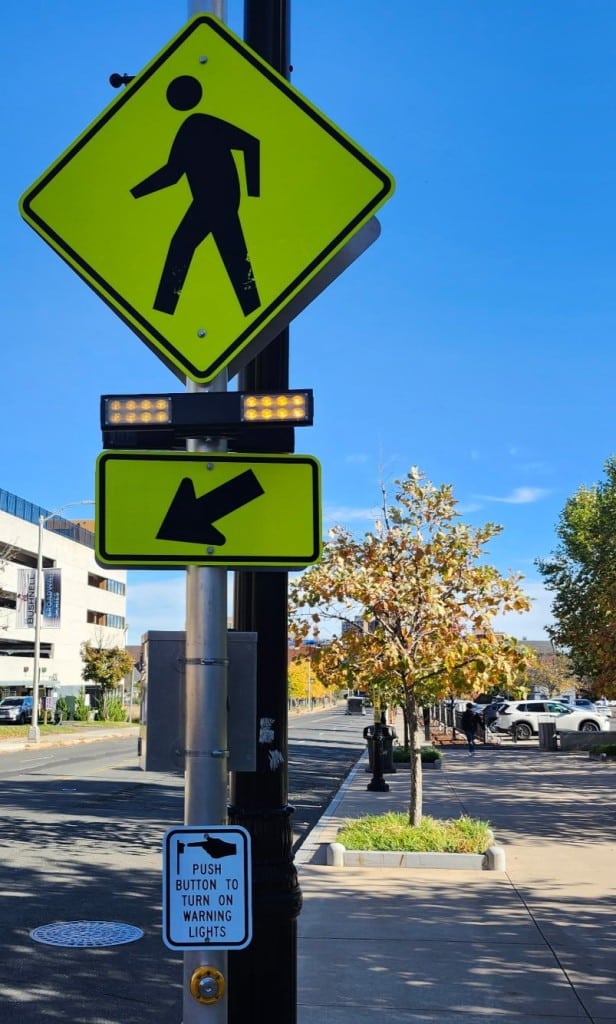
The Connecticut Department of Transportation (DOT) will hold a virtual public information meeting Dec. 8 on proposed pedestrian crossing safety upgrades in eight Eastern Connecticut towns, including on Route 156 in Old Lyme.
The DOT in a news release said the project will involve installing or updating advanced crosswalk beacons – known as rectangular rapid flash beacons (RRFB) – and improving sidewalk landing areas, ramps and signage. Construction is set to begin in summer 2028, subject to funding, easement acquisition and permit approvals.
The Old Lyme work is planned for Shore Road at the intersection of Smith Neck Road, which does not currently have a flashing beacon.
The Dec. 8 virtual meeting will begin at 6 p.m. and include a question-and-answer session following the presentation.
According to the DOT, the beacons use an irregular flash pattern similar to emergency flashers on police vehicles to alert drivers a pedestrian is crossing.
The project will update nearby crosswalks in Old Saybrook on Main Street at Pennywise Lane, and in East Lyme on Main Street at Baptist Lane. Sites in East Hampton, Groton, Marlborough, Portland and Stonington will also be addressed.
The estimated project cost is $2.2 million, funded with 90% federal and 10% state funds.
The flashing beacons consist of a foundation and pedestal, accessible pedestrian signal push buttons, flashers and signs. The beacons will be solar powered unless there’s no direct sunlight or overhead utilities conflict with the array.
Residents can join the meeting online or listen by calling 877-853-5257 and entering Meeting ID 882 8423 5305. Additional meeting information is available at portal.ct.gov/DOTEasternCT0172-0551.
Public comments and questions may be submitted through Dec. 22 to DOTProject0172-0551@ct.gov or by calling 860-594-2020. Comments should reference State Project No. 0172-0551.
A recording of the meeting will be available on the agency’s public meeting archive.
Comments (2)
Comments are closed.
Related Articles

It’s Almost Time to Deck the Walls at Lyme Art Association, Hot Cocoa Included
The LAA holiday season features the annual Deck the Walls exhibition, a Dec. 5 open house with live music and festive treats, and three additional art shows.
Lyme Veterans Committee Hosts Annual Veterans Day Observance
The Nov. 11 ceremony at Lyme Town Hall will feature a speech by U.S. Army Reserve Capt. Dana Seero, recognize residents currently serving in the military and honor veterans who died during the past year.

UPDATED: Region 18 Special Election Rescheduled to Nov. 17
NEW DATE: Lyme voters will choose a successor to Gavin Lodge on the Region 18 Board of Education Tuesday, Nov. 17, at a 6 p.m. Special Town Meeting.
I enjoy many of Old Lyme’s scenic roads as Mr. Kelsey does — particularly the walk along Johnnycake Hill to Smith Neck Rd., but I don’t want to be killed trying to dash across Rt. 156 while doing it. It’s a popular walking route but cars are routinely doing 50 mph and not paying attention to the crosswalk. That is why I made the suggestion for this type of light in response to the safety survey. I am pleased to see the State support pedestrian traffic. I wish Old Lyme was as bucolic as it was when I moved here 40 years ago, but it’s clearly not and some small sacrifices like signs are necessary.
When does it end? In the last ten years, Old Lyme has become an absolute hideous forest of more and more DOT signs that not only degrade our historic town and bucolic roads, but are simply not effective. How many signs do we need to announce the approach of a clearly visible stop sign or pedestrian crosswalk, bus stop signs for unsafe, bizarre locations and no parking signs where they are simply not needed? Now more flashing lights, to be coupled with the satellite beacon that is the LOL schools sign illuminating Lyme Street far into the night every night.
I hope that our selectmen and public works are advocating actively for Old Lyme with DOT to ensure signs are needed – this should be an easy victory for quality of life. An excuse of “best practices” to allow our town to be visually destroyed is defeatist at best. When DOT has a hammer (signage), everything looks like a nail. I would venture a guess DOT gets federal funding for sign programs like most of their projects which pays for the signs, but more importantly funds their payroll necessary to oversee installation. Crafty state bureaucrats “earning” revenue from a federal government that borrows $2 trillion a year to pay states for such things as hare-brained signage programs.