

Lyme, Old Lyme Seek to Balance New Police Restrictions With Election Safety on Primary Day
New state restrictions limited police presence near polling places Tuesday, but Lyme and Old Lyme election officials haven’t stopped working closely with local law enforcement.
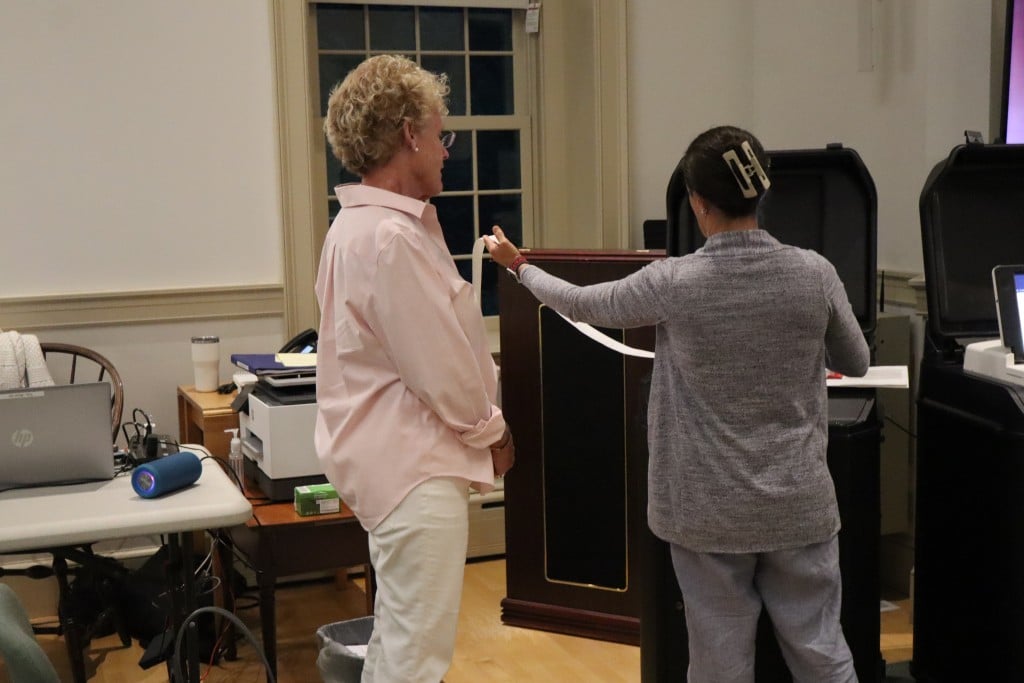
LYME/OLD LYME, CT – In Lyme and Old Lyme, where registrars of voters say they have long relied on close relationships with local police, Tuesday’s Democratic primary offered a first test of new state restrictions on the presence of law enforcement within 250 feet of polling places.
Lyme’s constable and members of Old Lyme’s police department checked in at their respective polling places throughout the day as requested by election officials, although neither town required an officer to remain at the polls.
By Tuesday night, Gov. Ned Lamont had notched decisive victories over challenger Josh Elliott in both towns, with election officials reporting a smooth day at the polls. It was the only contested office on either ballot.
Lamont defeated Elliott 405-199 in Old Lyme and 183-78 in Lyme. Old Lyme’s turnout represented roughly 32% of the town’s 1,905 registered Democrats. In Lyme, approximately 38% of 692 registered Democrats came out to the polls.
Lyme Democratic Registrar of Voters Dottie Wells said the new election reform law did not prevent election officials from asking Lyme Constable John C.L. Evans to check in on the election periodically, which he did.
Lyme is served by the local constable and members of Connecticut State Police from the Troop F barracks in Westbrook.
“I was never concerned we were not going to have the support if we needed it,” Wells said.
The new law, signed by Lamont in May to protect voters from intimidation, generally bars members of law enforcement from being within 250 feet of polling places. Exceptions allow officers to respond to serious threats involving life or property and permit election officials to request police assistance when necessary to maintain order.
A subsequent clarification from Secretary of the State Stephanie Thomas said officers may also respond to non-urgent incidents, provided their presence does not interfere with election operations.
The voter intimidation provision was prompted in part by concerns that federal immigration enforcement agents could be used to police polling places in blue states, according to the Connecticut Mirror.
Thomas’ office in an Aug. 10 memo to registrars acknowledged members of law enforcement “are foreseeably going to engage in official and unofficial actions within the restricted area that have no impact on the elections site or associated election, primary, or referendum.”
The memo said Thomas, acting on discretion granted to her in the law, authorizes election officials to call in members of law enforcement “to engage in official on-duty actions that do not in purpose or in effect interfere with the elections site” or the administration of primaries, elections and referendums.
“Everyone at the Office of the Secretary of the State recognizes that secure elections are possible in part due to the partnership we have with state and municipal members of law enforcement,” the guidance concluded.
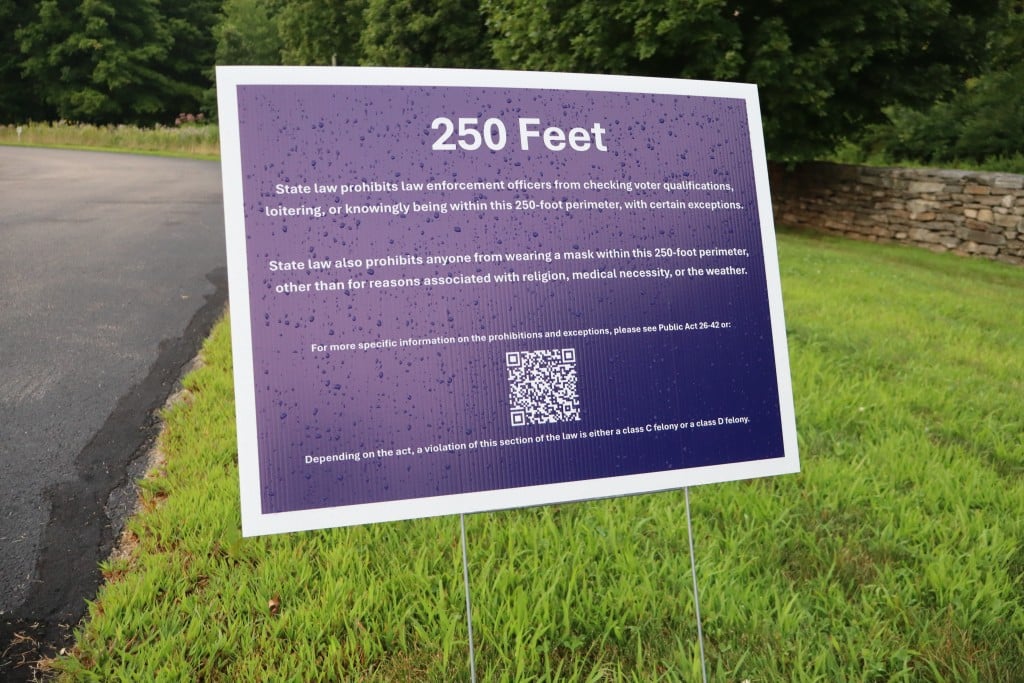
Blue signs announcing the 250-foot restriction were seen in the parking lot of Lyme Town Hall on primary day. Wells said they were provided by the state.
In Old Lyme, Democratic Registrar of Voters Jennifer Datum said registrars chose not to post the state-provided signs.
“We weren’t required to put them up,” she said. “We elected to not put them up. We didn’t feel it was necessary.”
The Old Lyme officials requested periodic patrols by the local police department overseen by Resident State Trooper Derek McGregor, according to Datum.
“We were in touch with the police before today and today we just asked them to do some drive-bys,” she said. “We didn’t anticipate there to be any need for somebody to be here the entire day.”
She cited plans to meet with the police department to come up with a plan for the November election. This year’s ballot includes races for governor and other constitutional state offices as well as contests for the U.S. Congress and state legislature.
Datum said a dedicated officer has been assigned to the polls on Election Day in recent years, which is a practice she would like to continue.
“A lot of times they’ll just sit in the car and do their work, and then they’ll come and check on us, but they’re just kind of a presence that’s nearby,” she said.
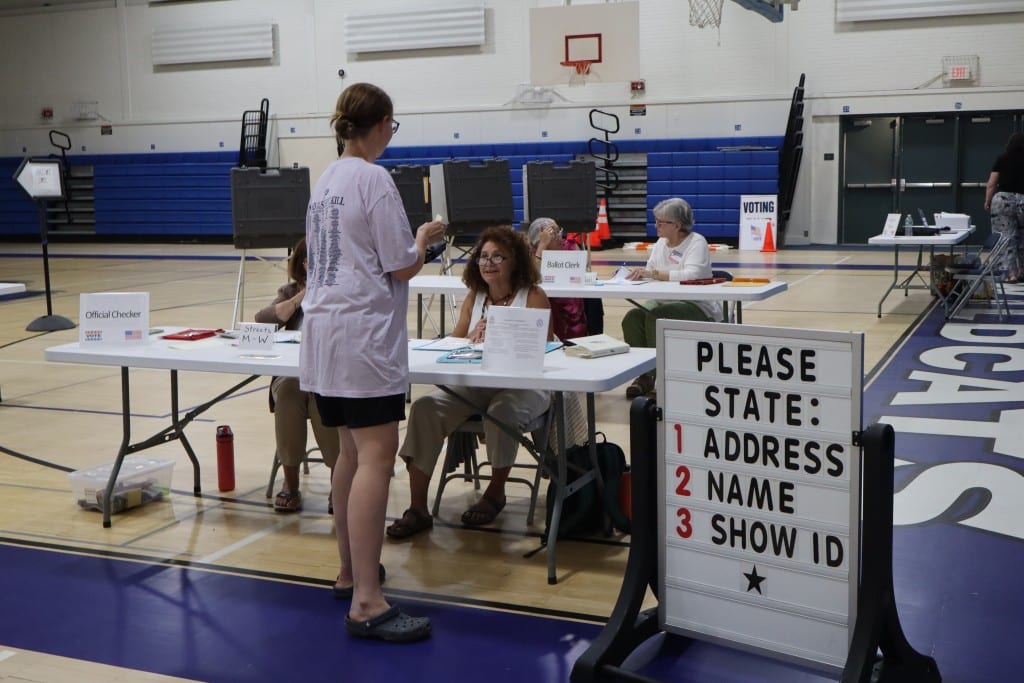
Republican Registrar of Voters Cathy Carter described years of positive experiences working alongside local officers.
“And we have always worked hand in hand with the Old Lyme police very closely,” she said. “They’ve been very helpful at the polls to us.”
She recounted occasions when police helped address traffic backups near polling places, assisted voters and ensured safety for election officials who were checking the absentee ballot box or walking from the middle school to the Town Hall in the dark.
She recalled an elderly voter who appeared disoriented after casting his ballot during a previous early voting session. Officers recognized him, contacted his family and ensured he got home safely.
“He died a week later, but he got to vote,” Carter said.
Carter and Deputy Democratic Registrar Katherine Thuma said police have helped de-escalate situations before they became problems.
“Certainly they don’t interfere at all or come into the area where the voters are,” Carter said. “But we’ve had numerous occasions where they have helped us.”
Thuma emphasized support for maintaining local relationships with police is not a commentary on the law or how it should be applied in other cities and towns.
“We also acknowledge and want to respect that we live in a town where having that type of relationship with our local police officers is a beautiful privilege that we have, and it’s not everyone’s experience,” Thuma said. “We want everyone to feel comfortable wherever they are casting their ballot.”
Author

Related Articles
Marx Eyes Broader Housing Protections and Relief for Families in 20th District
State Sen. Martha Marx, D-New London, discusses psychedelic therapy for veterans, eviction protections and the equal time dispute that took her opponent off the air.
Lee Elci Talks Politics, Policing and Personal Freedom Off the Air
After more than two decades on the radio, Lee Elci wants to be a voice in Hartford for lower spending, limited government and a shift away from progressive politics.
Ferraro Aims to Return to State Office
Charles Ferraro, a former state representative, is challenging Norm Needleman on housing, energy costs and local control.